Banner
Pilot Study: Fibromyalgia Fatigue Improved By TENS Therapy

Fibromyalgia is the term for a poorly-understood condition where people experience pain and fatigue...

High Meat Consumption Linked To Lower Dementia Risk

Older people who eat large amounts of meat have a lower risk of dementia and cognitive decline...

Long Before The Inca Colonized Peru, Natives Had A Thriving Trade Network

A new DNA analysis reveals that long before the Incan Empire took over Peru, animals were...

Mesolithic People Had Meals With More Tradition Than You Thought

The common imagery of prehistoric people is either rooting through dirt for grubs and picking berries...

User picture.
News StaffRSS Feed of this column.

News Releases From All Over The World, Right To You... Read More »

Blogroll
In almost every diet book you read, they tell you to never get hungry.   You will binge if you do, they all say, because of temptation and that gnawing in your stomach.   Yet all those snacks and meals have corresponded to a ballooning obesity problem which gets instead blamed on trans fats, high fructose corn syrup, salt - you name it.

It may be that all those self-help books and catering to mental weakness has caused a drop in self-control, says psychological theory.   If you want to lose weight, keep a house full of chocolate.
 
Variations in the brightness of the Q0957+561 quasar, also known as the “twin quasar” due to its duplicated image on Earth, are intrinsic to the entity itself and not caused by the gravitational effects of possible planets or stars from a far away galaxy.

This is the conclusion of a study carried out by Spanish researchers resolving a mystery that has intrigued astronomers for the past 30 years.
The origin of species may be almost as random as a throw of the dice, says Iosif Pinelis, a professor of mathematical sciences at Michigan Technological University, who claims to have worked out a mathematical solution to a biological puzzle: Why is the typical evolutionary tree so lopsided?

In other words, the reason some descendants of a parent species evolve into hundreds of different species  while others produce so few goes beyond natural selection  and into math; simple probability yields a surprisingly elegant solution, Pinelis says.
A century-old drug that failed in its original intent to treat tuberculosis but has worked well as an anti-leprosy medicine now holds new promise as a potential therapy for multiple sclerosis and other autoimmune diseases.

"We never expected that an old antibiotic would hit this target that has been implicated in multiple sclerosis, psoriasis and type 1 diabetes," says Johns Hopkins pharmacologist Jun O. Liu "People have been working for years and spending tens of millions of dollars on developing a drug to inhibit a specific molecular target involved in these diseases, and here, we have a safe, known drug that hits that target," known as the Kv1.3 potassium channel. 

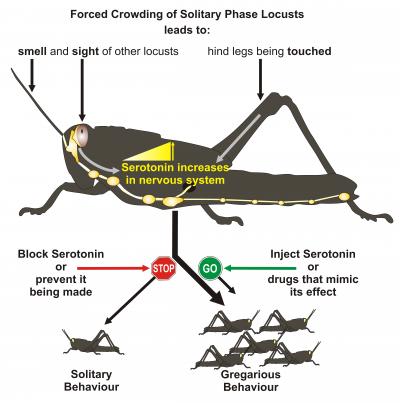
Desert locusts are harmless, solitary creatures until they get a certain chemical - and it isn't firewater, catnip or anything that comes from Colombia.   It's serotonin, a common brain chemical, but in the right amount they turn into hordes of hungry ... well ... locusts.

With desert locusts, the expression of this swarming characteristic generally means serious trouble for nearby farmer.   Locusts are known to sometimes swarm by the billions, and they often devastate crop yields.  Dr. Stephen Rogers from the University of Cambridge and the University of Oxford in the UK says about 20 percent of the world is affected by desert locusts.

Researchers from Northwestern University's Feinberg School of Medicine appear to have reversed the neurological dysfunction of early-stage multiple sclerosis patients by transplanting their own immune stem cells into their bodies and thereby "resetting" their immune systems. 

The patients in the small phase I/II trial continued to improve for up to 24 months after the transplantation procedure and then stabilized. They experienced improvements in areas in which they had been affected by multiple sclerosis including walking, ataxia, limb strength, vision and incontinence. The study will be published online January 30 and in the March issue of The Lancet Neurology