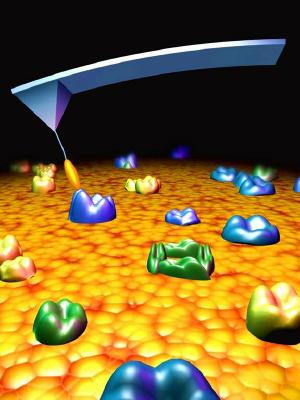
Nanotechnology exploits the properties of materials on a nanometric scale, (a nanometer is one millionth of a millimeter). The ultimate limit for such miniaturization is the development of devices formed by atomic structures created artificially to fulfil a determined purpose.
The tools that permit the visualization and manipulation of atoms are called proximity microscopes. This includes the Scanning Tunneling Microscope (STM), whose development in 1986 earned G. Binning and H. Rohrer the Novel prize for physics, and more recently the Atomic Force Microscope (AFM).
The International Year of Astronomy 2009 (IYA2009) is a global celebration of astronomy and its contribution to society and culture, with strong emphasis on education, public participation, and the involvement of young people, and with events at national, regional, and global levels. Many thousands of individuals in over 135 countries around the world are already involved, forming the world's largest ever astronomy network.
IYA2009 portrays astronomy as a peaceful global scientific endeavour that unites astronomers in an international, multicultural family of scientists, working together to find answers to some of the most fundamental questions that humankind has ever asked.
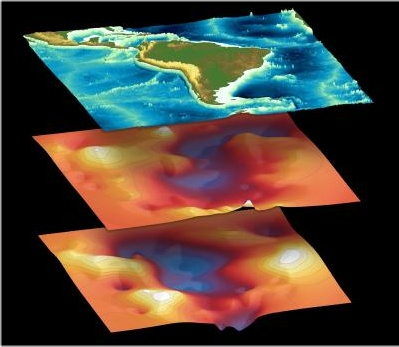
South America is the world’s most species-rich area and there have been many theories as to why, ranging from animals and plants accompanying the continent when it broke loose from Africa to variations in the extent of the rainforests over millions of years creating new species.
A thesis from a Gothenburg University doctoral student proposes a different theory: that the formation of the Andes was a 'species pump' which spread animals and plants across the continent.
When Charles Darwin published his landmark book On the Origin of Species(*) in 1859, his theories on evolution were quickly accepted by the vast majority of scientists. The general public, however, was not as eager to accept Darwin’s ideas, due largely to the fact that they challenged established religious beliefs.
Today, 150 years after the publication of Darwin’s book, science and religion remain as conflicted as ever when it comes to the subject of evolution.
“There is a real disconnect between what science says and what the public believes, at least in the United States,” says Ben Pierce, holder of the Lillian Nelson Pratt Chair in Biology at Southwestern University in Georgetown, Texas.
Kawasaki Disease, recently in the news due to the death of Hollywood film star John Travolta's son Jett, has had some genetic variations identified in a genome-wide association study published in PLoS Genetics.
New research into the effects of antipsychotic drugs commonly prescribed to Alzheimer's patients concludes that the medication nearly doubles risk of death over three years. The study, funded by the Alzheimer's Research Trust, was led by Prof Clive Ballard's King's College London team and is published in Lancet Neurology on 9 January.
The study involved 165 Alzheimer's patients in UK care homes who were being prescribed antipsychotics. 83 continued treatment and the remaining 82 had it withdrawn and were instead given oral placebos.


 Pilot Study: Fibromyalgia Fatigue Improved By TENS Therapy
 High Meat Consumption Linked To Lower Dementia Risk
 Long Before The Inca Colonized Peru, Natives Had A Thriving Trade Network
 Mesolithic People Had Meals With More Tradition Than You Thought