Banner
Pilot Study: Fibromyalgia Fatigue Improved By TENS Therapy

Fibromyalgia is the term for a poorly-understood condition where people experience pain and fatigue...

High Meat Consumption Linked To Lower Dementia Risk

Older people who eat large amounts of meat have a lower risk of dementia and cognitive decline...

Long Before The Inca Colonized Peru, Natives Had A Thriving Trade Network

A new DNA analysis reveals that long before the Incan Empire took over Peru, animals were...

Mesolithic People Had Meals With More Tradition Than You Thought

The common imagery of prehistoric people is either rooting through dirt for grubs and picking berries...

User picture.
News StaffRSS Feed of this column.

News Releases From All Over The World, Right To You... Read More »

Blogroll
A preliminary study suggests that economic incentives appear to be effective for achieving short-term weight loss, according to a report in the December 10 issue of JAMA.
New research at the Faculty of Life Sciences (LIFE) at the University of Copenhagen – shows that dark chocolate is far more filling than milk chocolate, lessening our craving for sweet, salty and fatty foods. In other words, eating dark chocolate may be an efficient way to keep your weight down over Christmas. 

We have known for a long time that it is healthier to eat dark chocolate, but now scientists at the Department of Human Nutrition at LIFE, University of Copenhagen, have found that dark chocolate also gives more of a feeling of satiety than milk chocolate. 

Chocolate experiment 
Two common diabetes drugs — rosiglitazone and pioglitazone — are linked to higher fracture rates in women, according to a meta-analysis in CMAJ by a team of researchers from the University of East Anglia in the United Kingdom and Wake Forest University in the United States.

The drugs, called thiazolidinediones, help improve glycemic control and decrease insulin resistance in patients with diabetes. 
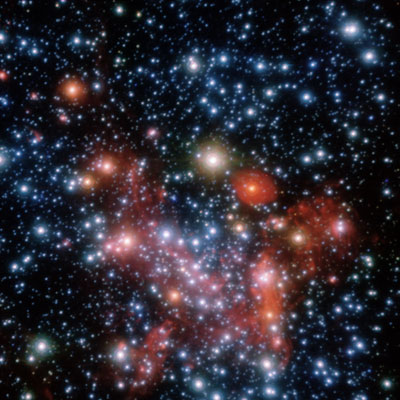
By watching the motions of 28 stars orbiting the Milky Way's most central region with admirable patience and amazing precision, astronomers have been able to study the supermassive black hole lurking there. It is known as Sagittarius A* (pronounced "Sagittarius A star"). The new research marks the first time that the orbits of so many of these central stars have been calculated precisely and reveals information about the enigmatic formation of these stars — and about the black hole to which they are bound.
Everyone knows mountaineering can be dangerous and climbing Mt. Everest more dangerous than most. Counterintuitively, most deaths occur during the descent, in the so-called 'Death Zone' just above 8,000 meters. But why deaths happen hadn't really been explored until now. An international research team has conducted the first detailed analysis of deaths during expeditions to the summit of Mt. Everest. They identified factors that appear to be associated with a greater risk of death, particularly symptoms of high-altitude cerebral edema and published their results in the British Medical Journal.
Measures imposed to reduce exposure to nuts are often based on irrational fears of nut allergies and are becoming increasingly sensationalist, according to Professor Nicolas Christakis from Harvard Medical School on bmj.com today.

A peanut on the floor of a school bus leading to evacuation and decontamination for fear that it might be eaten by the 10 year old passengers, and schools declaring themselves "nut free" by banning nuts, peanut butter, homebaked goods and any foods without ingredient labels, are just some examples cited in the article.  According to Christaki, there is no evidence that any of these extreme restrictions work better than more circumscribed policies or that they are worth the money and disruptions they create.