Banner
Pilot Study: Fibromyalgia Fatigue Improved By TENS Therapy

Fibromyalgia is the term for a poorly-understood condition where people experience pain and fatigue...

High Meat Consumption Linked To Lower Dementia Risk

Older people who eat large amounts of meat have a lower risk of dementia and cognitive decline...

Long Before The Inca Colonized Peru, Natives Had A Thriving Trade Network

A new DNA analysis reveals that long before the Incan Empire took over Peru, animals were...

Mesolithic People Had Meals With More Tradition Than You Thought

The common imagery of prehistoric people is either rooting through dirt for grubs and picking berries...

User picture.
News StaffRSS Feed of this column.

News Releases From All Over The World, Right To You... Read More »

Blogroll
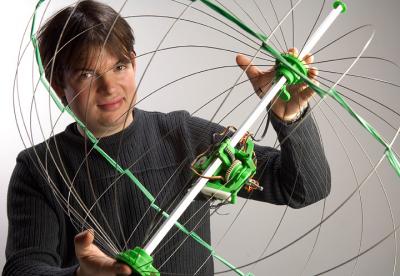
The first robot that can jump like a grasshopper and roll like a ball could play a key role in future space exploration. The 'Jollbot' has been created by Rhodri Armour, a PhD student from the University of Bath. It's hoped his creation, which can jump over obstacles and roll over smoother terrain, could be used for space exploration or land survey work in the future.

Rhodri Armour designed Jollbot as part of his Ph.D. thesis. Photo Credit: Nic Delves-Broughton, University of Bath)

Researchers using functional MRI (fMRI) have determined that the circuitry in the area of the brain responsible for suppressing memory is dysfunctional in patients suffering from stress-related psychiatric disorders. Results of the study will be presented today at the annual meeting of the Radiological Society of North America (RSNA).
Astronomers have uncovered strong evidence that brown dwarfs form like stars. Using the Smithsonian's Submillimeter Array (SMA), they detected molecules of carbon monoxide shooting outward from the object known as ISO-Oph 102. Such molecular outflows typically are seen coming from young stars or
protostars. However, this object has an estimated mass of 60 Jupiters, too small to be a star. Astronomers have classified it as a brown dwarf.
A Duke University study suggests that evolution can behave as differently as dogs and cats. While the dogs depend on an energy-efficient style of four-footed running over long distances to catch their prey, cats seem to have evolved a profoundly inefficient gait, tailor-made to creep up on a mouse or bird in slow motion.

"It is usually assumed that efficiency is what matters in evolution," said Daniel Schmitt, a Duke associate professor of evolutionary anthropology. "We've found that's too simple a way of looking at evolution, because there are some animals that need to operate at high energy cost and low efficiency."

Namely cats.

A study led by researchers at The University of Nottingham has identified a gene that protects the body from lung cancer.

The research, published in the journal Proceedings of the National Academy of Sciences, USA and funded by a £72,000 grant from the British Lung Foundation, has found that the tumor suppressor gene, LIMD1, is responsible for protecting the body from developing lung cancer — paving the way for possible new treatments and early screening techniques.

Lead researcher Dr Tyson Sharp and his University of Nottingham team, together with US collaborator Dr Greg Longmore, set out to examine if loss of the LIMD1 gene correlated with lung cancer development.
Researchers have discovered that DNA damage decreases a cell's ability to regulate which genes are turned on and off in particular settings. This mechanism, which applies both to fungus and to us, might represent a universal culprit for aging. 

"This is the first potentially fundamental, root cause of aging that we've found," says Harvard Medical School professor of pathology David Sinclair. "There may very well be others, but our finding that aging in a simple yeast cell is directly relevant to aging in mammals comes as a surprise."  

Their findings appear in the November 28 issue of the journal Cell.