Chandrayaan-1, the Indian Space Research Organisation’s (ISRO) lunar orbiter, was captured into orbit around the Moon on 8 November. One day later, the spacecraft performed a manoeuvre that lowered the closest point of its orbit down to 200 km from the Moon.
The spacecraft’s liquid-fuel propelled engine was fired at 12:21 CET (16:51 Indian Standard Time) when it was at a distance of about 500 km from the Moon. This reduced the spacecraft’s velocity, enabling the Moon’s gravitational field to capture Chandrayaan-1 into lunar orbit. In this configuration, the orbit’s point closest to the lunar surface was at 504 km and the spacecraft circled the Moon in 11 hours.
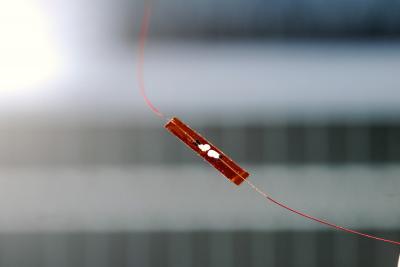
Researchers have developed a new type of small-scale electric power generator able to produce alternating current through the cyclical stretching and releasing of zinc oxide wires encapsulated in a flexible plastic substrate with two ends bonded.
The new "flexible charge pump" generator is the fourth generation of devices designed to produce electrical current by using the piezoelectric properties of zinc oxide structures to harvest mechanical energy from the environment, the authors write in Nature Nanotechnology.
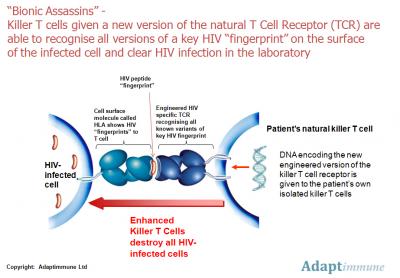
HIV is a master of disguise, able to rapidly change its identity and hide undetected in infected cells. But now, in a long-standing collaborative research effort partially-funded by the Wellcome Trust, scientists from Oxford-based Adaptimmune Limited, in partnership with the Universities of Cardiff and Pennsylvania have engineered immune cells to act as "bionic assassins" that see through HIV's many disguises.
From the Tour de France to NASCAR, competitors and fans know that speed is only part of the equation. Strategy, including the ability to use elements like aerodynamic drafting, which makes it easier to follow closely behind a leader than to be out in front, is also critical.
But in some cases, drafting happens in reverse: It's the leader of a pack who experiences reduced drag, while the followers encounter more resistance -- and have to expend more energy to keep up.
Researchers have taken the first critical steps in unraveling the mysteries of brain aneurysms, the often fatal rupturing of blood vessels that afflicts 500,000 people worldwide each year.
Annual crops grow, blossom and die within one year. Perennials overwinter and grow again the following year. The life strategy of many annuals consists of rapid growth following germination and rapid transition to flower and seed formation, thus preventing the loss of energy needed to create permanent structures. They germinate quickly after the winter so that they come out before other plants, thus eliminating the need to compete for food and light. The trick is basically to make as many seeds as possible in as short a time as possible.


 Pilot Study: Fibromyalgia Fatigue Improved By TENS Therapy
 High Meat Consumption Linked To Lower Dementia Risk
 Long Before The Inca Colonized Peru, Natives Had A Thriving Trade Network
 Mesolithic People Had Meals With More Tradition Than You Thought