Banner
Pilot Study: Fibromyalgia Fatigue Improved By TENS Therapy

Fibromyalgia is the term for a poorly-understood condition where people experience pain and fatigue...

High Meat Consumption Linked To Lower Dementia Risk

Older people who eat large amounts of meat have a lower risk of dementia and cognitive decline...

Long Before The Inca Colonized Peru, Natives Had A Thriving Trade Network

A new DNA analysis reveals that long before the Incan Empire took over Peru, animals were...

Mesolithic People Had Meals With More Tradition Than You Thought

The common imagery of prehistoric people is either rooting through dirt for grubs and picking berries...

User picture.
News StaffRSS Feed of this column.

News Releases From All Over The World, Right To You... Read More »

Blogroll
Nalini Nadkarni of Evergreen State College currently advises a team of researchers who sport shaved heads, tattooed biceps and prison-issued garb rather than the lab coats and khakis typically worn by researchers. Why is Nadkarni's team composed of such apparently iconoclastic researchers? Because all of her researchers are inmates at Cedar Creek Corrections Center, a medium security prison in Littlerock, Washington.

Why did Nadkarni recruit inmates into her research team? "Because," she explains, "I need help from people who have long periods of time available to observe and measure the growing mosses; access to extensive space to lay out flats of plants; and fresh minds to put forward innovative solutions."
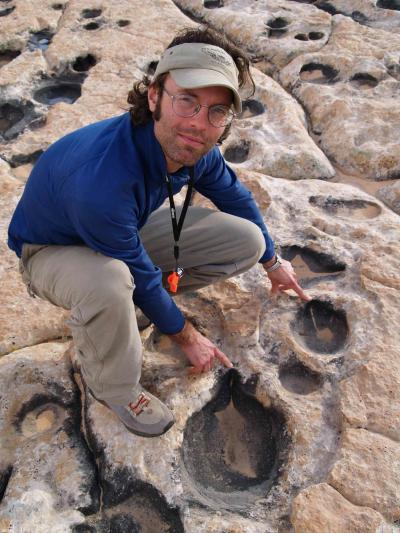
University of Utah geologists identified an amazing concentration of dinosaur footprints that they call “a dinosaur dance floor,” located in a wilderness on the Arizona-Utah border where there was a sandy desert oasis 190 million years ago.

The three-quarter-acre site – which includes rare dinosaur tail-drag marks – provides more evidence there were wet intervals during the Early Jurassic Period, when the U.S. Southwest was covered with a field of sand dunes larger than the Sahara Desert.

More than four in 10 parents with underweight and overweight children mistakenly believe their children are in the average weight range, according to University of Melbourne research.

The study also finds that different methods of assessing children's weight – such as BMI or waist circumference – result in different rates of children being identified as overweight or underweight. According to BMI, more children were classified as overweight, than compared to waist circumference.

While conducting a study about a link between breast size and heart cancer, Helena Jernström, an oncologist at Lund University in southern Sweden, discovered a gene that that about half of women possess is involved in breast cancer - and so is coffee.
About three times a second, a 10,000-year-old stellar corpse sweeps a beam of gamma-rays toward Earth. This object, known as a pulsar, is the first one known to "blink" only in gamma rays, and was discovered by the Large Area Telescope (LAT) onboard NASA's Fermi Gamma-ray Space Telescope, a collaboration with the U.S. Department of Energy (DOE) and international partners.

"This is the first example of a new class of pulsars that will give us fundamental insights into how stars work," says Stanford University's Peter Michelson, principal investigator for the LAT. The LAT data is processed by the DOE's Stanford Linear Accelerator Center and analyzed by the International LAT Collaboration.
Astronomers think that many - perhaps all - galaxies in the universe contain massive black holes at their centers. New observations with the Submillimeter Array now suggest that such colossal black holes were common even 12 billion years ago, when the universe was only 1.7 billion years old and galaxies were just beginning to form. The new conclusion comes from the discovery of two distant galaxies, both with black holes at their heart, which are involved in a spectacular collision.

4C60.07, the first of the galaxies to be discovered, came to astronomers' attention because of its bright radio emission. This radio signal is one telltale sign of a quasar - a rapidly spinning black hole that is feeding on its home galaxy.