Banner
Pilot Study: Fibromyalgia Fatigue Improved By TENS Therapy

Fibromyalgia is the term for a poorly-understood condition where people experience pain and fatigue...

High Meat Consumption Linked To Lower Dementia Risk

Older people who eat large amounts of meat have a lower risk of dementia and cognitive decline...

Long Before The Inca Colonized Peru, Natives Had A Thriving Trade Network

A new DNA analysis reveals that long before the Incan Empire took over Peru, animals were...

Mesolithic People Had Meals With More Tradition Than You Thought

The common imagery of prehistoric people is either rooting through dirt for grubs and picking berries...

User picture.
News StaffRSS Feed of this column.

News Releases From All Over The World, Right To You... Read More »

Blogroll

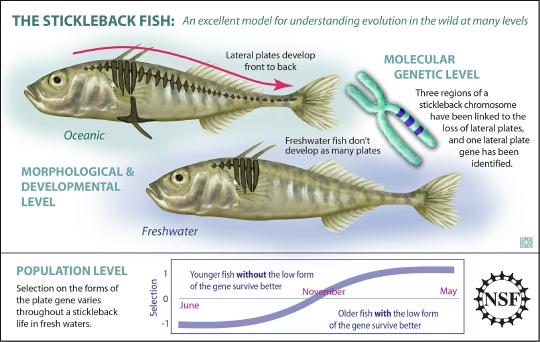
The stickleback fish, Gasterosteus aculeatus, is one of the most thoroughly studied organisms in the wild, and has been a particularly useful model for understanding variation in physiology, behavior, life history and morphology caused by different ecological situations in the wild.

On biological levels from molecular and genetic to developmental and morphological, and finally ending with the population level, it has proven far more complex than even imagined.

Studies of stickleback have provided us with a much better understanding of how organisms cope with new environmental conditions, first through acclimation over an individual's lifespan, and subsequently through adaptation of population via changes in gene form (allele) frequencies.

Given the rapidly changing global environment, this research not only provides insight into evolutionary processes, but is of practical importance in understanding how organisms will adapt to a changing world.

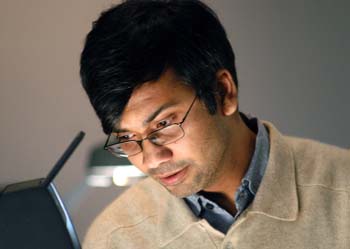
In a seminar co-organized by Stanford University and the American Institute of Mathematics, Kannam Soundararajan, Professor of Mathematics, announced that he and Roman Holowinsky have proven a significant version of the quantum unique ergodicity (QUE) conjecture.

The motivation behind the problem is to understand how waves are influenced by the geometry of their enclosure. Imagine sound waves in a concert hall. In a well-designed concert hall you can hear every note from every seat. The sound waves spread out uniformly and evenly. At the opposite extreme are "whispering galleries" where sound concentrates in a small area.

The mathematical world is populated by all kinds of shapes, some of which are easy to picture, like spheres and donuts, and others which are constructed from abstract mathematics. All of these shapes have waves associated with them. Soundararajan and Holowinsky showed that for certain shapes that come from number theory, the waves always spread out evenly. For these shapes there are no "whispering galleries."

This week, Astronomy & Astrophysics is publishing new observations with AMBER/VLTI of the gas component in the vicinity of young stars. An international team of astronomers led by E. Tatulli (Grenoble, France) and S. Kraus (Bonn, Germany) [1] used the VLT near-infrared interferometer, coupled with spectroscopy, to probe the gaseous environment of Herbig Ae/Be stars. These are young stars of intermediate mass (approximately 2 to 10 solar masses), which are still contracting and often show strong line emissions.

Scientists from the Universities of Bath and Exeter have developed a rapid new way of checking for toxic genes in disease-causing bacteria which infect insects and humans. Their findings could in the future lead to new vaccines and anti-bacterial drugs.

They studied a bacterium called Photorhabdus asymbiotica, which normally infects and kills insects, but which can also cause an unpleasant infection in humans.

By testing groups of genes from the bacteria against three types of invertebrates (insects, worms and amoebae) and mammalian cells, the scientists were able to identify toxins and other molecules, called virulence factors, made by the bacteria that allow it to infect each type of organism.

Sleep in man is divided in two main phases : non-REM sleep, which occupies most of our early sleep night, and REM sleep, during which our dreams prevail. Non-REM sleep is usually considered as a compensatory ‘resting’ state for the brain, following the intense waking brain activity. Indeed, previous brain imaging studies showed that the brain was less active during periods of non-REM sleep as compared to periods of wakefulness.

Although not rejecting this concept, researchers from the Cyclotron Research Centre of the University of Liège in Belgium and from the Department of Neurology of Liege University Hospital demonstrate that, even during its deepest stages (also called ‘slow-wave-sleep’), non-REM sleep should not be viewed as a stage of constant and continuous brain activity decrease, but is also characterized by transient and recurrent activity increases in specific brain areas.

Do females intrinsically have less ability than males to excel in mathematics at the very highest level? That used to be the conventional wisdom. But that has changed in the last few years and more gender equality in math has been the result - but we are still losing too many potential mathematicians, according to "Cross-Cultural Analysis of Students with Exceptional Talent in Mathematical Problem Solving," appearing in the November 2008 issue of the Notices of the American Mathematical Society.

The study brings together decades of data from several extremely high-level mathematics competitions for young people. These data show that there exist many females with profound intrinsic ability in mathematics. What is more, whether this ability is identified and nurtured is highly dependent on socio-cultural, educational, or other environmental factors. In the United States, these factors keep many boys as well as most girls from developing their mathematical talents to the fullest.