Banner
Pilot Study: Fibromyalgia Fatigue Improved By TENS Therapy

Fibromyalgia is the term for a poorly-understood condition where people experience pain and fatigue...

High Meat Consumption Linked To Lower Dementia Risk

Older people who eat large amounts of meat have a lower risk of dementia and cognitive decline...

Long Before The Inca Colonized Peru, Natives Had A Thriving Trade Network

A new DNA analysis reveals that long before the Incan Empire took over Peru, animals were...

Mesolithic People Had Meals With More Tradition Than You Thought

The common imagery of prehistoric people is either rooting through dirt for grubs and picking berries...

User picture.
News StaffRSS Feed of this column.

News Releases From All Over The World, Right To You... Read More »

Blogroll

Recent studies indicate that infusing hearts with stem cells taken from bone marrow could improve cardiac function after myocardial infarction - tissue damage that results from a heart attack. But in a recent systematic review, Cochrane Researchers concluded that more clinical trials are needed to assess the effectiveness of stem cell therapies for heart patients, as well as studies to establish how these treatments work.

In a heart attack, blocked arteries can cut off the blood supply to areas of heart tissue. This leads to myocardial infarction - severe tissue damage caused by lack of oxygen, which is transported in the blood.

New research provides support for the use of St. John’s wort extracts in treating major depression - Cochrane Systematic Review backs up previous research that showed the plant extract is effective in treating mild to moderate depressive disorders.

Extracts of the plant Hypericum perforatum, commonly known as St. John’s wort, have long been used in folk medicine to treat depression and sleep disorders. The plant produces a number of different substances that may have anti-depressive properties, but the whole extract is considered to be more effective.

There is no evidence probiotics can relieve the symptoms of eczema and there is evidence that they may occasionally cause infections and gut problems. These findings from The Cochrane Library come at a time when use of probiotics to treat eczema is increasing.

Eczema is an itchy skin condition that affects more than 1 in 20 people at some time in their lives and is especially common in children. Its cause is complex and not well understood, but sufferers do have different bacteria in their guts compared to unaffected people. Consequently, some nutritionists have suggested that eating live gut-dwelling bacteria, such as those found in probiotic yogurts and some infant formulas, could be beneficial.

Scientists at the University of Leicester, where genetic 'fingerprinting' was invented by Professor Sir Alec Jeffreys, say they are developing techniques which may one day allow police to work out someone’s surname from DNA alone.

Research by Turi King has shown that, unsurprisingly, men with the same British surname are highly likely to be genetically linked even in today's multicultural world. The results of her research have implications in the fields of forensics, genealogy, epidemiology and the history of surnames.

On Wednesday 8th October Dr King will present the key findings of her Ph.D. research in which she recruited over two and a half thousand men bearing over 500 different surnames to take part in the study. Carried out in Professor Mark Jobling’s lab, Dr Turi King’s research involved exploring this potential link between surname and Y chromosome type.

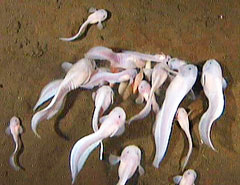
Scientists filming in one of the world’s deepest ocean trenches have found groups of highly sociable snailfish swarming over their bait, nearly five miles (7700 metres) beneath the surface of the Pacific Ocean. This is the first time cameras have been sent to this depth.

‘We got some absolutely amazing footage from 7700 metres. More fish than we or anyone in the world would ever have thought possible at these depths,’ says project leader Dr Alan Jamieson of the University of Aberdeen’s Oceanlab, on board the Japanese research ship the Hakuho-Maru.

‘It’s incredible. These videos vastly exceed all our expectations from this research. We thought the deepest fishes would be motionless, solitary, fragile individuals eking out an existence in a food-sparse environment,’ says Professor Monty Priede, director of Oceanlab.

Smell plays an important role in our lives: It influences the way in which we choose fruit and vegetables, perfume, and even a partner. And yet, smell is not just what we smell with our noses, it's also what we taste, explains Prof. Alexander Vainstein, who is heading the team at the Robert H. Smith Faculty of Agriculture, Food and Environment at the Hebrew University of Jerusalem. "Aroma is of major importance for defining the taste of food."

Scent in flowers and plants is used to attract pollinating insects like bees and beetles that pass on the pollen and help in the reproduction and creation of fruit. The intensity of the scent that the flower emanates is influenced by the time of day, depending on weather, age of the flower and the species.

Now Vainstein and others have found a way to genetically enhance the scent of flowers and implant a scent in those that don't have one.