Banner
Pilot Study: Fibromyalgia Fatigue Improved By TENS Therapy

Fibromyalgia is the term for a poorly-understood condition where people experience pain and fatigue...

High Meat Consumption Linked To Lower Dementia Risk

Older people who eat large amounts of meat have a lower risk of dementia and cognitive decline...

Long Before The Inca Colonized Peru, Natives Had A Thriving Trade Network

A new DNA analysis reveals that long before the Incan Empire took over Peru, animals were...

Mesolithic People Had Meals With More Tradition Than You Thought

The common imagery of prehistoric people is either rooting through dirt for grubs and picking berries...

User picture.
News StaffRSS Feed of this column.

News Releases From All Over The World, Right To You... Read More »

Blogroll

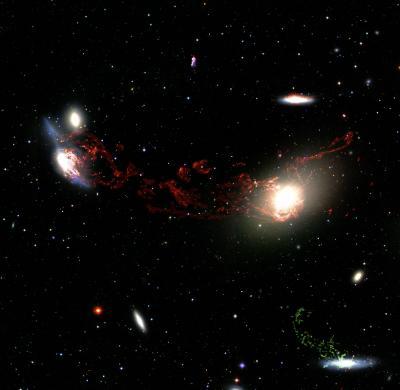
Astronomers studying new images of a nearby galaxy cluster have found evidence that high-speed collisions between large elliptical galaxies may prevent new stars from forming, according to a paper in the November 2008 Astrophysical Journal Letters.

Led by Jeffrey Kenney, professor and chair of astronomy at Yale, the team saw a spectacular complex of warm gas filaments 400,000 light-years-long connecting the elliptical galaxy M86 and the spiral galaxy NGC 4438 in the Virgo galaxy cluster, providing striking evidence for a previously unsuspected high-speed collision between the galaxies. The view was constructed using the wide-field Mosaic imager on the National Science Foundation telescope at Kitt Peak National Observatory near Tucson, Arizona.

Moderate consumption of red wine may decrease the risk of lung cancer in men, according to a report in the October issue of Cancer Epidemiology, Biomarkers & Prevention.

Chun Chao, Ph.D., a research scientist at Kaiser Permanente Department of Research and Evaluation in Pasadena, California, analyzed data collected through the California Men's Health Study, which linked clinical data from California's health system with self-reported data from 84,170 men aged 45 to 69 years. Researchers obtained demographics and lifestyle data from surveys computed between 2000 and 2003, and identified 210 cases of lung cancer.

The Royal Swedish Academy of Sciences has decided to award the Nobel Prize in Physics for 2008 with one half to Yoichiro Nambu of the Enrico Fermi Institute, University of Chicago, IL, USA "for the discovery of the mechanism of spontaneous broken symmetry in subatomic physics"

and the other half jointly to;

Makoto Kobayashi, High Energy Accelerator Research Organization (KEK), Tsukuba, Japan and Toshihide Maskawa,Yukawa Institute for Theoretical Physics (YITP), Kyoto University, Japan, "for the discovery of the origin of the broken symmetry which predicts the existence of at least three families of quarks in nature".

Your next wireless network could use light instead of radio waves. Researchers funded by a National Science Foundation grant expect to piggyback data communications capabilities on low-power light emitting diodes, or LEDs, to create "Smart Lighting" that would be faster and more secure than current network technology.

This initiative, known as the Smart Lighting Engineering Research Center (http://smartlighting.bu.edu), is part of an $18.5 million, multi-year NSF program awarded to Boston University, Rensselaer Polytechnic Institute and the University of New Mexico to develop the optical communication technology that would make an LED light the equivalent of a WiFi access point. This innovative alternative may one day replace most of today's lighting devices.

When astronauts land on the Moon again they may be able to get a critical commodity there – water.

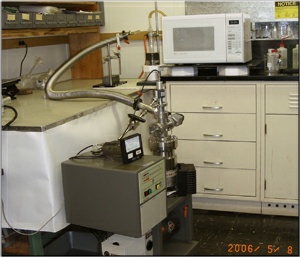
Bill Kaukler, an Associate Research Professor in the Center for Materials Research at The University of Alabama in Huntsville, has spent the past three years investigating the use of microwaves to replenish water on space missions or as a rocket fuel supply.

“A lot of people think that water doesn’t exist on the Moon,” said Kaukler. “It’s true that not all parts of the Moon have water. Where the Apollo missions landed, there isn’t much water because it is exposed to the sun half of the time. However, in the polar regions, exploratory satellites have found huge amounts of hydrogen, which is evidence that water exists.”

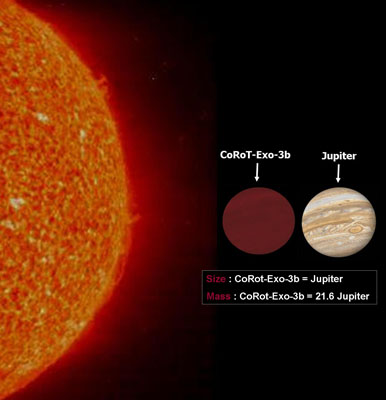
COROT has discovered a massive planet-sized object orbiting its parent star closely, unlike anything ever spotted before. It is so exotic, that scientists are unsure as to whether this oddity is actually a planet or a failed star.

The object, named COROT-exo-3b, is about the size of Jupiter, but packs more than 20 times the mass. It takes only 4 days and 6 hours to orbit its parent star, which is slightly larger than the Sun.

As a planet, COROT-exo-3b would be the most massive and the densest found to date - more than twice as dense as lead. Studying it will help them better understand how to categorise such objects. The mystery is how such a massive object formed so close to its parent.