Banner
Pilot Study: Fibromyalgia Fatigue Improved By TENS Therapy

Fibromyalgia is the term for a poorly-understood condition where people experience pain and fatigue...

High Meat Consumption Linked To Lower Dementia Risk

Older people who eat large amounts of meat have a lower risk of dementia and cognitive decline...

Long Before The Inca Colonized Peru, Natives Had A Thriving Trade Network

A new DNA analysis reveals that long before the Incan Empire took over Peru, animals were...

Mesolithic People Had Meals With More Tradition Than You Thought

The common imagery of prehistoric people is either rooting through dirt for grubs and picking berries...

User picture.
News StaffRSS Feed of this column.

News Releases From All Over The World, Right To You... Read More »

Blogroll

For decades now, cigarette makers have marketed light cigarettes, which contain less nicotine than regular smokes, with the implication that they are less harmful to smokers' health. A new UCLA study shows, however, that they deliver nearly as much nicotine to the brain.

The basic numbers would seem to bear that out the less harmful claim. Light cigarettes have nicotine levels of 0.6 to 1 milligrams, while regular cigarettes contain between 1.2 and 1.4 milligrams.

In the brain, nicotine binds to specific molecules on nerve cells called nicotinic acetylcholine receptors, or nAChRs. When nerve cells communicate, nerve impulses jump chemically across gaps between cells called synapses by means of neurotransmitters. The neurotransmitters then bind to the receptor sites on nerve cells — in the case acetylcholine resulting in the release of a pleasure-inducing chemical called dopamine. Nicotine mimics acetylcholine, but it lasts longer, releasing more dopamine. Most scientists believe that's one key reason why nicotine is so addictive.

This kind of Mother Goose is no fairy tale. A 50 million year old skull reveals that huge birds with a 5 meter wingspan once skimmed across the waters that covered what is now London, Essex and Kent. These giant ocean-going relatives of ducks and geese also had a rather bizarre attribute for a bird: their beaks were lined with bony-teeth.

Described today in the journal Palaeontology, the skull belongs to Dasornis, a bony-toothed bird, or pelagornithid, and was discovered in the London Clay, which lies under much of London, Essex and northern Kent in SE England. The occurrence of bony-toothed birds in these deposits has been known for a long time, but the new fossil is one the best skulls ever found, and preserves previously unknown details of the anatomy of these strange creatures.

<

Cities are unfairly blamed for greenhouse gas emissions by misguided politicians and well-meaning people who listen to them, and this threatens efforts to truly impact climate change, warns a study in the October 2008 issue of the journal Environment and Urbanization. The paper says cities are commonly blamed for 75 to 80 percent of emissions but that the true value is around half that and the potential for cities to help address climate change is being overlooked because of this error.

United Nations agencies, former US President Bill Clinton’s climate change initiative and New York Mayor Michael Bloomberg have all claimed that between 75 and 80 per cent of emissions come from cities even though data from the Intergovernmental Panel on Climate Change (IPCC) shows that only 40 percent of all greenhouse gases are from human activities generated within cities.

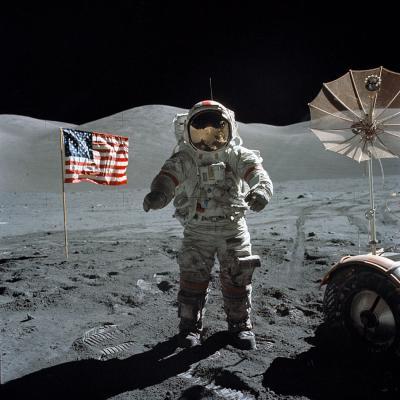
The Apollo Moon missions of 1969-1972 all share a dirty secret. "The major issue the Apollo astronauts pointed out was dust, dust, dust," says Professor Larry Taylor, Director of the Planetary Geosciences Institute at the University of Tennessee. Fine as flour and rough as sandpaper, Moon dust caused 'lunar hay fever,' problems with space suits, and dust storms in the crew cabin upon returning to space.

The trouble with moon dust stems from the strange properties of lunar soil. The powdery grey dirt is formed by micrometeorite impacts which pulverize local rocks into fine particles. The energy from these collisions melts the dirt into vapor that cools and condenses on soil particles, coating them in a glassy shell.

Nothing says fun to physicists and mathematicians like baseball - it's the perfect sport for the numbers-oriented crowd, and because it's the only game where the defense has the ball, it's ideally suited for the rebel mentality.

With baseball playoffs heating up and the World Series right around the corner, it's guaranteed that fans will see daring slides, both feet-first and head-first, and even slides on bang-bang plays at first. But the eternal question has always been, who gets there faster, the head-first slider or the feet-first?

The heads first player, says David A. Peters, Ph.D., the McDonnell Douglas Professor of Engineering at Washington University in St. Louis, and big-time baseball fan.

Why aren't pregnant women included in most clinical trials? Bioethicists at Duke University Medical Center, Johns Hopkins and Georgetown Universities writing in the International Journal of Feminist Approaches to Bioethics(*) say it's time to confront the challenges that have led to the exclusion of pregnant women from important research that could positively impact maternal and fetal health.

"Only in the last two decades did people recognize that women were being excluded not just from the risks, but from the benefits of research -- primarily because of their potential to become pregnant or because of concerns that female physiology - such as menstrual cycles - might complicate study results," says Anne Drapkin Lyerly, MD, an obstetrician/gynecologist and medical ethicist at Duke.