Banner
Pilot Study: Fibromyalgia Fatigue Improved By TENS Therapy

Fibromyalgia is the term for a poorly-understood condition where people experience pain and fatigue...

High Meat Consumption Linked To Lower Dementia Risk

Older people who eat large amounts of meat have a lower risk of dementia and cognitive decline...

Long Before The Inca Colonized Peru, Natives Had A Thriving Trade Network

A new DNA analysis reveals that long before the Incan Empire took over Peru, animals were...

Mesolithic People Had Meals With More Tradition Than You Thought

The common imagery of prehistoric people is either rooting through dirt for grubs and picking berries...

User picture.
News StaffRSS Feed of this column.

News Releases From All Over The World, Right To You... Read More »

Blogroll

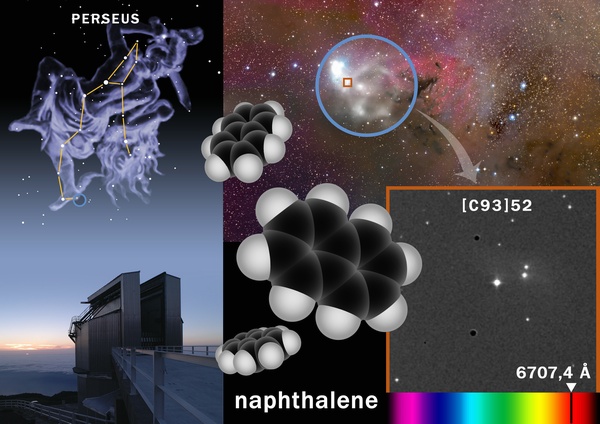
Naphthalene molecules, in combination with water, ammonia and ultraviolet radiation, produce many of the amino acids fundamental to the development of life.

A team of scientists led by researchers from the Instituto Astrofísica de Canarias (IAC) has succeeded in identifying naphthalene in a star formation region in the constellation Perseus, in the direction of the star Cernis 52.

This means a large number of the key components in prebiotic terrestrial chemistry could have been present in the interstellar matter from which the Solar System was formed.


Using various telescopes in La Palma and Texas, IAC researchers have detected the pr

Pirates, like gangsters, highwayman, and other colorful outlaws, have always carried a certain romantic appeal and, thanks to "Pirates of the Caribbean", they are the most appealing of the outlaws at this moment.

In a swashbuckling article for the Journal of Political Economy, Peter Leeson explored the fascinating “golden age” of piracy during the late seventeenth and early eighteenth centuries and finds that these criminal organizations were able to establish a remarkably stable form of self-government.

Identity thieves can learn a lot about you from your trash and so it goes that a cell's "trash" can yield treasures for biologists.

Using a new technique they developed, scientists at University of Delaware's Delaware Biotechnology Institute analyzed the cellular waste of one of the world's most-studied plants and discovered formerly hidden relationships between genes and the small molecules that can turn them off.

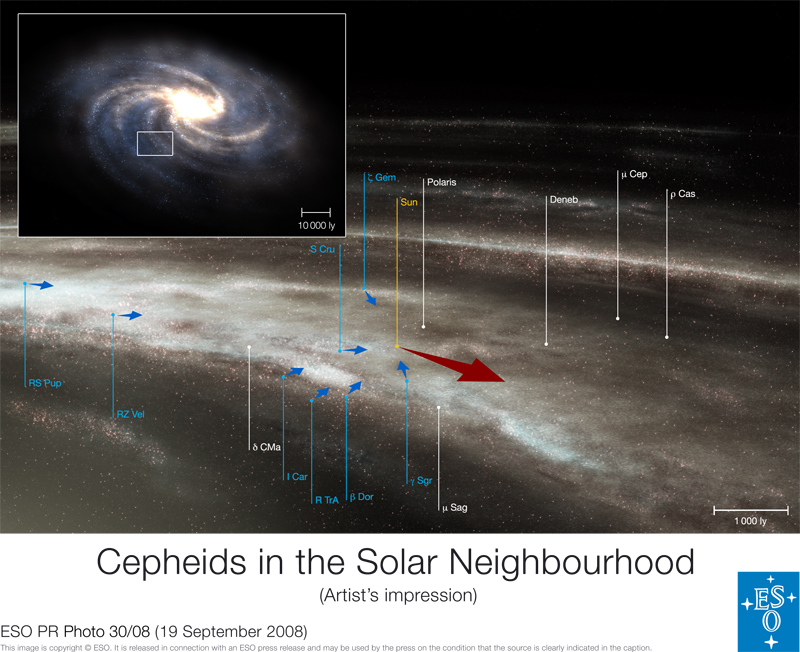
Precise measurements by the ESO instrument HARPS now show that the rotation of the Milky Way is simpler than previously thought - the much debated, apparent 'fall' of neighborhood Cepheid stars towards our Sun stems from an intrinsic property of the Cepheids themselves, say a group of astrophysicists led by Nicolas Nardetto in a Astronomy & Astrophysics article.

Since Henrietta Leavitt's discovery of their unique properties in 1912, the class of bright, pulsating stars known as Cepheids has been used as a distance indicator. Combined with velocity measurements, the properties of Cepheids are also an extremely valuable tool in investigations of how our galaxy, the Milky Way, rotates.

"The motion of Milky Way Cepheids is confusing and has led to disagreement among researchers," says Nardetto. "If the rotation of the Galaxy is taken into account, the Cepheids appear to 'fall' towards the Sun with a mean velocity of about 2 km/s."

New research from Stanford University scientists suggests that type 1 diabetes, an autoimmune disease that develops in children and young adults, may not be due to bad genes but rather to good genes behaving badly.

Because type 1 diabetes typically runs in families, scientists have looked for inborn genetic errors or gene variants passed on from generation to generation. Although this search has failed to find a single type 1 diabetes gene, many candidate type 1 diabetes susceptibility genes have been identified. These susceptibility genes, located in a region known as the major histocompatibility complex (MHC), help the body distinguish its own cells and tissues from those that are foreign.

A Bonn-based company is launching a virtual TV studio accessible to everyone via http://make.tv. The new service will be presented for the first time at photokina in Cologne on 23rd September, at Booth B054 in Hall 9, and they say it will revolutionize live TV.

Making an appearance at both the world's biggest imaging exhibition and on the internet, after a year in development, http://make.tv is being introduced as a new 'virtual' TV studio for the production of their own live transmissions, without having to invest in traditional TV transmission technology.

The virtual studio is controlled from a computer, is easy to use and requires no installation, since it works through an internet browser. As a result, it is possible to basically transmit for free from anywhere in the world.