Banner
Pilot Study: Fibromyalgia Fatigue Improved By TENS Therapy

Fibromyalgia is the term for a poorly-understood condition where people experience pain and fatigue...

High Meat Consumption Linked To Lower Dementia Risk

Older people who eat large amounts of meat have a lower risk of dementia and cognitive decline...

Long Before The Inca Colonized Peru, Natives Had A Thriving Trade Network

A new DNA analysis reveals that long before the Incan Empire took over Peru, animals were...

Mesolithic People Had Meals With More Tradition Than You Thought

The common imagery of prehistoric people is either rooting through dirt for grubs and picking berries...

User picture.
News StaffRSS Feed of this column.

News Releases From All Over The World, Right To You... Read More »

Blogroll

Pheromones are molecules that an organism releases to trigger a specific behavior in other members of its species. Insects make wide use of pheromones to attract mates, signal the location of food, warn of attackers and provide other signals.

A new study finds that genes significantly affect variation in voter turnout, shedding new light on the reasons why people vote and participate in the political system.

"Although we are not the first to suggest a link between genes and political participation," note the authors, "this study is the first attempt to test the idea empirically."

They do so by conducting three tests of the claim that part of the variation in political participation can be attributed to genetic factors. The results suggest that individual genetic differences make up a large and significant portion of the variation in political participation, even after taking socialization and other environmental factors into account. They also suggest that, contrary to decades of conventional wisdom, family upbringing may have little or no effect on children's future participatory behavior.

It has been commonly regarded as a good sign that the nation's homocide rate has remained flat but the big picture obscures a disturbing fact, say researchers at the Johns Hopkins Bloomberg School of Public Health.

Namely that between 1999 and 2005, homicide involving firearms increased 31 percent among black men ages 25 to 44 and 12 percent among white men of the same age.

For the study, Susan Baker, MPH, co-author of the study and a professor with the Bloomberg School's Center for Injury Research and Policy, and her colleagues Daniel Webster and Gouqing Hu, the study's lead author, analyzed data from WISQARS™ (Web-based Injury Statistics Query and Reporting System), which includes information on injury-related deaths and mortality rates per 100,000 population from 1981-2005. Mortality data by urbanization level was obtained through the Wonder System at the Centers for Disease Control and Prevention.

Materials scientists at the National Institute of Standards and Technology (NIST) have developed a process to build complex, three-dimensional nanoscale structures of magnetic materials such as nickel or nickel-iron alloys using techniques compatible with standard semiconductor manufacturing. The process, described in a recent paper, could enable whole new classes of sensors and microelectromechanical (MEMS) devices.

The NIST team also demonstrated that key process variables are linked to relatively quick and inexpensive electrochemical measurements, pointing the way to a fast and efficient way to optimize the process for new materials.

Energy from the sun and carbon dioxide fuel photosynthesis in plants and algae, making life on earth possible. Carbon that is fixed by plants is converted to starch and sucrose, which are utilized by plants for energy and to build biomass.

Human evolution and society have been intimately tied to our exploitation of plant biomass for food, fuel, tools, and shelter. However, to be usable, the starch carbohydrate stored in plants must be broken down to component sugars. Some aspects of starch metabolism have been known for many years, but regulation of the process and exact physical mechanisms are still not well understood.

With new information emerging from genome sequencing and mutational analyses, we are beginning to gain a better understanding of these complex and finely tuned processes. Such knowledge is especially critical as we struggle with issues of energy and food supply.

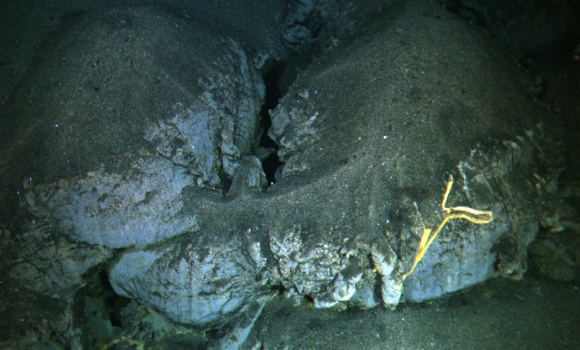
An international team of researchers says they have evidence of explosive volcanism in the deeps of the ice-covered Arctic Ocean for the first time.

Researchers from an expedition to the Gakkel Ridge report in the current issue of Nature that they discovered extensive layers of volcanic ash on the seafloor, which indicates a gigantic volcanic eruption.

A major part of Earth's volcanism happens at the so-called mid-ocean ridges and, therefore, completely undetected on the seafloor. There, the continental plates drift apart; liquid magma intrudes into the gap and constantly forms new seafloor through countless volcanic eruptions. Accompanied by smaller earthquakes, which go unregistered on land, lava flows onto the seafloor. These unspectacular eruptions usually last for only a few days or weeks.