Banner
Pilot Study: Fibromyalgia Fatigue Improved By TENS Therapy

Fibromyalgia is the term for a poorly-understood condition where people experience pain and fatigue...

High Meat Consumption Linked To Lower Dementia Risk

Older people who eat large amounts of meat have a lower risk of dementia and cognitive decline...

Long Before The Inca Colonized Peru, Natives Had A Thriving Trade Network

A new DNA analysis reveals that long before the Incan Empire took over Peru, animals were...

Mesolithic People Had Meals With More Tradition Than You Thought

The common imagery of prehistoric people is either rooting through dirt for grubs and picking berries...

User picture.
News StaffRSS Feed of this column.

News Releases From All Over The World, Right To You... Read More »

Blogroll

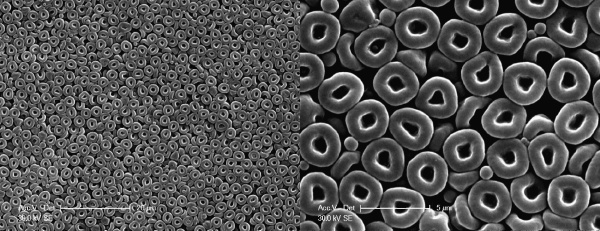
Just like humans, liver cells love doughnuts, but these are polystyrene ring “doughnuts”, just a few microns across, and they might give scientists a new way to deliver drugs selectively, potentially eliminating nasty side effects of life-saving treatments such as chemotherapy, according to chemists writing in Chemical Communications.

Mark Bradley and colleagues at the University of Edinburgh, UK, serendipitously made the polymer doughnuts while studying potential drug-carrying microparticles.

While synthesising micro-spheres, the team added a small amount of dioxane to their usual ethanol solvent. To their surprise, the resulting microparticles were regular in size and shape, with a hole through the middle like a doughnut.

More than 55 million cosmetic surgery procedures will be performed in 2015, predicts a recent study in Plastic and Reconstructive Surgery, the journal of the American Society of Plastic Surgeons (ASPS).

That's 4 times the number of procedures performed in 2005. Pushing this growth is what you might expect - marketing and vanity.

The study's findings are great news for the plastic surgery industry but the ASPS suggests caution to current and future patients. While cosmetic procedures seem lower risk than ever and are easy to access, they are not a cure-all for many patients, and choosing a surgeon with the training to perform all procedures, from non-invasive therapies to surgery, can mean the difference between achieving desired results and requiring more procedures down the road.

An international team has reached a milestone in the construction of one of the largest ever cameras to detect the mysterious Dark Energy component of the Universe. The pieces of glass for the five unique lenses of the camera have been shipped from the US to France to be shaped and polished into their final form. The largest of the five lenses is one metre in diameter, making it one of the largest in the world.

Each milestone in the completion of this sophisticated camera brings us closer to detecting the mysterious and invisible matter that cosmologists estimate makes up around three quarters of our Universe and is driving its accelerating expansion. Observations suggest that roughly 4% of the Universe is made up from ordinary matter and 22% from Dark Matter; this leaves 74% unaccounted for - the so-called Dark Energy.

The Dark Energy Survey (DES) camera will map 300 million galaxies using the Blanco 4-meter telescope - a large telescope with new advanced optics at Chile’s Cerro Tololo Inter-American Observatory.

Ritalin, CIBA-Geneva's brand name for methylphenidate, has long been the weapon of choice against rambunctious children (and even used by some who actually have attention deficit hyperactivity disorder - ADHD) so it's no surprise it has become fashionable as "cognition enhancers" by those who like their addictions culturally accepted.

Thanks to almost two decades of human experimental trials in the mass population, there is some knowledge of what these drugs actually do in the brain. In a Biological Psychiatry paper, University of Wisconsin-Madison psychology researchers David Devilbiss and Craig Berridge report how Ritalin affects the functioning of neurons in the prefrontal cortex (PFC) - a brain region involved in attention, decision-making and impulse control.

Because of the potential for addiction and abuse, controversy has swirled for years around the use of stimulants to treat ADHD, especially in children. By helping pinpoint Ritalin's action in the brain, the study should give drug developers a better road map to follow as they search for safer alternatives - and parents some guidance as to when children need medication and when they need parenting.

A recent Northwestern University study has a surprising results - substantially more men are likely to share their creative work online than women even though both genders engage in creative activities at essentially equal rates.

Even more surprising - the researchers think that's ... unfair.

Overall, almost two-thirds of men reported posting their work online while only half of women reported doing so. When Eszter Hargittai, assistant professor of communication studies at Northwestern University, and Northwestern's Gina Walejko controlled for self-reported digital literacy and Web know-how, however, they found that men and women actually posted their material about equally.

A study recently published in Social Science Quarterly finds that religious beliefs play a more significant role than church attendance or religious traditions in political participation.

Religious beliefs affected political participation more than other measures of religious behavior. In addition, different types of religious beliefs influence political participation differently.

Generalized, macro religious beliefs affected national political participation. Macro beliefs include religious beliefs that involve broad, worldly concerns. Narrow, individually experienced micro beliefs that are personal and affect individual concerns had no effect on national politics.