Banner
Pilot Study: Fibromyalgia Fatigue Improved By TENS Therapy

Fibromyalgia is the term for a poorly-understood condition where people experience pain and fatigue...

High Meat Consumption Linked To Lower Dementia Risk

Older people who eat large amounts of meat have a lower risk of dementia and cognitive decline...

Long Before The Inca Colonized Peru, Natives Had A Thriving Trade Network

A new DNA analysis reveals that long before the Incan Empire took over Peru, animals were...

Mesolithic People Had Meals With More Tradition Than You Thought

The common imagery of prehistoric people is either rooting through dirt for grubs and picking berries...

User picture.
News StaffRSS Feed of this column.

News Releases From All Over The World, Right To You... Read More »

Blogroll

Researchers in Spain have proven that metamaterials, materials defined by their unusual man-made cellular structure, can be designed to produce an acoustic cloak - a cloak that can make objects impervious to sound waves, literally diverting sound waves around an object.

The research, 'Acoustic cloaking in two dimensions: a feasible approach', published today, Friday, 13 June, 2008, in the New Journal of Physics (NJP), builds on recent theoretical research which has sought ways to produce materials that can hide objects from sound, sight and x-rays.

Daniel Torrent and José Sánchez-Dehesa from the Wave Phenomena Group, Department of Electronics Engineering at the Polytechnic University of Valencia, cite theoretical work published early last year in NJP by researchers from Duke University in North Carolina, US, as the starting point for their more practical approach.

With the proper spin, forests can be the cause of global warming. They produce methane. American environmentalists have an irrational dislike of nuclear power so they forced America to use more coal so they can be blamed for the spike in CO2.

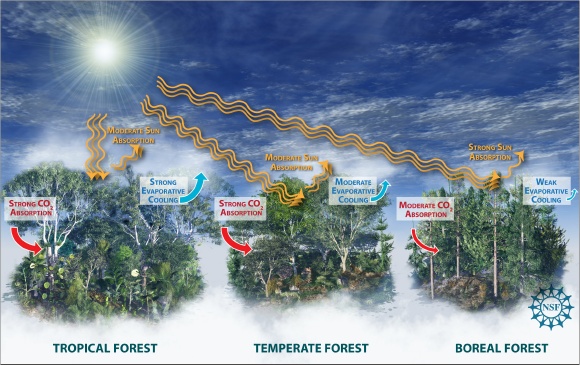
It takes understanding to go beyond perspective and detailed analysis of the forests impact on climate change is still sketchy. There are roughly 42 million square kilometers of forest on Earth, a swath that covers almost a third of the land surface, and those wooded environments play a key role in both mitigating and enhancing global warming.

The teeming life of forests, and the physical structures containing them, are in continuous flux with incoming solar energy, the atmosphere, the water cycle and the carbon cycle--in addition to the influences of human activities. The complex relationships both add and subtract from the equations that dictate the warming of the planet.

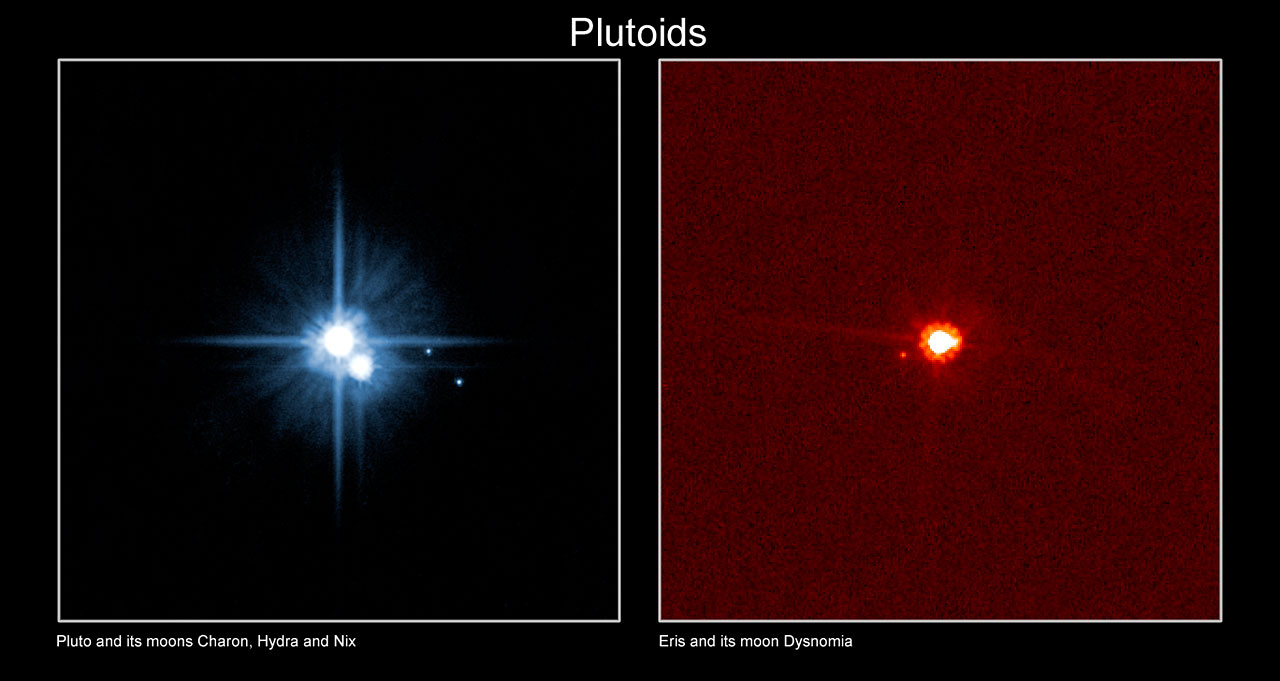
Almost two years after the International Astronomical Union (IAU) General Assembly introduced the category of dwarf planets, the IAU, as promised, has decided on a name for transneptunian dwarf planets similar to Pluto.

The name plutoid was proposed by the members of the IAU Committee on Small Body Nomenclature (CSBN), accepted by the Board of Division III, by the IAU Working Group for Planetary System Nomenclature (WGPSN) and approved by the IAU Executive Committee at its recent meeting in Oslo, Norway.

Plutoids are celestial bodies in orbit around the Sun at a distance greater than that of Neptune that have sufficient mass for their self-gravity to overcome rigid body forces so that they assume a hydrostatic equilibrium (near-spherical) shape, and that have not cleared the neighbourhood around their orbit. The two known and named plutoids are Pluto and Eris. It is expected that more plutoids will be named as science progresses and new discoveries are made.

Genetically modified foods are the enemy, say some activists, but organic foods have caused all the salmonella say others. The food safety message is a mess and Americans lack confidence in the system because of it.

A new national study conducted by the Harvard School of Public Health Project on the Public and Biological Security finds that, though there have been food safety incidents in recent years, Americans are confident that the food produced in the United States is safe but have concerns about the safety of imported food produced in some other countries.

The poll found that a majority of Americans believe that the food produced in the U.S. is either very (37%) or somewhat (58%) safe. Only 4% thought US-produced foods were unsafe. When asked about foods available in the U.S. but produced in other countries, fewer than one in ten (6%) considered foods from Canada to be unsafe. In contrast, almost half of Americans (47%) thought food from Mexico was unsafe, and 56% thought this about food from China. Possibly responding to these concerns, about half (53%) of Americans reported at least sometimes looking for information about what countries foods come from when shopping for groceries.

Silicone breasts for a football star's girlfriend, aging Hollywood actresses with doll-like, over-tightened faces - all this could soon be a matter of the past.

Cosmetic surgery is developing into an interdisciplinary medicine of beauty and rejuvenation which has only little use for silicone and scalpel.New cosmetic surgery relies to an important part on minimal-invasive, gentle surgery, done under local anaesthesia. Liposuction by use of microcannulas offers a good example, being easy on the tissue and allowing for precise shaping of body and face, followed by only minimal aftercare.

The second pillar on which new cosmetic surgery rests is the use of body-own stem cells. These allow for lasting breast augmentation without silicone and have made operations such as standard facelift, lid correction and wrinkle treatment with "fillers" obsolete. Stem cells have shown immediate rejuvenating and regenerating local effects and can be used for many aesthetic treatments.

Conserving biodiversity must be considered when developing plans to reduce greenhouse gas emissions from deforestation, researchers warn in a paper today.

The 2007 statistics from the Food and Agriculture Organization of the United Nations indicate that from 1990 to 2005 the world lost 3% of its total forest area, some 13 million hectares per year. The greatest losses were in Latin American and the Caribbean ( 7 % over 15 years or about 16 million hectares per year) Africa (9% over 15 years or 4.4 million hectares per year). Land use change (mostly deforestation) accounts for 18-25% of global annual greenhouse gas emissions.

The United Nations Framework Convention on Climate Change is currently discussing ways of Reducing Emissions from Deforestation and Degradation (REDD) in developing countries. REDD has great potential to deliver benefits for biodiversity and people, as well as for the climate, however it is likely that these benefits will be concentrated in forests with high carbon stocks and that land use change may shift to low-carbon forests and other ecosystems important for biodiversity.