Banner
Here's Where Your Backyard Was 300 Million Years Ago

We may use terms like "grounded" and terra firma to mean stability and consistency but geology...

Convergent Evolution Cheat Sheet Now 120 Million Years Old

One tenet of natural selection is a random walk of genes but nature may be more predictable than...

Synchrotron Could Shed Light On Exotic Dark Photons

There are many hypothetical particles proposed to explain dark matter and one idea to explore how...

The Pain Scale Is Broken But This May Fix It

Chronic pain is reported by over 20 percent of the global population but there is no scientific...

User picture.
News StaffRSS Feed of this column.

News Releases From All Over The World, Right To You... Read More »

Blogroll

Revelations of the extent of American government surveillance into the private lives of both the American public and foreign leaders worldwide has shone a spotlight on the lack of security in digital communications.

Even today's encrypted data is vulnerable but physics may come to the rescue, according to a Nature article by Artur Ekert and Renato Renner ("The ultimate physical limits of privacy", doi:10.1038/nature13132).

Six glaciers in West Antarctica are moving faster than they did 40 years ago.

The amount of ice draining collectively from those half-dozen glaciers increased by 77 percent from 1973 to 2013, causing global sea level to rise, according to new research. 

We know the Voyager spacecraft has left the solar system. What no one can really say is when. Boundaries in space are entirely human vanities, there is no 'Now leaving the Local System' sign after Pluto.

Well, it's all so unsettled that two percent of astronomers even decided Pluto wasn't even a planet. 

But no matter how we define a planet, the solar system has a new most-distant member, according to new work from Carnegie's Scott Sheppard and Chadwick Trujillo of the Gemini Observatory. In Nature, they report the discovery of the distant dwarf planet 2012 VP113 beyond the known 'edge' of the Solar System.

Natural history, the study of organisms in the environment, is in steep decline and for good reason.

A large part of the modern chemophobia that has undermined science acceptance in America is due to natural history - it became a haven for weak observational studies that got media headlines or, in the case of Rachel Carson and "Silent Spring", a book of anecdotes and observations. Modern scientists prefer experiments rather than observations and so the primary use of natural history has been for 'spray and count' practitioners who need to demonize pesticides or BPA or whatever the scare journalism of the week is.

Researchers with the U.S. Department of Energy Joint BioEnergy Institute have identified the genetic origins of a microbial resistance to ionic liquids, based on a pair of genes discovered in a bacterium native to a tropical rainforest in Puerto Rico, and successfully introduced this resistance into a strain of E. coli bacteria.

Yes, it's Frankenfuel, but hopefully anti-science zealots won't make creating an abomination of nature that leads to less fossil fuels.

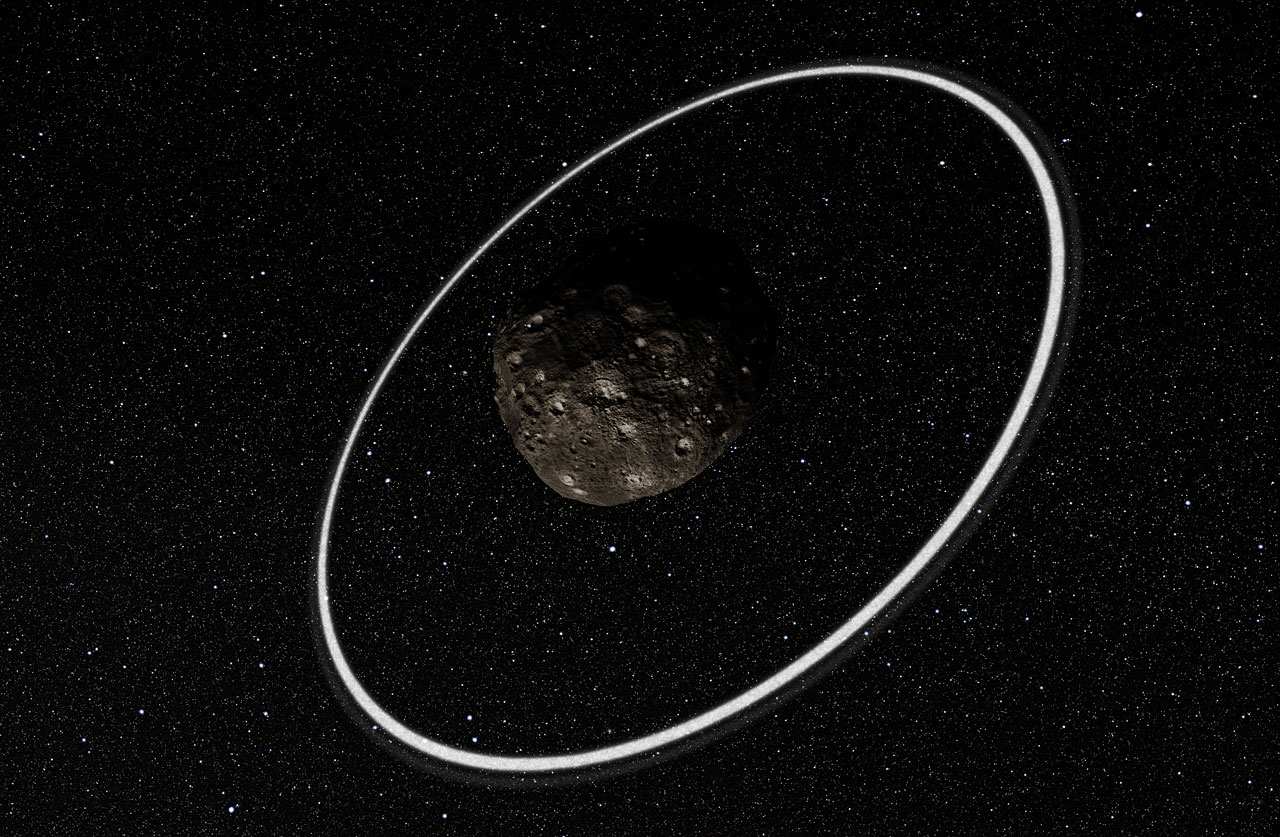
Astronomers have announced the surprise discovery that the asteroid Chariklo is surrounded by two dense and narrow rings, by far the smallest object to have rings. 

The rings of Saturn are, of course, one of the most spectacular sights in the sky. Despite many careful searches, no rings had been found around smaller objects orbiting the Sun in the Solar System. Now observations of the distant minor planet (10199) Chariklo as it passed in front of a star have shown that it is surrounded by two fine rings. Minor planet? Yes, the IAU which demoted Pluto has generally made a mess of things and so asteroid and minor planet are interchangeable in common parlance.