Banner
Pilot Study: Fibromyalgia Fatigue Improved By TENS Therapy

Fibromyalgia is the term for a poorly-understood condition where people experience pain and fatigue...

High Meat Consumption Linked To Lower Dementia Risk

Older people who eat large amounts of meat have a lower risk of dementia and cognitive decline...

Long Before The Inca Colonized Peru, Natives Had A Thriving Trade Network

A new DNA analysis reveals that long before the Incan Empire took over Peru, animals were...

Mesolithic People Had Meals With More Tradition Than You Thought

The common imagery of prehistoric people is either rooting through dirt for grubs and picking berries...

User picture.
News StaffRSS Feed of this column.

News Releases From All Over The World, Right To You... Read More »

Blogroll
Many people feel the need to live in important times, so they complain about how much worse things are today.

But scientists studying the ancient ruins of Çatalhöyük, in modern Turkey, found that its inhabitants - 3,500 to 8,000 people at its peak - experienced overcrowding, infectious diseases, violence and environmental problems. And that was 9,000 years ago.

Sorry readers of The Guardian, it wasn't better then. One ne of the world's first large farming communities were also among the first humans to complain about modern urban living.
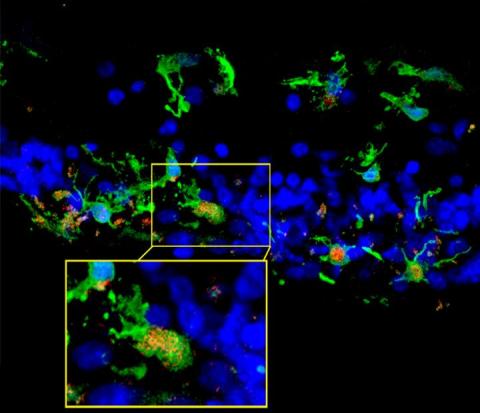
A new exploratory study in mice found that the complement system, part of the innate immune system, plays a protective role to slow retinal degeneration in retinitis pigmentosa, an inherited eye disease.

Retinitis pigmentosa is an incurable and unpreventable blinding eye disease that affects 1 in 4,000 people but if "in mice" isn't caution enough, even more is warranted. Other studies have found that the complement system worsens retinal degeneration because it mediates some aspects of inflammation and worsens damage in age-related macular degeneration (AMD), a leading cause of blindness in people age 65 years and older. 
The concept of quasiparticles was coined by Nobel laureate Lev Davidovich Landau, who used it to describe collective states of lots of particles or rather their interactions due to electrical or magnetic forces. Due to this interaction, several particles act like one single one.

The assumption has been that quasiparticles in interacting quantum systems decay after a certain time but the opposite is the case, according to a recent paper: strong interactions can even stop decay entirely. Collective lattice vibrations in crystals, so-called phonons, are one example of such quasiparticles.
Social psychologists say we send out social cues not just with our facial expressions, but with the tilt of our heads as well.

An otherwise neutral expression looks more dominant when the head is tilted down. The authors speculate that is because tilting one's head downward leads to the artificial appearance of lowered and V-shaped eyebrows--which elicit perceptions of aggression, intimidation, and dominance.

But why does looking like a serial killer seem more dominant than someone with their head tilted back, a pose usually regarded as more confident? Dominant means something different to them than it does the public.
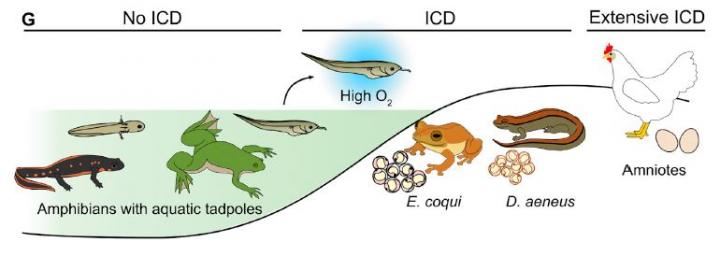
Free fingers have obvious advantages on land, and don't even get us started on opposable thumbs, but provides aquatic or gliding animals with more suitable webbed ones. But both amphibians and amniotes, which include mammals, reptiles, and birds, can have webbed digits. 

A new study has found that during embryo development, some animal species detect the presence of atmospheric oxygen, which triggers removal of interdigital webbing.

A familiar table salt ingredient has been hiding in plain sight on the surface of Jupiter's moon Europa, finds a recent analysis. Using a visible light spectral analysis, planetary scientists have discovered that the yellow color visible on portions of the surface of Europa is actually sodium chloride, a compound known on Earth as table salt, which is also the principal component of sea salt.

The discovery suggests that the salty subsurface ocean of Europa may chemically resemble Earth's oceans more than previously thought, challenging decades of supposition about the composition of those waters and making them potentially a lot more interesting for study.