Banner
Here's Where Your Backyard Was 300 Million Years Ago

We may use terms like "grounded" and terra firma to mean stability and consistency but geology...

Convergent Evolution Cheat Sheet Now 120 Million Years Old

One tenet of natural selection is a random walk of genes but nature may be more predictable than...

Synchrotron Could Shed Light On Exotic Dark Photons

There are many hypothetical particles proposed to explain dark matter and one idea to explore how...

The Pain Scale Is Broken But This May Fix It

Chronic pain is reported by over 20 percent of the global population but there is no scientific...

User picture.
News StaffRSS Feed of this column.

News Releases From All Over The World, Right To You... Read More »

Blogroll

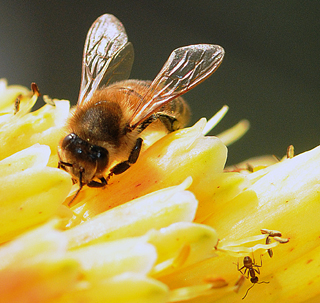
Bees are more genetically related to ants than they are to social wasps such as yellow jackets and paper wasps, according to a new paper.

 Ants, bees and stinging wasps all belong to the aculeate (stinging) Hymenoptera clade, the insect group in which social behavior is most extensively developed, said senior author and ant specialist Phil Ward, professor of entomology at UC Davis. 

The use of genome sequencing and bioinformatics answers a piece of a long-standing, unanswered evolutionary puzzle. Previously it was thought that ants and bees were distantly related, with ants being closer to certain parasitoid wasps.

Triathletes participate in a grueling endurance sport - in the Olympic version, it means swimming about 1 mile, bicycling 40 miles and then running 6.2 miles. Those in the Ironman version get even more extreme, a 2.4 mile swim, 112 mile bike race and then running a full marathon, 26.2 miles.

Clearly, in both training and competition, they regularly push their bodies beyond the limits most of us can endure. There is no doubt that triathletes are tougher than most people, the mystery is why.

High taxes or low taxes, anti-global warming or anti-GMO. You can often figure out how an American votes by asking their stance on a few issues.

The government is currently in the middle of a shutdown because neither side remembers what bipartisan means. Yet one things remains the same in both camps; belief superiority, the idea that their views on certain issues are not only correct but also that all other views are inferior.

A recent psychology paper examined whether one end of the American political spectrum believes more strongly than the other in the superiority of its principles and positions. It found both sides have elements of "belief superiority," depending on the issue. 

Premenstrual syndrome (PMS) is the name given to women who are in a bad mood when they are about to get their periods.  Most women are unaffected by the hormonal changes of the menstrual cycle, but approximately 20% of women say they experience premenstrual syndrome and 5% say they have a severe disorder characterized by functionally impairing or distressing mood and physical symptoms in the luteal phase of the menstrual cycle (second half of cycle) - which scholars call premenstrual dysphoric disorder (PMDD), a more severe form of PMS.  

Since 1996, corn containing a gene that allows it to create a protein that is toxic to certain insects yet is safe for human consumption has been grown in the United States.

Most of this genetically modified "Bt corn" has been used for animal feed or processed into corn meal, starch, or other products. Varieties of sweet corn (corn on the cob) have existed since the late 1990s, though relatively few acres have been planted related to the impact of marketing campaigns against it by activist groups. 

A new study doesn't rehash the well-documented safety issue and instead deals with the environmental aspects. It suggests that Bt sweet corn is better for the environment because it requires fewer pesticide applications than conventional corn.

James Rothman, Randy Schekman and Thomas Südhof have been awarded the 2013 Nobel Prize in Medicine for their work on how the cell organizes its transport system.

Disturbances in the control system for the transport and delivery of cellular molecules contribute to conditions such as neurological diseases, diabetes, and immunological disorders. The three US researchers received the award for their discoveries of machinery regulating vesicle traffic, a major transport system in our cells.