Banner
Here's Where Your Backyard Was 300 Million Years Ago

We may use terms like "grounded" and terra firma to mean stability and consistency but geology...

Convergent Evolution Cheat Sheet Now 120 Million Years Old

One tenet of natural selection is a random walk of genes but nature may be more predictable than...

Synchrotron Could Shed Light On Exotic Dark Photons

There are many hypothetical particles proposed to explain dark matter and one idea to explore how...

The Pain Scale Is Broken But This May Fix It

Chronic pain is reported by over 20 percent of the global population but there is no scientific...

User picture.
News StaffRSS Feed of this column.

News Releases From All Over The World, Right To You... Read More »

Blogroll

A neuropeptide named natalisin regulates the sexual activity and reproductive ability of insects, according to a new study in which the neuropeptide is observed and named Natalisin is composed of short chains of amino acids in the brain of insects and arthropods and the finding may open new possibilities for environmentally friendly pest management.

Worries about the amount of salt you consume may be misplaced.

A new study documents in humans what neuroscientists have reported for some time: animals’ sodium (salt) intake is controlled by networks in the brain and not by the salt in one’s food. The findings have important implications for future U.S. nutrition policy directed at sodium intake.

Manganese, the second-most common metal in the earth's crust, rapidly changes between oxidation states while reacting with other elements in the environment. It is an element critical to many life processes and helps plants produce oxygen during photosynthesis. 

Manganese is present in the environment in three forms — manganese(II), manganese(III) and manganese(IV) — the difference related to the oxidation state, or number of electrons present. When elements lose or gain an electron, the oxidation state changes in a "redox reaction," like when iron turns into rust by losing electrons to oxygen in air.

Tracking a fish is not as easy as you might think. The radio signals that are the backbone of traditional GPS cannot pass through seawater.

But sound travels remarkably well and scientists often use acoustic telemetry to estimate an individual fish’s location. That means attaching an acoustic transmitter to a fish and then using a network of stationary underwater listening stations to monitor for the short clicking sounds that these tags emit. When a fish swims near to a receiver, its click is heard, and its individual code number is recorded.

The annual melting of sea ice in the Arctic is approaching its yearly "minimum," the time when the floating ice cap covers less of the Arctic Ocean than at any other period during the year, and there is some good news -   this year's summer low is not going to be too bad. 

The concerning news is that this year's melt rates are in line with the sustained decline of the Arctic ice cover observed by NASA and other satellites over the last several decades.

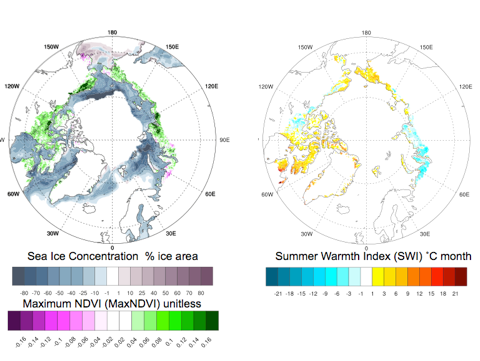
A recent review of research on the response of plants, marine life and animals to declining sea ice in the Arctic found that sea ice decline and warming trends are changing the vegetation in nearby arctic coastal areas.