The expansion of the universe should slow as time marches on, some even conjectured it would slow and then collapse again - that's what all that mass and its gravity in the universe should do.
But Hubble showed us distant supernovae in the 1990s and researchers realized the universe had actually been expanding slower in the past, not faster - and that was a pickle for current theory. So researchers hypothesized Einstein's theory of gravity and a cosmological constant might account for it, or some strange kind of energy-fluid filled space or Einstein's theory of gravity was wrong and a new one including some kind of field creates cosmic acceleration. No one knew what it was, but they called this mystery Dark Energy.
Protein folding is where the coiled strings of amino acids that make up proteins in all living things fold into more complex three-dimensional structures. Incorrectly folded proteins in humans result in such diseases as Alzheimer's, Parkinson's, Huntington's, emphysema and cystic fibrosis, so developing better modeling techniques for protein folding is a good strategy to assist in creating more effective pharmaceutical treatments for such diseases.
By understanding how proteins fold, and what structures they are likely to assume in final form, researchers are then able to move closer to predicting their function.
It is generally accepted that pathological violence is a combination of factors, both biological and psychological, but brain studies of violent criminals haven't revealed much.
However, a new brain imaging study suggests that men with a history of violent behavior may have greater gray matter volume in certain brain areas, whereas men with a history of substance use disorders may have reduced gray matter volume in other brain areas.
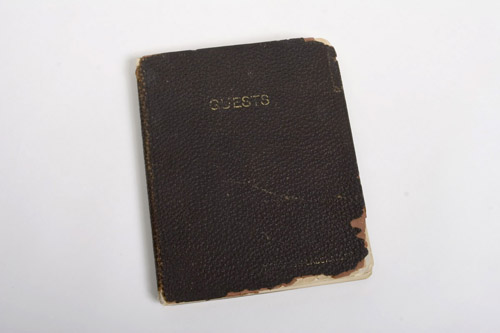
What do Ivan Pavlov, Guglielmo Marconi and Thomas Edison all have in common? Not much, you might think - but after the creation of General Electric’s first Global Research Laboratory in the barn behind Chief Engineer Charles Steinmetz’s house in Schenectady, NY, numerous top scientists began to visit to see what GE was working on next.
MIT Chemistry professor Wilis Whitney was hired as the Global Research Laboratory's first director and each famous mind that visited would stop to sign the VIP guest book, which he kept at that desk from 1914 to 1935. The signatures are a veritable Who’s Who of inventors, physicists, chemists, physiologists, and businessmen of the period.
The creation, trapping and storage of antihydrogen atoms for up to 1,000 seconds not only represents the longest time period so far that antihydrogen has been captured, but it also brings us closer to answering the question, do matter and antimatter obey the same laws of physics?
Antimatter particles are routinely produced in particle accelerators as well as in space, but holding onto them, particularly the neutral ones, is difficult because antimatter and matter will annihilate on contact and conventional containers are made of matter.
Preliminary data from DNA sequencing performed in cooperation with the University Hospital Muenster, Germany, on the Ion Personal Genome Machine (PGM) strongly suggests that the bacterium at the root of the deadly outbreak in Germany is a new hybrid type of pathogenic E. coli strains.


 Ousiometrics Analysis Says All Human Language Is Biased
  Wavelengths Of Light Are Why CO2 Cools The Upper Atmosphere But Warms Earth
 Here's Where Your Backyard Was 300 Million Years Ago
 Convergent Evolution Cheat Sheet Now 120 Million Years Old