Banner
Pilot Study: Fibromyalgia Fatigue Improved By TENS Therapy

Fibromyalgia is the term for a poorly-understood condition where people experience pain and fatigue...

High Meat Consumption Linked To Lower Dementia Risk

Older people who eat large amounts of meat have a lower risk of dementia and cognitive decline...

Long Before The Inca Colonized Peru, Natives Had A Thriving Trade Network

A new DNA analysis reveals that long before the Incan Empire took over Peru, animals were...

Mesolithic People Had Meals With More Tradition Than You Thought

The common imagery of prehistoric people is either rooting through dirt for grubs and picking berries...

User picture.
News StaffRSS Feed of this column.

News Releases From All Over The World, Right To You... Read More »

Blogroll
Exercise of all kinds is known to be beneficial to bone health but there is reluctance to use high intensity programs in older women with low bone mass because of concerns about increased risk of fracture or other injury. 

Yet high intensity doesn't need to be prolonged, according to a new study in the Journal of Bone and Mineral Research which found that even 30 minutes twice a week of high intensity resistance and impact training improved functional performance and bone density, structure, and strength in postmenopausal women with low bone mass (T-score < –1.0), without adverse effects.
The realization that livestock like cows are ruminants - and produce a lot of methane while chewing - was a real boon to vegetarian activists because they got to say curbing meat would mean less global warming.

Methane has 23X the warming power of the more popular CO2 in climate change estimates but it drastically shorter in duration. Still, that is enough. When natural gas caused American CO2 emissions from energy to plummet back to early 1990s levels, solar and wind lobbyists and their environmental allies claimed that methane, which they had endorses as an alternative to coal for decades, was suddenly a crisis.

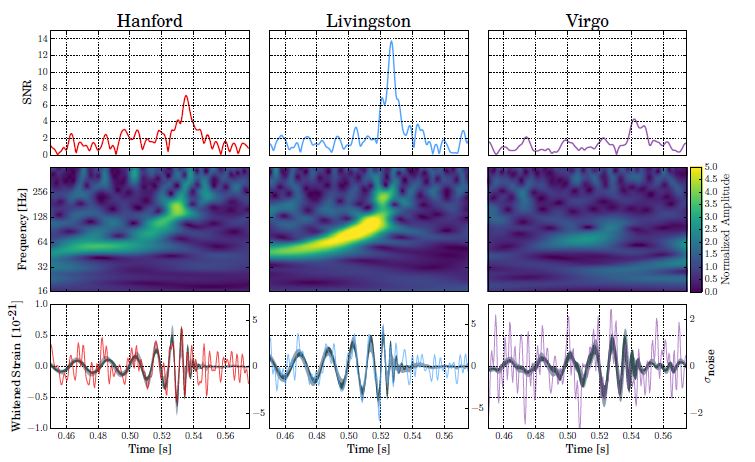
Three detectors tracking gravitational waves emitted by a merger of two black holes have brought science a little closer to locating a gravitational wave's birthplace in space. 

Gravitational waves are ripples in space and time created when two massive, compact objects such as black holes merge. The new detections were made on August 14, 2017 by two gravitational-wave detectors in the United States - Hanford and Livingston at the Laser Interferometer Gravitational-Wave Observatory (LIGO), operated by Caltech and MIT - and by the Virgo Gravitational-Wave Observatory in Italy. This marks the fourth detection of a binary black-hole system.

In the wake of Hurricanes Harvey and Irma, many claims have been made that science denial, particularly as it relates to climate change, is primarily a problem of the political right.

But what happens when scientific conclusions challenge liberals’ attitudes on public policy issues, such as gun control, nuclear power or immigration?

A new paper claims that guns are only involved in 5 percent of suicide attempts but are 50 percent of suicide deaths. Despite everyone claiming to want to be data-driven about gun deaths, few are and this is no exception.  

Although 29 states and the District of Columbia allow marijuana use for medical purposes, there is no evidence it is medicine. Obviously some of the reason for that is because it's illegal and therefore hard to study, but regardless of the past it seems odd that scholars at Washington University School of Medicine in St. Louis surveyed medical school deans, residents and fellows, and examined a curriculum database maintained by the Association of American Medical Colleges (AAMC), and lament that medical marijuana is not being addressed in medical education.