Banner
Pilot Study: Fibromyalgia Fatigue Improved By TENS Therapy

Fibromyalgia is the term for a poorly-understood condition where people experience pain and fatigue...

High Meat Consumption Linked To Lower Dementia Risk

Older people who eat large amounts of meat have a lower risk of dementia and cognitive decline...

Long Before The Inca Colonized Peru, Natives Had A Thriving Trade Network

A new DNA analysis reveals that long before the Incan Empire took over Peru, animals were...

Mesolithic People Had Meals With More Tradition Than You Thought

The common imagery of prehistoric people is either rooting through dirt for grubs and picking berries...

User picture.
News StaffRSS Feed of this column.

News Releases From All Over The World, Right To You... Read More »

Blogroll

University of Utah physicists developed small devices that turn heat into sound and then into electricity. The technology holds promise for changing waste heat into electricity, harnessing solar energy and cooling computers and radars.

"We are converting waste heat to electricity in an efficient, simple way by using sound," says Orest Symko, a University of Utah physics professor who leads the effort. "It is a new source of renewable energy from waste heat."


University of Utah physicist Orest Symko holds a match to a small heat engine that produces a high-pitched tone by converting heat into sound.

Southeastern Brazil, South America’s largest and most populous country, is highlighted in this 26 May 2007 Envisat image.

Brazil consists of one federal district and twenty-six states, four of which comprise the southeastern region – Rio de Janeiro, Minas Gerais, Sao Paolo (all visible) and Espirito Santo.


CLICK ABOVE FOR HIGH RES. Credits: ESA

The huge potential of agricultural soils to reduce greenhouse gases and increase production at the same time has been reinforced by new research findings at NSW Department of Primary Industries' (DPI) Wollongbar Agricultural Institute.

Trials of agrichar - a product hailed as a saviour of Australia's carbon-depleted soils and the environment - have doubled and, in one case, tripled crop growth when applied at the rate of 10 tonnes per hectare.

Albert Einstein’s theory of general relativity has fascinated physicists and generated debate about the origin of the universe and the structure of objects like black holes and complex stars called quasars. A major focus has been on confirming the existence of the gravitomagnetic field, as well as gravitational waves.

A physicist at the University of Missouri-Columbia recently argued in a paper that the interpretation of the results of Lunar Laser Ranging (LLR), which is being used to detect the gravitomagnetic field, is incorrect because LLR is not currently sensitive to gravitomagnetism and not effective in measuring it.

The discovery of how some abnormal cells can avoid a biochemical program of self-destruction by increasing their energy level and repairing the damage, is giving investigators at St. Jude Children's Research Hospital insights into a key strategy cancer cells use to survive and thrive.

The finding offers an explanation of how abnormal cells that have cheated death once by disabling the main suicide pathway called apoptosis can also foil a backup self-destruct program, which allows them to survive and become cancerous.

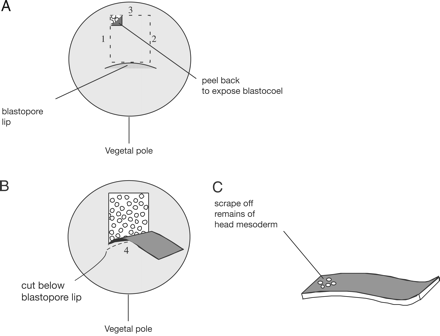
The basic Keller explant is a rectangle of dorsal mesendoderm and ectoderm from an early-gastrula-stage Xenopus laevis embryo. It is ~60° to 90° wide, extending from the bottle cells to the animal pole. This protocol describes how to dissect, assemble, and cultivate Keller explants. The purpose of Keller explants was initially to allow observation of gastrulation movements, particularly convergent extension, in culture. This is difficult to do when explants curl up, but in Keller sandwiches, the explants are cultured flat, either as a single sheet (open-face explant) or more frequently as two sheets sandwiched together with their inner surfaces apposed (closed sandwich).