Banner
Pilot Study: Fibromyalgia Fatigue Improved By TENS Therapy

Fibromyalgia is the term for a poorly-understood condition where people experience pain and fatigue...

High Meat Consumption Linked To Lower Dementia Risk

Older people who eat large amounts of meat have a lower risk of dementia and cognitive decline...

Long Before The Inca Colonized Peru, Natives Had A Thriving Trade Network

A new DNA analysis reveals that long before the Incan Empire took over Peru, animals were...

Mesolithic People Had Meals With More Tradition Than You Thought

The common imagery of prehistoric people is either rooting through dirt for grubs and picking berries...

User picture.
News StaffRSS Feed of this column.

News Releases From All Over The World, Right To You... Read More »

Blogroll

Colgate anthropology professor Allan Maca and a team of researchers have found a previously unknown tomb in Copán, Honduras, dating back to the 7th century A.D. that contained the skeleton of an elite member of ancient Maya society in the city.

The unusual characteristics of the tomb’s construction, the human remains, and the artifacts found near the body, according to Maca, paint a picture of an urban state that was more politically complex and culturally diverse than was previously thought.

A team of biomedical engineers has developed a computer model that makes use of more or less predictable “guesstimates” of human muscle movements to explain how the brain draws on both what it recently learned and what it’s known for some time to anticipate what it needs to develop new motor skills.

The engineers exploited the fact that all people show similar “probable” learning patterns and use them to develop and fine tune new movements, whether babies trying to walk or stroke patients re-connecting brain-body muscle links.

Researchers at the University of California, Santa Cruz, have performed atomic spectroscopy with integrated optics on a chip for the first time, guiding a beam of light through a rubidium vapor cell integrated into a semiconductor chip.

Based on the interactions of light and matter, spectroscopy is often used to identify substances by the wavelengths of light they absorb or emit. Conventional systems have many large components, whereas the compact, fully planar device developed at UCSC enables the study of atoms and molecules on a chip-based platform with integrated optics, said Holger Schmidt, associate professor of electrical engineering.

New charcoal and plant microfossil evidence from Mexico’s Central Balsas valley links a pivotal cultural shift, crop domestication in the New World, to local and regional environmental history. Agriculture in the Balsas valley originated and diversified during the warm, wet, postglacial period following the much cooler and drier climate in the final phases of the last ice age.

A significant dry period appears to have occurred at the same time as the major dry episode associated with the collapse of Mayan civilization, Smithsonian researchers and colleagues report.

Designing the first fuel-cell manned intercity aircraft is the goal of a recently launched EU-funded project.

The Environmentally Friendly Inter City Aircraft powered by Fuel Cells (ENFICA-FC) project is receiving €2.9 million from the EU as part of the aeronautics and space priority of the Sixth Framework Programme (FP6).

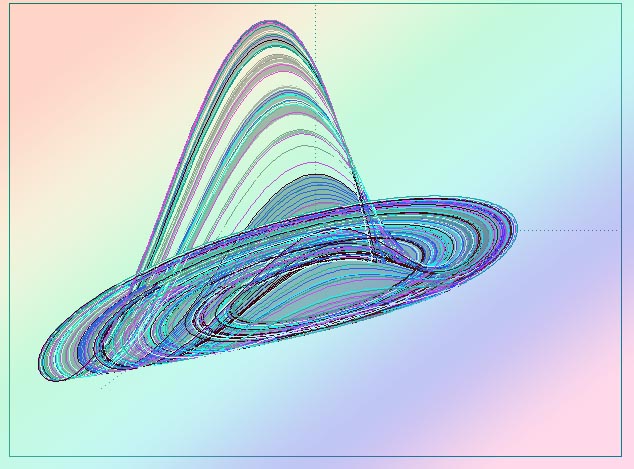
Belgian mathematician hopes to use the science of chaos, the butterfly effect and strange attractors to help build a complete model of climate and resources that will lead to a new approach to sustainable development. Jacques Nihoul of the department of Model Environment at the University of Liège, in Belgium, writing in the inaugural issue of the International Journal of Computing Science and Mathematics published by Inderscience, explains how a new approach to sustainable development and climate change could emerge from his research.


Chaos pattern. Credit: urbanhonking.com