Banner
Pilot Study: Fibromyalgia Fatigue Improved By TENS Therapy

Fibromyalgia is the term for a poorly-understood condition where people experience pain and fatigue...

High Meat Consumption Linked To Lower Dementia Risk

Older people who eat large amounts of meat have a lower risk of dementia and cognitive decline...

Long Before The Inca Colonized Peru, Natives Had A Thriving Trade Network

A new DNA analysis reveals that long before the Incan Empire took over Peru, animals were...

Mesolithic People Had Meals With More Tradition Than You Thought

The common imagery of prehistoric people is either rooting through dirt for grubs and picking berries...

User picture.
News StaffRSS Feed of this column.

News Releases From All Over The World, Right To You... Read More »

Blogroll

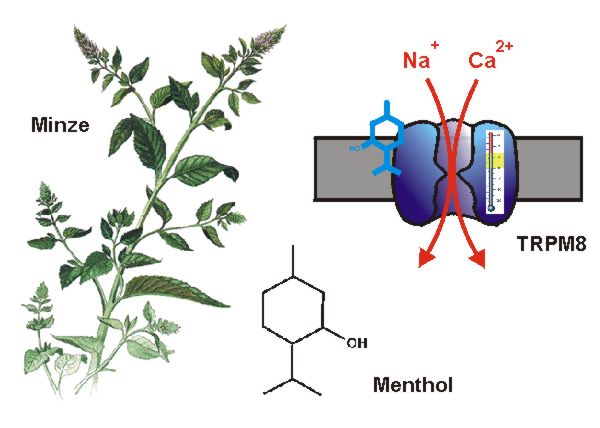
Scientists have identified the receptor in cells of the peripheral nervous system that is most responsible for the body's ability to sense cold.

The findings reveal one of the key mechanisms by which the body detects temperature sensation. But in so doing it also illuminates a mechanism that mediates how the body experiences intense stimuli – temperature, in this case – that can cause pain.


Menthol and TRPM8

Animals differ strikingly in character and temperament. Yet only recently has it become evident that personalities are a widespread phenomenon in the animal kingdom. Animals as diverse as spiders, mice and squids appear to have personalities. Personality differences have been described in more than 60 species, including primates, rodents, birds, fish, insects and mollusks.

New work by Max Wolf (University of Groningen; currently at the Santa Fe Institute), Santa Fe Institute Postdoctoral Fellow Sander van Doorn, Franz Weissing (University of Groningen), and Olof Leimar (Stockholm University) offers an explanation for the evolution of animal personalities.

Huge waves that struck Reunion Island and coastlines across Indonesia earlier this month all originated from the same storm that occurred south of Cape Town, South Africa, and were tracked across the entire Indian Ocean for some 10 000 kilometres over a nine-day period by ESA's Envisat satellite.


Picture taken on 14 May 2007 in Saint-Leu, on the French Indian Ocean island of Reunion, of a giant wave breaking on the coast. Credits: AFP

It seems almost certain that San Francisco Giants slugger Barry Bonds will pass Hank Aaron as baseball’s all-time home-run king sometime this summer, but his pursuit has generated little public interest.

There may be several reasons for this, ranging from Bonds’ prickly personality to the suspicion that he may have used performance-enhancing drugs later in his career, say two Duke University professors.

Courtesy Orange County Register

You might think it's something from the movie "Total Recall" but instead researchers are using brain "pacemakers" to regulate diseased signals in the brains of Parkinson's disease patients.

These devices are FDA-approved and in use in 30,000 patients but still not well understood.

Biomedical engineers at Duke University's Pratt School of Engineering have found that stimulation administered by rapid-fire electrical pulses deep in the brain produces what they call an "informational lesion." By relaying a repetitious and therefore meaningless message, constant pulses overwhelm the erratic bursts of brain activity characteristic of disease.

"Periodic bursts in the brains of people with tremor -- which might follow a pattern such as 'pop-pop-pop, silence, pop-pop-pop, silence' -- propa

How well do you know your child's pediatrician? Is he or she board certified in pediatrics, or has he or she ever completed specialty training in the field?

Findings from a new study from the University of Michigan C.S. Mott Children's Hospital's Child Health Evaluation and Research (CHEAR) Unit may prompt parents to find out if their child's physician really is who he claims to be – a board-certified and specialty-trained pediatrician.