Banner
Pilot Study: Fibromyalgia Fatigue Improved By TENS Therapy

Fibromyalgia is the term for a poorly-understood condition where people experience pain and fatigue...

High Meat Consumption Linked To Lower Dementia Risk

Older people who eat large amounts of meat have a lower risk of dementia and cognitive decline...

Long Before The Inca Colonized Peru, Natives Had A Thriving Trade Network

A new DNA analysis reveals that long before the Incan Empire took over Peru, animals were...

Mesolithic People Had Meals With More Tradition Than You Thought

The common imagery of prehistoric people is either rooting through dirt for grubs and picking berries...

User picture.
News StaffRSS Feed of this column.

News Releases From All Over The World, Right To You... Read More »

Blogroll

In the May 1st issue of Genes & Development, Drs. Yong Sun Lee and Anindya Dutta (UVA) reveal that microRNAs can function as tumor suppressors in vitro.

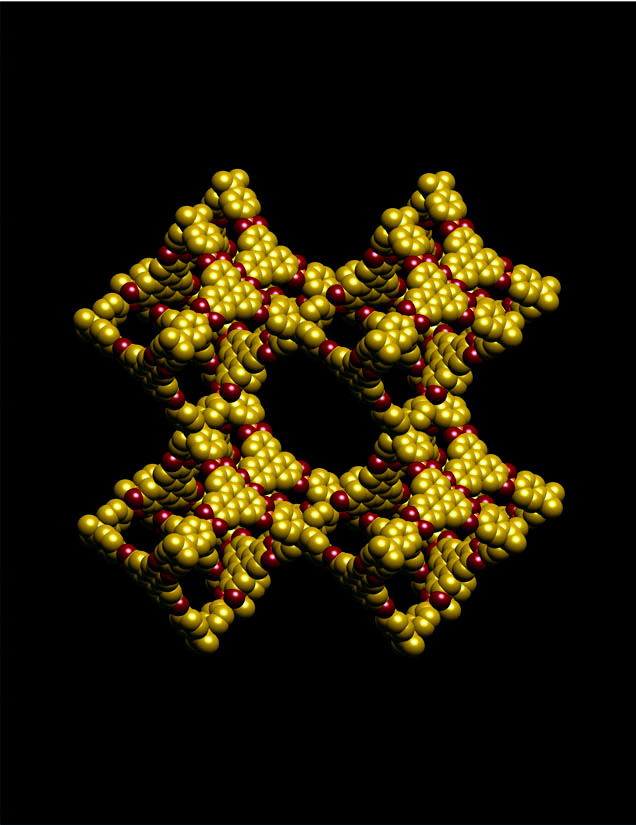
Chemists at UCLA have designed new organic structures for the storage of voluminous amounts of gases for use in alternative energy technologies.

The research, to be published on April 13 in the journal Science, demonstrates how the design principles of reticular chemistry have been used to create three-dimensional covalent organic frameworks, which are entirely constructed from strong covalent bonds and have high thermal stability, high surface areas and extremely low densities.


The image shows the crystal structure of COF-108. Synthesized only from light elements (H,B,C,O) COF-108 is the lowest-density crystal ever produced (0.17 g/cubic cm). (Credit: José L. Mendoza-Cortés)

Scientists have found one of the largest fields of seafloor vents gushing super-hot, mineral-rich fluids on a mid-ocean ridge that, until now, remained elusive to the ten-year hunt to find them.

"The discovery of the first active vents ever found on an ultraslow-spreading ridge is a significant milestone event," said Jian Lin, leader of a team of Woods Hole Oceanographic Institution (WHOI) scientists who participated in a Chinese expedition to the remote Southwest Indian Ridge in the Indian Ocean in February and March.

This week in Science, Yale researchers present “roadmaps” showing that shared protons, a common loose link between two biological molecules, simply vibrate between the molecules as a local oscillator, rather than intimately entangling with the molecular vibrations of the attached molecules.

Led by Professor Mark A. Johnson in the Department of Chemistry, the new data reveal distinct, isolated vibrational patterns, solely associated with the bridging proton, that change dramatically according to the chemical properties of the tethered molecules.


Two oxygen atoms on different molecules are connected by their mutual attraction to an extra proton, shown as a fuzzy ball between them.

A drug under study to treat various cancers selectively kills cancer cells because of its affinity for a modified version of a critical heat shock protein they contain, researchers have found.

They found in cancer a modified version of heat shock protein 90, or hsp90, which like most heat shock proteins, promotes cell survival.

Research by Renee Theiss, Jason Kuo and C J Heckman, which has just been published in The Journal of Physiology, throws light on how information is processed in the Central Nervous System (CNS) to drive movement. The findings are relevant to understanding mechanisms underlying movement and disorders such as spinal cord injury and motor neurone disease (ALS).