Banner
Pilot Study: Fibromyalgia Fatigue Improved By TENS Therapy

Fibromyalgia is the term for a poorly-understood condition where people experience pain and fatigue...

High Meat Consumption Linked To Lower Dementia Risk

Older people who eat large amounts of meat have a lower risk of dementia and cognitive decline...

Long Before The Inca Colonized Peru, Natives Had A Thriving Trade Network

A new DNA analysis reveals that long before the Incan Empire took over Peru, animals were...

Mesolithic People Had Meals With More Tradition Than You Thought

The common imagery of prehistoric people is either rooting through dirt for grubs and picking berries...

User picture.
News StaffRSS Feed of this column.

News Releases From All Over The World, Right To You... Read More »

Blogroll

Flavonoids. You’ve heard of them -- the good-for-your-health compounds found in plants that we enjoy in red wine, dark chocolate, green tea and citrus fruits. Mother Nature is an ace at making them, producing different ones by the thousands, but no chemist has figured out a good way to synthesize a special class of these chemicals in the laboratory. Until now.

Karl Scheidt, assistant professor of chemistry in the Weinberg College of Arts and Sciences at Northwestern University, and his research team have synthesized 10 different flavanones, a type of flavonoid, using a new general method they developed that takes advantage of one simple catalyst.

There is broad consensus today that personality traits are best described by the "Big Five": Extraversion, agreeableness, conscientiousness, emotional stability, and openness to experience. Each of these broad measures can be broken down into smaller ones, but in general, this taxonomy appears to take in most of what we think of as personhood. When you think of someone as "steady" or "flaky" or "gloomy" or "daring," what you’re really doing is unconsciously taking a measure of these five traits and crunching them together.

Common practice in the treatment of adolescent eating disorder patients has been to exclude the parents. Many experts consider parents part of the problem and thus keep them away during therapy.

Two U.S.–based clinicians disagree and have written a "how to" book published in February that includes family in the treatment of these patients. They say parents are well poised to help their children overcome bulimia nervosa, a disorder characterized by binging and purging.

Texas wheat offers high quality when it comes to baking and milling characteristics, said Texas Agricultural Experiment Station's state wheat breeder.

Dr. Jackie Rudd, Experiment Station wheat breeder at Amarillo, received the annual Millers' Award from Tim Aschbrenner of Cereal Food Processors at the recent Wheat Quality Council annual meeting in Kansas City.

Oceanographers have completed an important step in constructing the first deep-sea observatory off the continental United States. Workers in the multi-institution effort laid 32 miles (52 kilometers) of cable along the Monterey Bay sea floor that will provide electrical power to scientific instruments, video cameras, and robots 3,000 feet (900 meters) below the ocean surface. The link will also carry data from the instruments back to shore, for use by scientists and engineers from around the world.


An illustration of the MARS undersea observatory shows its cabled links. Credit: David Fierstein, MBARI

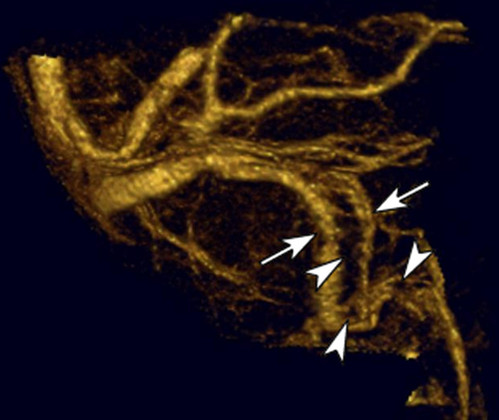
University of Cincinnati (UC) neuroradiologists believe a brain imaging approach that combines standard magnetic resonance imaging (MRI) scans with specialized contrast-enhanced techniques could lead to more effective diagnoses in patients with difficult-to-detect blood clots in veins of the brain.

James Leach, MD, reports these findings in the April issue of the American Journal of Neuroradiology. This is the first study to correlate the clinical importance of data gleaned from standard MRI scans and detailed contrast-enhanced imaging techniques in patients with chronic thrombosis (blood clots) in veins of the brain.