Banner
Pilot Study: Fibromyalgia Fatigue Improved By TENS Therapy

Fibromyalgia is the term for a poorly-understood condition where people experience pain and fatigue...

High Meat Consumption Linked To Lower Dementia Risk

Older people who eat large amounts of meat have a lower risk of dementia and cognitive decline...

Long Before The Inca Colonized Peru, Natives Had A Thriving Trade Network

A new DNA analysis reveals that long before the Incan Empire took over Peru, animals were...

Mesolithic People Had Meals With More Tradition Than You Thought

The common imagery of prehistoric people is either rooting through dirt for grubs and picking berries...

User picture.
News StaffRSS Feed of this column.

News Releases From All Over The World, Right To You... Read More »

Blogroll

A team of researchers from Rensselaer Polytechnic Institute has created the world’s first material that reflects virtually no light. Reporting in the March issue of Nature Photonics, they describe an optical coating made from the material that enables vastly improved control over the basic properties of light. The research could open the door to much brighter LEDs, more efficient solar cells, and a new class of "smart" light sources that adjust to specific environments, among many other potential applications.

Researchers have long said they won't be able to understand the brain until they can put together a "wiring diagram" – a map of how billions of neurons are interconnected. Now, researchers at the Salk Institute for Biological Studies have jumped what many believe to be a major hurdle to preparing that chart: identifying all of the connections to a single neuron.

In the March 1 issue of the journal Neuron, the researchers describe how they modified the deadly rabies virus, turning it into a tool that can cross the synaptic space of a targeted nerve cell just once to identify all the neurons to which it is directly connected.

"We've wanted to do this for a very long time and finally found a way to make it possible," says the study's senior author, Edward M.

Sweat may be another way to pass on hepatitis B infection during contact sports, suggests research published ahead of print in the British Journal of Sports Medicine.

Hepatitis B virus attacks the liver and can cause lifelong infection, cirrhosis (scarring) of the liver, liver cancer, liver failure, and death.

The research team analysed blood and sweat samples from 70 male Olympic wrestlers for evidence of hepatitis B infection (HBV).

The wrestlers, who were all aged between 18 and 30, were all asked about injuries, as blood-borne infection is a common route of transmission.

Over a third said they had had bleeding or weeping wounds during training and competition.

Cardiff University scientists will shortly set sail (March 5) to investigate a startling discovery in the depths of the Atlantic.

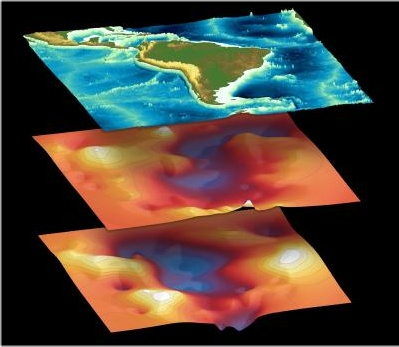
Scientists have discovered a large area thousands of square kilometres in extent in the middle of the Atlantic where the Earth's crust appears to be missing. Instead, the mantle - the deep interior of the Earth, normally covered by crust many kilometres thick - is exposed on the seafloor, 3000m below the surface.

Marine geologist Dr Chris MacLeod, School of Earth, Ocean and Planetary Sciences said: "This discovery is like an open wound on the surface of the Earth. Was the crust never there? Was it once there but then torn away on huge geological faults?

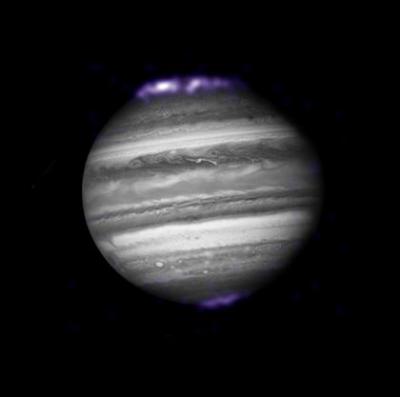
On February 28, 2007, NASA's New Horizons spacecraft made its closest approach to Jupiter on its ultimate journey to Pluto. This flyby gave scientists a unique opportunity to study Jupiter using the package of instruments available on New Horizons, while coordinating observations from both space- and ground-based telescopes including NASA's Chandra X-ray Observatory.


In preparation for New Horizon's approach of Jupiter, Chandra took 5-hour exposures of Jupiter on Feb. 8, 10 and 24. In this new composite image, data from those separate Chandra's observations were combined, and then superimposed on the latest image of Jupiter from the Hubble Space Telescope.

Scientists at North Carolina State University have discovered that the fungus-like pathogen that caused the 1840s Irish potato famine originally came from the Andes of South America.

By comparing the sequences of both the nuclear and the cellular powerhouse, mitochondria, of nearly 100 pathogen samples from South America, Central America, North America and Europe, Dr.