Banner
Pilot Study: Fibromyalgia Fatigue Improved By TENS Therapy

Fibromyalgia is the term for a poorly-understood condition where people experience pain and fatigue...

High Meat Consumption Linked To Lower Dementia Risk

Older people who eat large amounts of meat have a lower risk of dementia and cognitive decline...

Long Before The Inca Colonized Peru, Natives Had A Thriving Trade Network

A new DNA analysis reveals that long before the Incan Empire took over Peru, animals were...

Mesolithic People Had Meals With More Tradition Than You Thought

The common imagery of prehistoric people is either rooting through dirt for grubs and picking berries...

User picture.
News StaffRSS Feed of this column.

News Releases From All Over The World, Right To You... Read More »

Blogroll

RICHLAND, Wash. - Nature's figured it out already, how to best break down food into fuel. Now scientists have caught up, showing that fungi found in the guts of goats, horses and sheep could help fill up your gas tank too.

The researchers report in the journal Science on Feb. 18 that these anaerobic gut fungi perform as well as the best fungi engineered by industry in their ability to convert plant material into sugars that are easily transformed into fuel and other products.

"Nature has engineered these fungi to have what seems to be the world's largest repertoire of enzymes that break down biomass," said Michelle O'Malley, lead author and professor of chemical engineering at the University of California, Santa Barbara.

The mitochondrion isn't the bacterium it was in its prime, say two billion years ago. Since getting consumed by our common single-celled ancestor the "energy powerhouse" organelle has lost most of its 2,000+ genes, likely to the nucleus. There are still a handful left--depending on the organism--but the question is why. One explanation, say a mathematician and biologist who analyzed gene loss in mitochondria over evolutionary time, is that mitochondrial DNA is too important to encode inside the nucleus and has thus evolved to resist the damaging environment inside of the mitochondrion. Their study appears February 18 in Cell Systems.

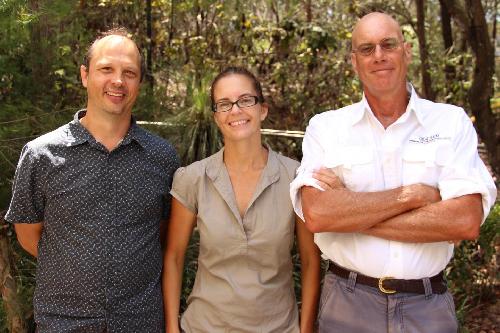
Ecotourism can provide the critical difference between survival and extinction for endangered animals, according to new research from Australia's Griffith University.

Using population viability modelling, the Griffith team of Professor Ralf Buckley, Dr Guy Castley and Dr Clare Morrison have developed a method that for the first time quantifies the impact of ecotourism on threatened species.

Their findings are published in the journal PLOS ONE.

pic

Griffith University researchers, from left, are Dr Guy Castley, Dr Clare Morrison and Professor Ralf Buckley. Credit: Griffith University

Imagine living on a world where, every 69 years, the sun disappears in a near-total eclipse that lasts for three and a half years.

That is just what happens in an unnamed binary star system nearly 10,000 light years from Earth. The newly discovered system, known only by its astronomical catalog number TYC 2505-672-1, sets a new record for both the longest duration stellar eclipse and the longest period between eclipses in a binary system.

When Ebola hysteria broke out in the United States in 2014, mainstream media got a little crazy. While one person was afflicted, 28,000 people got heart disease with far less fanfare. Meanwhile, the National Institutes of Health engaged in political theater and claimed it couldn't work on Ebola because they lacked the budget. Science 2.0 noted that they had gotten $300 billion while one tiny company strugged to get money for clinical trials - and it's only help was from the Defense Threat Reduction Agency, rather than the NIH. Nonetheless, Congress gave the NIH more money.

While there is speculation and numerical estimates about what might happen to Antarctica's nation-sized Ross Ice Shelf in a warming climate,  oceanographers have a good idea of what happened to a 100,000-square-mile section within 1,500 years after the last Ice Age ended. 

The Ross Ice Shelf is a vast floating extension of the West Antarctic Ice Sheet, about the size of France,  and the world's largest ice shelf. But it was once much larger, extending farther north and covering the entire Ross Sea.  The present Ross Ice Shelf is about 500 miles wide and several hundred feet thick. Because the ice shelf is already floating, its breakup and melting would not pose a risk of raising global sea level.