




Some of that is economics. A subsidy prevents innovation because it props up the status quo, and environmentalists and the politicians they support remain opposed to nuclear power, but some is plain physics. Lithium-ion batteries are stuck in the 1990s because there are real challenges to be overcome in the next generation.
Solid metal batteries are battery in nearly every way than lithium but the physics hurdle is so crippling even US Senator Bernie Sanders hasn't tried to claim they are better than natural gas - they form cracks, and those cracks cause short-circuits. That is why Lithium-ion became the default over solid-state. Lithium metal as an anode and a solid electrolyte is superior in every way to Lithium-ion except the practical.
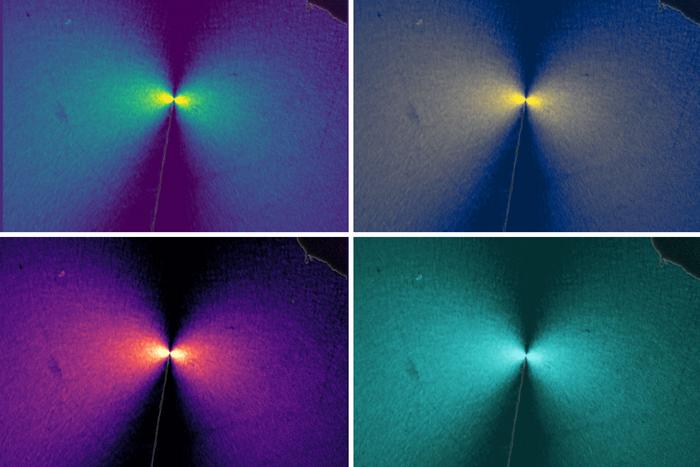
Four graphs of dendrite cryogenic scanning transmission electron microscopy with different color schemes. Brighter colors correspond to higher stress.A bowtie-shaped pattern can be seen at the crack tip. Courtesy of Cole Fincher and Yet-Ming Chiang
'Prevent cracks' sounds simple enough except it is unclear how they occur. They form at levels far below what mechanical stress should create. Instead, a new study using cryogenic scanning transmission electron microscopy found it is chemicalm and resulting from high electrical currents. High electrical current is the one absolute a battery needs. Real-world use is often different from a lab, that is why government economists are concerned about the high degradation rate of '30-year' solar panels at 12 years, and understanding why in practical usage a battery fails is the only way to solve the problem.
Citation: Cole D. Fincher, Colin Gilgenbach, Christian Roach, Rachel Osmundsen, Aubrey Penn, Michael D. Thouless, W. Craig Carter, Brian W. Sheldon, James M. LeBeau, Yet-Ming Chiang, 'Electrochemical corrosion accompanies dendrite growth in solid electrolytes', Nature (2026), https://www.nature.com/articles/s41586-026-10279-z



Comments