Banner
Pilot Study: Fibromyalgia Fatigue Improved By TENS Therapy

Fibromyalgia is the term for a poorly-understood condition where people experience pain and fatigue...

High Meat Consumption Linked To Lower Dementia Risk

Older people who eat large amounts of meat have a lower risk of dementia and cognitive decline...

Long Before The Inca Colonized Peru, Natives Had A Thriving Trade Network

A new DNA analysis reveals that long before the Incan Empire took over Peru, animals were...

Mesolithic People Had Meals With More Tradition Than You Thought

The common imagery of prehistoric people is either rooting through dirt for grubs and picking berries...

User picture.
News StaffRSS Feed of this column.

News Releases From All Over The World, Right To You... Read More »

Blogroll

The expert report underpinning the latest dietary guidelines for Americans fails to reflect much relevant scientific literature in its reviews of crucial topics and therefore risks giving a misleading picture.

Concern about the report has prompted the US Congress to schedule a hearing on the guidelines in October, when two cabinet secretaries are scheduled to testify, writes journalist Nina Teicholz in an article published today.

At a Chevron oil refinery in Hawaii, researchers are growing microalgae in a 5,000-liter photobioreactor, flowing wastewater from the refinery through the reactor, and taking advantage of the algae's appetite for chemical nutrients to polish the water, removing noxious chemicals, including 90% of the ammonia-nitrogen and 97% of the phosphorus.

As the microbes feed, they grow and multiply, providing a wealth of algae-based biomass for producing bioenergy and high-value biobased chemicals and specialty products, as described the article "Algae-Mediated Valorization of Industrial Waste Streams" in Industrial Biotechnology.

As much as 47 percent of the edible U.S. seafood supply is lost each year, mainly from consumer waste, according to a paper in Global Environmental Change, which takes advantage of a recent spotlight on the sustainability of the world's seafood resources.

 The 2010 U.S. Dietary Guidelines recommended increasing seafood consumption to eight ounces per person per week and consuming a variety of seafood in place of some meat and poultry. Yet achieving those levels would require doubling the U.S. seafood supply, which could threaten the global seafood supply if more farming and less waste are not considered.

Climate-related changes in flower diversity have resulted in a decrease in the length of alpine bumble bees' tongues, a new paper in Science says, leaving these insects poorly suited to feed from and pollinate the deep flowers they were adapted to previously.

The results highlight how certain mutually beneficial ecological partnerships can be lost due to shifts in climate. Many co-evolved species have precisely matched traits; for example, long-tongued bumble bees are well adapted for obtaining nectar from deep flowers with long corolla tubes. Recent studies suggest long-tongued bumble bees are declining in number.

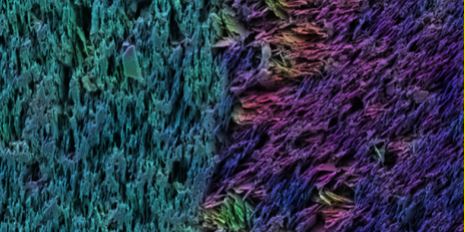
Teeth and seashells are among the stronger, more durable things in nature. The secret of these materials lies in their unique fine structure: they are composed of different layers in which numerous micro-platelets are joined together, aligned in identical orientation in each layer.

A proof-of-concept study finds that it is possible to identify an individual's ancestral background based on his or her fingerprint characteristics - a discovery with significant applications for law enforcement and anthropological research.

"This is the first study to look at this issue at this level of detail, and the findings are extremely promising," says Ann Ross, a professor of anthropology at North Carolina State University and senior author of a paper describing the work. "But more work needs to be done. We need to look at a much larger sample size and evaluate individuals from more diverse ancestral backgrounds."