Banner
Pilot Study: Fibromyalgia Fatigue Improved By TENS Therapy

Fibromyalgia is the term for a poorly-understood condition where people experience pain and fatigue...

High Meat Consumption Linked To Lower Dementia Risk

Older people who eat large amounts of meat have a lower risk of dementia and cognitive decline...

Long Before The Inca Colonized Peru, Natives Had A Thriving Trade Network

A new DNA analysis reveals that long before the Incan Empire took over Peru, animals were...

Mesolithic People Had Meals With More Tradition Than You Thought

The common imagery of prehistoric people is either rooting through dirt for grubs and picking berries...

User picture.
News StaffRSS Feed of this column.

News Releases From All Over The World, Right To You... Read More »

Blogroll

Research published recently in Science as Culture suggests that men are surprisingly positive and open to the concept of having cancer-detecting biosensors implanted within their bodies – effectively making them cyborgs.

Such auto biotechnologies can aid in the treatment or repair of tissue and organs without external human direction or control. They represent version 2.0 of cyborgs as originally invented by Clynes and Kline in the early 1960’s, referred to as the bodily adaptations required by individuals to live in outer space. Since then, science and technology have made giant leaps forward, leading to the innovative concept of ‘everyday cyborgs’, now increasingly forming an integral part of our reality.

We each give off millions of bacteria from our human microbiome to the air around us every day, and that cloud of bacteria can be traced back to an individual. New research focused on the personal microbial cloud -- the airborne microbes we emit into the air -- examined the microbial connection we have with the air around us.

The findings demonstrate the extent to which humans possess a unique 'microbial cloud signature.'

Is the public jaded to Internet marketing campaigns concerning overseas crises?

Astronomers have successfully peered through the 'amniotic sac' of a star that is still forming to observe the innermost region of a burgeoning solar system for the first time.

In a research paper published today in the journal Monthly Notices of the Royal Astronomical Society, an international team of astronomers describe surprising findings in their observations of the parent star, which is called HD 100546.

Lead author Dr Ignacio Mendigutía, from the School of Physics and Astronomy at the University of Leeds, said: "Nobody has ever been able to probe this close to a star that is still forming and which also has at least one planet so close in.

Genetic mutations called "escape variants" in the deadly Ebola virus appear to block the ability of antibody-based treatments to ward off infection, according to a team of U.S. Army scientists and collaborators.

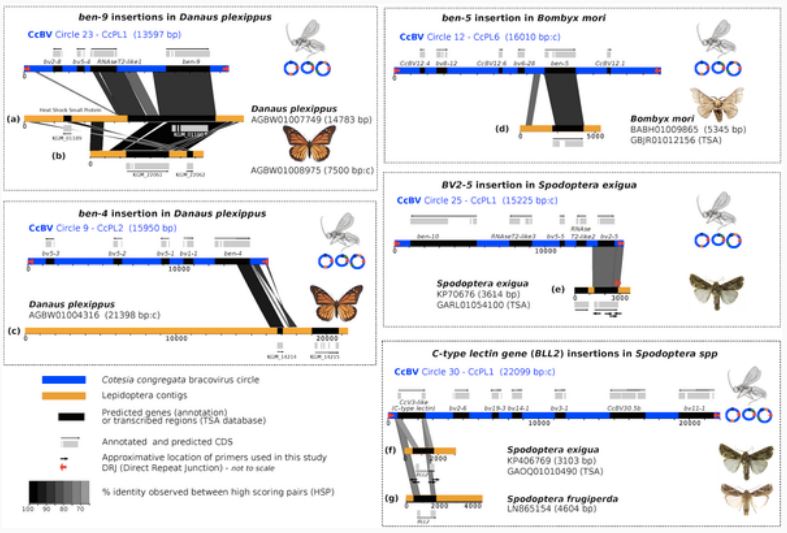
Do monarch butterflies need mandatory labeling? New research proves that the favorite butterfly of anti-science activists is actually a GMO.

Irony or paradox? Maybe both.

In one of the more memorable original Star Trek episodes, Captain Kirk uses a paradox to thwart an android’s attempt to capture the Enterprise. (1) Kirk tells Norman, the malicious robot, that everything Harry says is a lie. Harry then says, “Norman, I am lying.” Norman is unable to process the contradictory statements, causing his circuits to disintegrate: