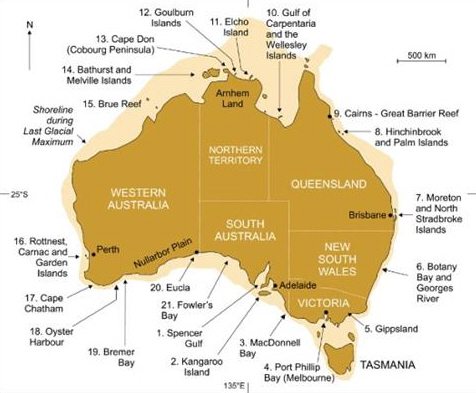
Patrick Nunn, a professor of geography at University of the Sunshine Coast, and collaborator Nick Reid, a University of New England linguist, believe aborigines in Australia have records of Australia's coastline going back 7,000 years - obviously unheard of in any other culture.
Their evidence they must be accurate? The stories are all consistent with one another.
Psychologists know that you can't send a sentence around a room and have it be accurate so the team contends that because the stories are similar, they must be true. “It’s important to note that it’s not just one story that describes this process. There are many stories, all consistent in their narrative, across 21 diverse sites around Australia’s coastline,” says Nunn.
A new paper finds that adolescents have become less likely to approve of and use marijuana over the last decade when compared to young adults. This is coming during a time where a majority of Americans support the full legalization of marijuana, according to a 2013 Gallup poll.
Using survey data collected from the nationally representative National Survey on Drug Use and Health (NSDUH) conducted between 2002 through 2013, the researchers broke the sample into three subgroups based upon age: younger adolescents (aged 12–14), older adolescents (aged 15–17), and young adults (aged 18–25). In breaking the sample into subgroups, distinct trends emerged within each category.
Engineers have developed a new medical device aimed at improving diagnostic procedures for various cancers. The Tadpole Endoscope is like a micro-robot fish with a camera which is swallowed by the patient.
It is different from existing wireless capsule endoscopes by addition of a soft tail that allows it to be guided around the stomach remotely by a doctor, allowing for more comprehensive imaging and accurate location of problems within the body.

For environmental activists who want to use social networks to mobilize the public beyond the retweet, there are three keys to success, according to a paper by scholars ar Universidad Carlos III de Madrid (UC3M) and INGENIO, a joint center of the Universidad Politécnica de Valencia and CSIC.
Targeted cancer treatments, toxicity sensors and living factories: synthetic biology has the potential to revolutionize science and medicine. But before the technology is ready for real-world applications, more attention needs to be paid to its safety and stability, according to a review article.
Synthetic biology involves engineering microbes like bacteria to program them to behave in certain ways. For example, bacteria can be engineered to glow when they detect certain molecules, and can be turned into tiny factories to produce chemicals.
Research has found evidence that spending time in nature provides protections against a startling range of diseases, including depression, diabetes, obesity, ADHD, cardiovascular disease, cancer, and many more. How this exposure to green space leads to better health has remained a mystery.
After reviewing hundreds of studies examining nature’s effects on health, University of Illinois environment and behavior researcher Ming Kuo believes the answer lies in nature’s ability to enhance the functioning of the body’s immune system.


 Pilot Study: Fibromyalgia Fatigue Improved By TENS Therapy
 High Meat Consumption Linked To Lower Dementia Risk
 Long Before The Inca Colonized Peru, Natives Had A Thriving Trade Network
 Mesolithic People Had Meals With More Tradition Than You Thought