Banner
Ousiometrics Analysis Says All Human Language Is Biased

A new tool drawing on billions of uses of more than 20,000 words and diverse real-world texts claims...

Wavelengths Of Light Are Why CO2 Cools The Upper Atmosphere But Warms Earth

There are concerns about projected warming on the Earth’s surface and in the lower atmosphere...

Here's Where Your Backyard Was 300 Million Years Ago

We may use terms like "grounded" and terra firma to mean stability and consistency but geology...

Convergent Evolution Cheat Sheet Now 120 Million Years Old

One tenet of natural selection is a random walk of genes but nature may be more predictable than...

User picture.
News StaffRSS Feed of this column.

News Releases From All Over The World, Right To You... Read More »

Blogroll

Mobile phones are in the hands of 80 percent of Americans so manufacturers are scrambling to find new ways to keep people buying the next model.

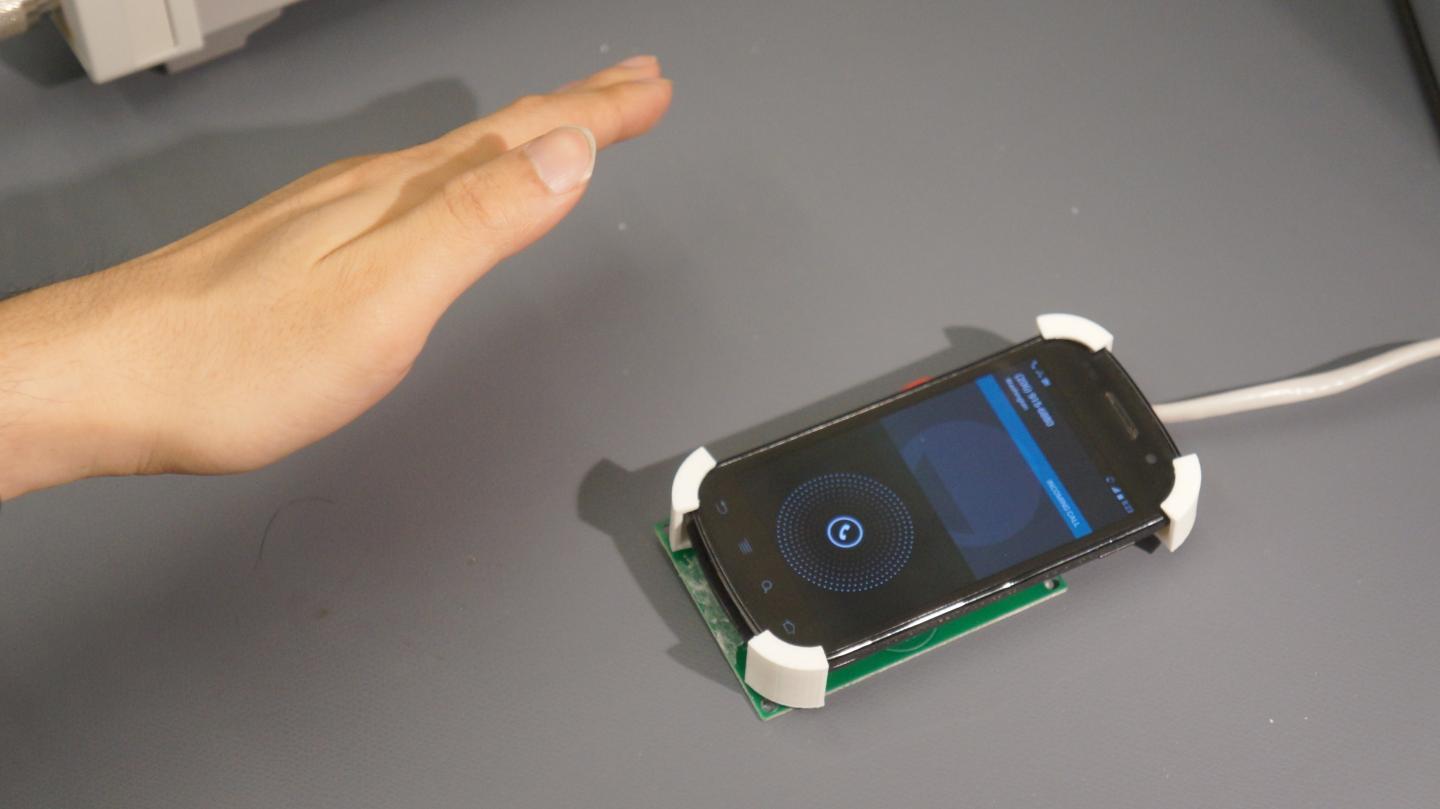
Being able to use gestures in the space around the phone rather than needing a screen may be the next big thing. Some smartphones have incorporated 3-D gesture sensing based on cameras, for example, but cameras consume significant battery power and require a clear view of the user's hands.

University of Washington engineers have developed a new form of low-power wireless sensing technology that could soon contribute to this growing field by letting users "train" their smartphones to recognize and respond to specific hand gestures near the phone.

A longstanding question in science has the role of mitochondria in debilitating and fatal motor neuron diseases.

Mitochondria are organelles – compartments contained inside cells – that serve several functions, including making ATP, a nucleotide that cells convert into chemical energy to stay alive. For this reason mitochondria often are called "cellular power plants." They also play a critical role in preventing too much calcium from building up in cells, which can cause apoptosis, or cell death.

For mitochondria to perform its functions, it must be distributed to cells throughout the body, which is accomplished with the help of small protein "motors" that transport the organelles along axons.

We've all been driving and come upon signs warning us that construction is happening and we have to slow down for the safety of workers and that penalties are going to be doubled. We see billboards with children imploring us to reduce speed because their parents are highway construction employees.

Then it turns out that there is no construction. Speed limit credibility is put to the test by those instances and as a result, people have been routinely ignoring speed limits, according to Dr. Ross Blackman, a scholar at Queensland University of Technology Centre for Accident Research&Road Safety - Queensland, who presented the findings at the Occupational Safety in Transport Conference on the Gold Coast in Australia.

As has been predicted for some time, there is a physics train wreck coming at the semiconductor industry - a size and speed where atoms have reached their limits. Quantum computing has remained a dream for 20 years with little progress, which means chips will have to start getting bigger again, to get better performance - or we settle for playing Angry Birds.

The present size and speed limitations of computer processors and memory could be overcome by replacing silicon with phase-change materials, which are capable of reversibly switching between two structural phases with different electrical states – one crystalline and conducting and the other glassy and insulating – in billionths of a second. 

Circular RNA were discovered a few years ago, but their role in our bodies is poorly understood. 

Our genetic information is stored in DNA, tiny strands of nucleic acid that contain instructions for the functioning of our bodies. To express this genetic data, our DNA is copied into RNA molecules, which then translate the instructions into proteins that perform tasks in our cells. Several years ago, scientists discovered a new type of RNA molecule. Unlike all other known RNAs, this molecule is circular, and was labeled circular RNA.

Referrals for genetic testing more than doubled across the UK after actress Angelina Jolie announced in May that she proactively underwent a double mastectomy due to testing positive for a BRCA1 gene mutation.

The rise in referrals continued through to October, long after the announcement was made, according to findings in Breast Cancer Research.