Banner
Ousiometrics Analysis Says All Human Language Is Biased

A new tool drawing on billions of uses of more than 20,000 words and diverse real-world texts claims...

Wavelengths Of Light Are Why CO2 Cools The Upper Atmosphere But Warms Earth

There are concerns about projected warming on the Earth’s surface and in the lower atmosphere...

Here's Where Your Backyard Was 300 Million Years Ago

We may use terms like "grounded" and terra firma to mean stability and consistency but geology...

Convergent Evolution Cheat Sheet Now 120 Million Years Old

One tenet of natural selection is a random walk of genes but nature may be more predictable than...

User picture.
News StaffRSS Feed of this column.

News Releases From All Over The World, Right To You... Read More »

Blogroll

A person's face is the first thing that others see, and much remains unknown about how it forms — or malforms — during early development. Recently, Chong Pyo Choe, a senior postdoctoral fellow working in the lab of USC stem cell researcher Gage Crump, has begun to unwind these mysteries.

In a September study published in the journal Development, Choe and Crump describe how a mutation in a gene called TBX1 causes the facial and other deformities associated with DiGeorge syndrome.

Carbon dioxide emissions, the greenhouse gas that has been most strongly implicated in global warming, will reach a record high of 40 billion tons.

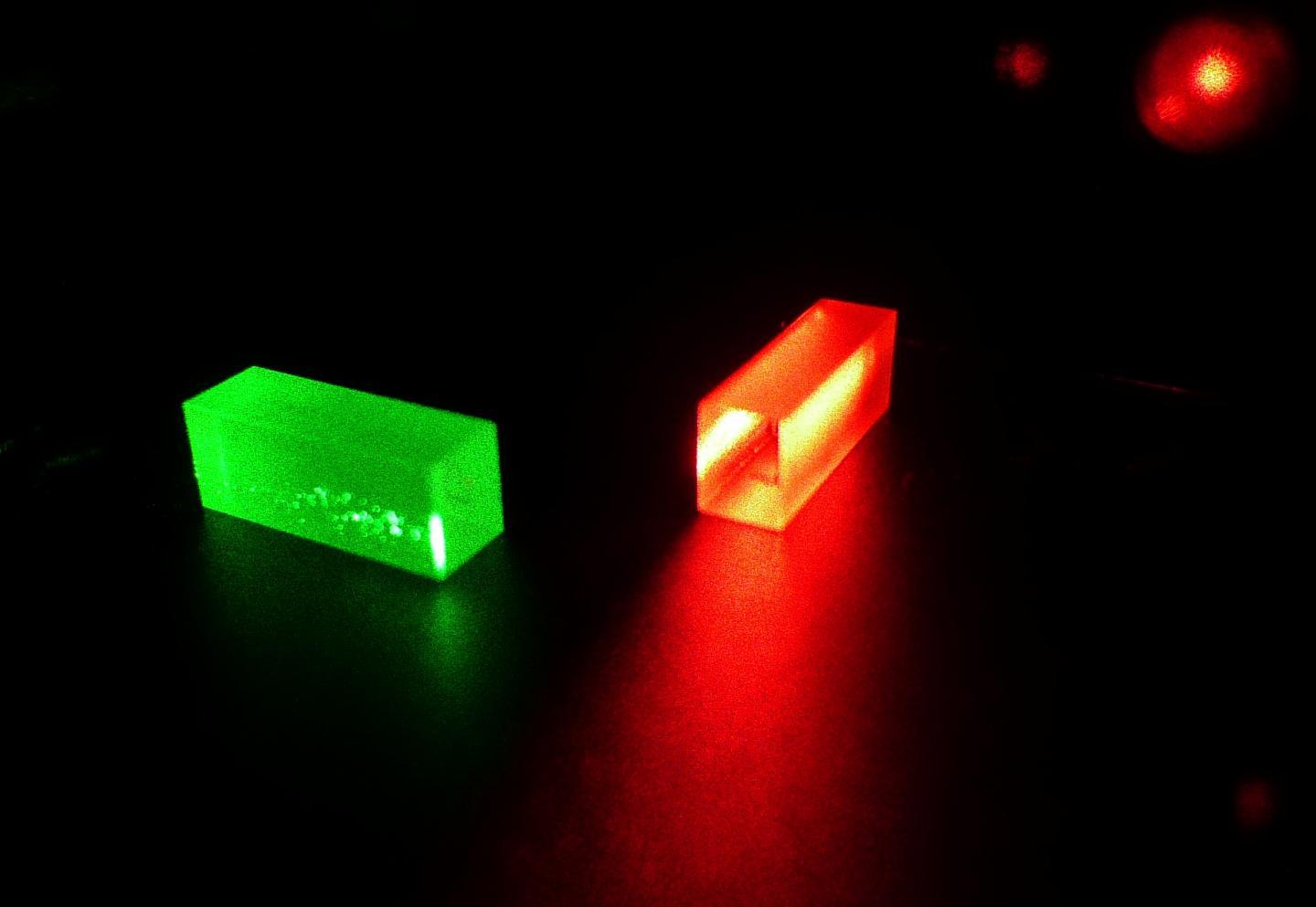
Physicists at the University of Geneva have succeeded in teleporting the quantum state of a photon to a crystal over 25 kilometers of optical fiber.

The experiment shatters the previous record of 6 kilometers achieved 10 years ago by the same  team. Passing from light into matter, using teleportation of a photon to a crystal, shows that, in quantum physics, it is not the composition of a particle which is important, but rather its state, since this can exist and persist outside such extreme differences as those which distinguish light from matter.

The latest experiments have enabled verifying that the quantum state of a photon can be maintained whilst transporting it into a crystal without the two coming directly into contact.

Breast cancer experts around the world have issued a plea to researchers, academics, drug companies, funders and advocates to carry out high quality research and clinical trials for advanced breast cancer, a disease which is almost always fatal and for which there are many unanswered questions.

In the latest international consensus guidelines for the management of advanced breast cancer, published simultaneously in the leading cancer journals The Breast and Annals of Oncology [1] today (Friday), the experts say that further research and clinical trials are "urgently needed" to find the best treatments for:

  • patients with breast cancer that has spread to the liver, or the space around the lungs (pleural cavity) or the skin;

The sense of fairness did not evolve for the sake of fairness per se but in order to reap the benefits of continued cooperation, so say Frans de Waal, PhD, and Sarah Brosnan, PhD, co-authors of a review article about inequity aversion (IA), which is defined as a negative reaction to unequal outcomes. The review is published in Science.

Their conclusion comes after the co-authors reviewed more than 35 IA-related studies to address their hypothesis that it is the evolution of forestalling partner dissatisfaction with obtained outcomes and its negative impact on future cooperation that allowed the development of a complete sense of fairness in humans.

An international collaboration led by research groups from Mainz and Darmstadt, Germany, has achieved the synthesis of a new class of chemical compounds for superheavy elements at the RIKEN Nishina Center for Accelerator-based Research (RNC) in Japan. For the first time, a chemical bond was established between a superheavy element – seaborgium (element 106) in the present study – and a carbon atom. Eighteen atoms of seaborgium were converted into seaborgium hexacarbonyl complexes, which include six carbon monoxide molecules bound to the seaborgium. Its gaseous properties and adsorption to a silicon dioxide surface were studied, and compared with similar compounds of neighbors of seaborgium in the same group of the periodic table.