Banner
Ousiometrics Analysis Says All Human Language Is Biased

A new tool drawing on billions of uses of more than 20,000 words and diverse real-world texts claims...

Wavelengths Of Light Are Why CO2 Cools The Upper Atmosphere But Warms Earth

There are concerns about projected warming on the Earth’s surface and in the lower atmosphere...

Here's Where Your Backyard Was 300 Million Years Ago

We may use terms like "grounded" and terra firma to mean stability and consistency but geology...

Convergent Evolution Cheat Sheet Now 120 Million Years Old

One tenet of natural selection is a random walk of genes but nature may be more predictable than...

User picture.
News StaffRSS Feed of this column.

News Releases From All Over The World, Right To You... Read More »

Blogroll

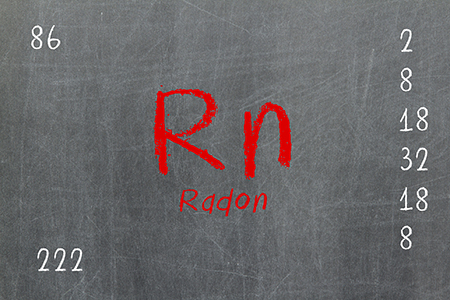
 An 'organic cage molecule' called CC3 has been found to separate krypton, radon and xenon from air at concentrations of only a few parts per million. 

Gases such as radon, xenon and krypton all occur naturally in the air but in minute quantities – typically less than one part per million. As a result they are expensive to extract for use in industries such as lighting or medicine and, in the case of radon, the gas can accumulate in buildings.

In the US, radon accounts for around 21,000 lung cancer deaths a year.

A new paper in Nature Genetics finds that nearly 60 percent of the risk of developing autism is genetic and most of that risk is caused by inherited variant genes that are common in the population and present in individuals without the disorder.

Although autism is thought to be caused by an interplay of genetic and other factors, there has been no consensus on their relative contributions and the nature of its genetic architecture. Recently, evidence has been mounting that genomes of people with autism are prone to harboring de novo mutations - rare, spontaneous mutations that exert strong effects and can largely account for particular cases of the disorder.


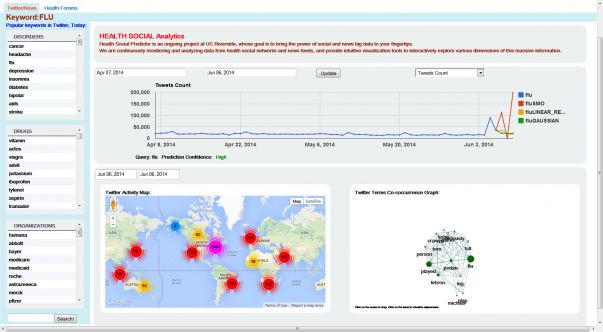
A site called Social Predictor (sociadictor.com) predicts future trends based on the number of tweets, sentiment of tweets, number of news stories and sentiment of the news stories about celebrities and culture. It can also try and predict stock prices or daily sales of a product, based on the chatter related to user-input keywords, such as a stock ticker or the name.

The creators said trading strategy based on their model outperformed other baseline strategies by between 1.4 percent and nearly 11 percent and did better than the Dow Jones Industrial Average during a four-month simulation. 
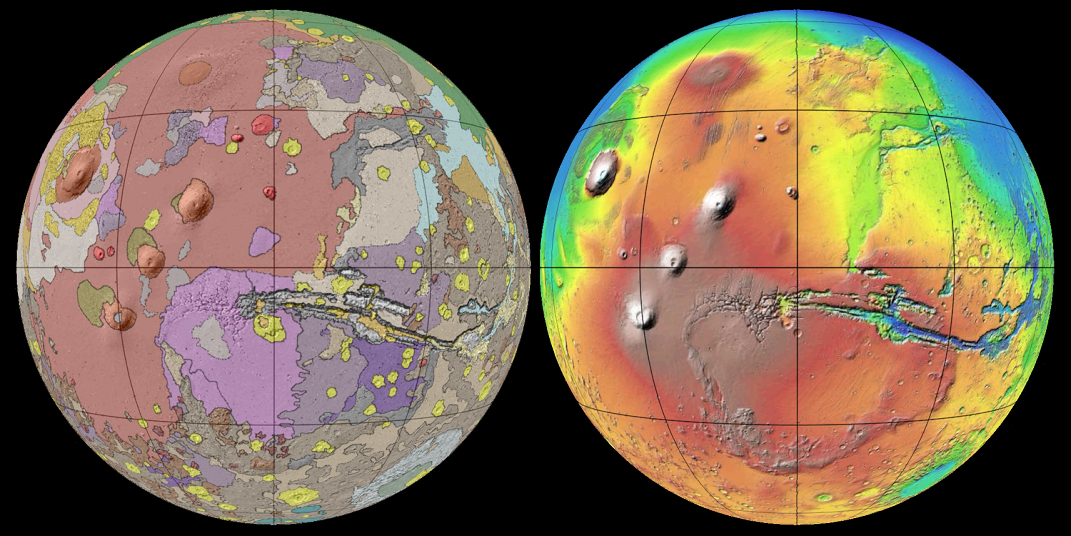
A new global geologic map of Mars is the most thorough representation of the "Red Planet's" surface, bringing together observations and scientific findings from four orbiting spacecraft that have been acquiring data for more than 16 years.

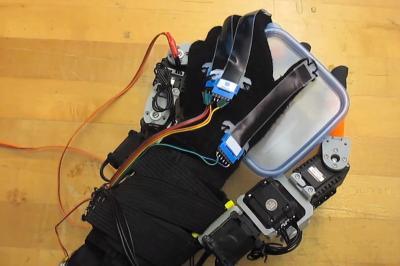
An MIT robotic device is worn around the wrist and basically works like two extra fingers adjacent to the pinky and thumb.

A novel control algorithm enables it to move in sync with the wearer's fingers to grasp objects of various shapes and sizes. Wearing the robot, a user could use one hand to, for instance, hold the base of a bottle while twisting off its cap. The robot, which the MIT researchers have dubbed "supernumerary robotic fingers," consists of actuators linked together to exert forces as strong as those of human fingers during a grasping motion.

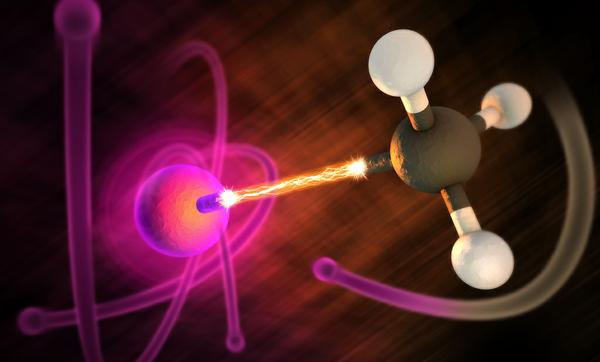
Ultra-short X-ray flashes have enabled scientists to watch electrons jumping between the fragments of exploding molecules. The study reveals up to what distance a charge transfer between the two molecular fragments can occur, marking the limit of the molecular regime.

The technique used can show the dynamics of charge transfer in a wide range of molecular systems. Such mechanisms play a role in numerous chemical processes, including photosynthesis.