Fake Banner
Enrico Stomeo - A Lifelong Passion For Meteor Studies

I was reached this evening by the news of the passing of a dear friend, Enrico Stomeo. Enrico was...

Surviving Queues: 1 - At The Airport

Nobody likes to wait in line. Whether you are sitting in your car waiting to reach the toll booths...

Choosing Your Bets: The Selection Bias

As some of the long-time readers of this blog know, in this column I have occasionally discussed...

Have A Master In Science, Want A Post-Doc Position Directly?

Do you have a master in Science, and want to start a Post-Doc position directly? You can have it...

User picture.
picture for Hank Campbellpicture for Heidi Hendersonpicture for Patrick Lockerbypicture for Bente Lilja Byepicture for Sascha Vongehrpicture for Johannes Koelman
Tommaso DorigoRSS Feed of this column.

Tommaso Dorigo is an experimental particle physicist, who works for the INFN at the University of Padova, and collaborates with the CMS and the SWGO experiments. He is the president of the Read More »

Blogroll
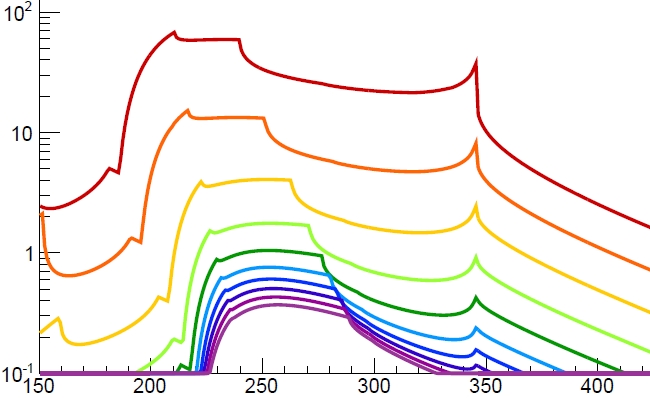
It has been a while since the last time I posted the last riddle of this series. It was fun though, so upon seeing the graph below I immediately decided I would use it here, to let you guess what it is about. Please use the comments thread to provide your input: what does the graph represent ? What are the different coloured lines ? Why the funny behaviour ? What is on the x axis ? And on the y axis ?


Of course it is virtually impossible to answer all the above without being given some hint. I can tell you it has to do with LHC searches, and that is all the help I am going to give you!
Ben Kilminster is a friend and a distinguished colleague working for the CMS and CDF experiments. Besides being a long-time higgs hunter, having sought that particle for over a decade in the two mentioned experiments, Ben is a veteran of science outreach since for many years he has published summaries of CDF results for the public on the online magazine "Fermilab Today". When I saw him posting on a social network an earlier version of the text below, which I liked a lot, I asked him to make it a guest post entry for my blog, and he graciously agreed.
The new PDG - a full-size copy of the glorious "Review of Particle Properties"- is on my desk since its arrival a few weeks ago, but only today did I get some time to browse it.

It is always awesome to observe how much information is contained in it. It is 1526 pages long, and I wonder how many typos and mistakes are contained in the data-thick pages... Probably much fewer than an ordinary book. Some of the review articles are of exceptionally good quality, because they have been passed from hand to hand in the last few dozen years, and constantly improved. If you want an example, for instance, go to the "Statistics" section - you will find a lot of new material which, along with the old one, still meets the highest standards.
I may have been unattentive to recent papers on Supersymmetry, but I got the impression that during the last few months the majority of SUSY phenomenologists have been keen on speculating on the few apparently non-standard features of the recently discovered Higgs boson, as published last June (such as the alleged copious decay of photon pairs, or the dearth of decays to tau lepton pairs or b-quark pairs - note: all are mostly back to what the standard model predicts, after the analysis of more data following the discovery announcements), but rather improductive on the front of taking the new signal as a pivot point for new global fits.
"Given that a repeated series of trials is required, frequentists are unable to assign probabilities to single events. Thus, with regard to whether it was raining in Manchester yesterday, there is no way of creating a large number of `yesterdays' in order to determine the probability. Frequentists would say that, even though they might not know, in actual fact it either was raining or it wasn't, and so this is not a matter for assigning a probability. And the same remains true even if we replace `Manchester' by `the Sahara Desert'.
I just read with interest and awe the nice article appeared today in the arxiv about the search for dark matter annihilation in the sun's core by the Baksan Underground Scintillator Telescope (BUST), a facility operating since December 1978 (!) in the Caucasian valley of Baksan.