

While the rapid emergence of antibiotic-resistant bacteria has prompted the medical community and media to educate the public to the dangers of misusing and overusing antibiotics but there may be more to the problem than medications - an ecologist is finding a way to blame nuclear research from the 1950s, good timing as environmentalists have declared open war on 'green' scientists who support nuclear energy as the most viable alternative to fossil fuels.

Using mathematical models, scientists have 'looked' into the interior of super-Earths and discovered that they may contain compounds that are forbidden by the classical rules of chemistry -- these substances may increase the heat transfer rate and strengthen the magnetic field on these planets. The findings have been presented in a paper published in the journal Scientific Reports.

The authors of the paper are a group of researchers from MIPT led by Artem Oganov, a professor of the Skolkovo Institute of Science and Technology and the head of the MIPT Laboratory of Computer Design. In a previous study, Oganov and his colleagues used an algorithm created by Oganov called USPEX to identify new compounds of sodium and chlorine, as well as other exotic substances.

WASHINGTON, D.C., Dec. 22, 2015 - Researchers at MINAO, a joint lab between The French Aerospace Lab in Palaiseau and the Laboratoire de Photonique et de Nanostructures in Marcoussis, have recently demonstrated metamaterial resonators that allow emission in the infrared to be tuned through the geometry of the resonator.

Their setup uses sub-wavelength scale metal-insulator-metal, or MIM, resonators to spatially and spectrally control emitted light up to its diffraction limit. This allows an array of resonators to be used to form an image in the infrared -- much as way the pixels in a television screen can form a visible light image -- with potential breakthrough applications in infrared televisions, biochemical sensing, optical storage, and anti-counterfeit devices.

When you look at the rainbow, what you see is the prism like effect of the mist (aerosolized water droplets) in the air reflecting the sunlight from different portions of the spheres.  These water droplets when suspended in air as mist will all reflect different colors at different angles.  The angle between you, the mist and the sun, will then determine which color is being refracted back to you from each location resulting in a rainbow.  This color is itself a special form of radiation, more specifically it is non-ionizing radiation with very specific wavelengths.

Few events encapsulate our infatuation with a well-told story as much as Christmas. As a culture, we are dependent on stories as a tool with which to negotiate our daily lives and make sense of the world around us. In particular, we love magical ones because they allow us to temporarily suspend our disbelief and revel in the joys of doing so.

Well, it’s that time of year again – and there it is; just four words into an article on Christmas I’ve used the word ‘time.’

Among the hodge-podge of rituals and holidays that survive in the post-Christian West, Christmas might just be the one that tells us the most about how humans relate to and experience temporality.

Christmas,
narrative,

Walk into any public square or shopping mall at this time of year and an encounter with a traditional Christmas carol is well-nigh unavoidable.
We may not sing them ourselves with anything like the frequency or fervor we once did at church but the tunes themselves defy relegation to our past.

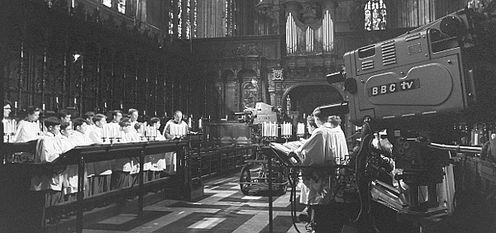
At 3 pm on Christmas Eve, millions of radios around the world will be tuned to the Festival of Nine Lessons and Carols from King’s College Chapel in Cambridge in time to hear the pure voice of a single boy chorister singing one of the hardest solos of the church calendar, the first verse of “Once in Royal David’s City”.

For many, this signals the start of Christmas. Broadcasts of the Christmas Eve service from King’s began in 1928, but arguably it was under the guidance of Sir David Willcocks, who died in September 2015, aged 95, that the service – and the choir – became household names.

We don’t need to be Christian to celebrate Christmas. That’s been true for a long time. We don’t even need to be religious. Considering the commercialization of the holiday, that might be an advantage.

But there is no way to get around the religious iconography. Jesus, nativity scenes and Christian symbols are everywhere. So how do you explain this to your children – or someone else’s children – if you and they are not religious?

Every year, almost without thinking about it, we incorporate certain plant species into our Christmas celebrations. The most obvious is the Christmas tree, linked historically in England to Prince Albert – but its use in British homes goes back to at least 1761 when Charlotte wife of George III put up a tree at the royal court. (It’s probably worth noting here that the first artificial-brush Christmas tree was produced using the same machinery that was originally designed to produce toilet brushes.)




