






Don't mobile payments make more sense? US Navy

By Ethan Zuckerman, Massachusetts Institute of Technology

Apple’s product launches are covered with breathless enthusiasm usually reserved for royal weddings and vaccines for dread diseases.

The recent launch of the iPhone6 featured an exciting new technology - ApplePay - which, if widely adopted, will allow Apple’s discerning customers to make electronic payments from their phones in situations where they would have used credit cards or cash.

Researchers have solved a puzzle in traffic research, namely why so many people 'jerk' the wheel when they steer a car. 

Groups like the U.S. Environmental Protection Agency and the Food and Drug Administration set the gold standard worldwide for science - but they are still soundly criticized. Every time the EPA clears a pesticide it is blasted because the studies it mandates are "industry-funded", which is required by law. As are trials for drugs.

For many people, the disclaimers about side effects of drugs at the end of television drug commercials (along with the omnipresent 'see our ad in Golf magazine' small print) are somewhat laughable - like with Proposition 65 'cancer-causing chemicals' here in California, when everything is a problem, nothing is - but they have a serious societal impact when the FDA says it.


Okay, but that's not the way to extract it. fabriceh_com, CC BY-NC-SA

By Benjamin Burke, University of Hull

In the development of new drugs, taking something from nature and modifying it has been a successful tactic employed by medicinal chemists for years.

Now, with the help of nanotechnology, researchers are turning once-discarded drug candidates into usable drugs.

A new study shows that plasma waves buffeting the planet's radiation belts are responsible for scattering charged particles into the atmosphere, creating the most detailed analysis so far of the link between these waves and the fallout of electrons from the planet's radiation belts.

The belts are impacted by fluctuations in "space weather" caused by solar activity that can disrupt GPS satellites, communication systems, power grids and manned space exploration.

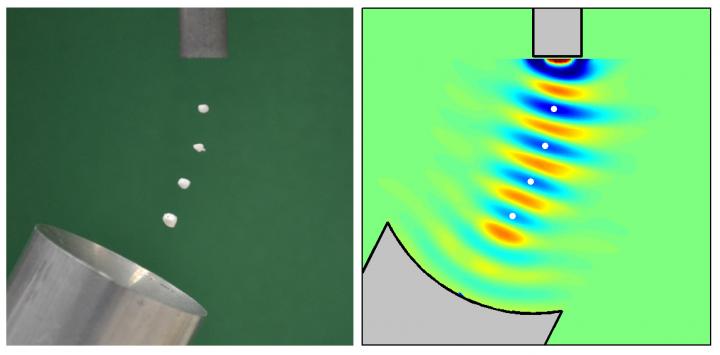
Acoustic levitation has been done in the past but it required a precise setup where the sound source and reflector were at fixed "resonant" distances. This made controlling the levitating objects difficult and isn't really proof-of-concept for anything practical.

Now a team of researchers have developed a new device that can levitate polystyrene particles by reflecting sound waves from a source above off a concave reflector below  - with more control than any instrument created before. Changing the orientation of the reflector allows the hovering particle to be moved around. 

Older men with locally advanced prostate cancer benefit by adding radiation treatment to hormone therapy versus hormone therapy alone, according to a new study which found that hormone therapy plus radiation reduced cancer deaths by nearly 50 percent in men aged 76 to 85 compared to men who only received hormone therapy.

Past studies have shown that 40 percent of men with aggressive prostate cancers are treated with hormone therapy alone, exposing a large gap in curative cancer care among "Baby Boomers" as they approach their their 70s. 

Researchers have developed a detailed explanation of how white-nose syndrome is killing bats in parts of North America - the fungus Pseudogymnoascus destructans makes bats die by increasing the amount of energy they use during winter hibernation.

Researchers from the U.S. Geological Survey and the University of Wisconsin created a model for how the disease progresses from initial infection to death in bats during hibernation. Since bats must carefully ration their energy supply during this time to survive without eating until spring, they tested the energy depletion hypothesis by measuring the amounts of energy used by infected and healthy bats hibernating under similar conditions.

Elderly patients admitted to intensive care units are about 35 percent more likely to die within five years of leaving the hospital if they develop an infection during their stay.

The upside to this finding is that preventing two of the most common health care-associated infections - bloodstream infections caused by central lines and pneumonia caused by ventilators - can increase the odds that these patients survive and reduce the cost of their care by more than $150,000, according to a study in American Journal of Infection Control.


