







When is a cat not a cat? Biodiversity Heritage Library (adapted), CC BY

By Ben Holt, Imperial College London and Knud Andreas Jønsson, Imperial College London

The yellow fever mosquito sustains its taste for human blood thanks to a genetic tweak that makes it more sensitive to human odor, according to a paper in Nature. They have a version of an odor-detecting gene in its antennae that is highly attuned to sulcatone, a compound prevalent in human odor.

The gene, AaegOr4, is more abundant and more sensitive in the human-preferring "domestic" form of the yellow fever mosquito than in its ancestral "forest" form that prefers the blood of non-human animals. 


Different people behave in different ways behind the wheel of a car. Flickr/Nuno Sousa, CC BY-NC-ND

By Vanessa Beanland, Australian National University and Martin Sellbom, Australian National University

In the fight against HIV, microbicides, which are chemical compounds applied topically to the female genital tract to protect against sexually transmitted infections, are touted as an alternative to condoms.

There's just one problem. They don't work outside a petri dish. Clinical trials using microbicides have failed and a new study from the Gladstone Institutes and the University of Ulm finds that this may be due to the primary mode of transportation of the virus during sexual transmission, semen.

17 genomes of supercentenarians, people living beyond 110 years of age, haven't led us any closer to discovering protein-altering variants significantly associated with extreme longevity, according to a study in PLOS ONE by Hinco Gierman from Stanford University and colleagues.

There are 74 supercentenarians alive worldwide, with 22 in the United States. The authors of this study performed whole-genome sequencing on 17 of them to explore the genetic basis underlying extreme human longevity. 

If surveys are accurate, up to 20 percent of students have taken Modafinil (Provigil), a psychostimulant embraced by "lifehackers" in the naturalistic crowd, to boost their ability to study and improve their chances of exam success. 

It is claimed, mostly by other students and readers of New York Magazine, that Modafinil is a 'smart' drug. Yet that isn't the case. Just like people without celiac disease are actually damaging their health giving up gluten and replacing it with the extra sugar, extra fat, hydroxypropyl methyl cellulose and xanthan gum found in gluten-free foods, healthy students who take Modafinil instead find their performance impaired by the drug. 

In hydraulic fracturing - fracking - a mixture of sand, water and chemicals is injected into deep wells to release fossil fuels. This has led to environmental corporation claims that the reduced emissions from natural gas are being offset environmentally by surfactants.

A surfactant is basically a detergent. It reduces the surface tension between water and oil, allowing for more oil to be extracted from porous rock underground. 

 A University of Colorado Boulder study has found there is little to fear. The surfactant chemicals found in samples of fracking fluid collected in five states were no more toxic than substances commonly found in homes - including organic products.

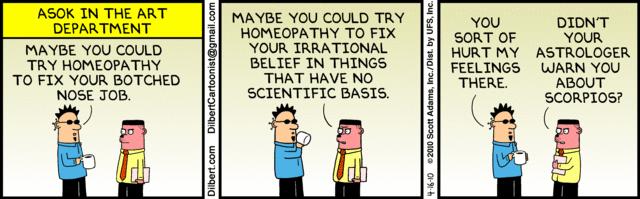
Can homeopathy actually work if someone knows it is a placebo? What if, for example, a skeptical Science 2.0 group was told they got a placebo and that nutritionists were getting medicine? Would we feel better anyway?(1)

Of course it's possible, it just wouldn't be due to magic water. It's a mystery of biology why some people just feel better taking something. That is why homeopathy still exists a few hundred years after its invention even though it has never worked.(2)

Does the placebo effect apply to dogs? Do they understand the concept of medicine? If not, they have a placebo effect.

In the last 30 years, the United States has grown more food using less land and with less environmental strain than ever believed possible. Fertilizers are better, pesticides are better and genetic modification has led to less need for both.

But some scientifically developing nations, including much of Europe, are still using more antiquated approaches, and then means a lot of nitrogen. Nitrogen boosts plant growth and yield even on poor soils, which helps plants avoid the typical characteristics of nitrogen deficiency - stunted growth and pale or yellow leaves - but in environmentally intensive approaches like organic farming, the left over nitrogen can be substantial. 

Hey, does anyone want this comet?

For the first time, mankind has successfully landed on a comet - a journey over 10 years in the making.

After a seven-hour final descent, Rosetta’s Philae probe signaled from the surface of Comet 67P/Churyumov–Gerasimenko and the message arrived on Earth at 16:03 GMT, completing the longest part of a 4 billion mile journey through the solar system.

The landing site, named Agilkia and located on the head of the bizarre double-lobed object, was chosen based on images and data collected at distances of 30–100 km from the comet. Those first images soon revealed the comet as a world littered with boulders, towering cliffs and daunting precipices and pits, with jets of gas and dust streaming from the surface.


