






A reference genome for coffee trees has been sequenced for the first time. It improves understanding of the organization of the genome, which is academic, but it also offers new possibilities for selection or improvement of coffee tree varieties. 

The researchers chose Robusta coffee because of its average sized genome (710 million pairs of DNA bases) and its diploid nature contrary to Coffea arabica, which is tetraploid. The genetic map of the coffee tree studied was produced in the 1980s and also had the advantage of being a homozygous plant (two identical sets of eleven chromosomes), which is easier to analyze than natural heterozygotes.

Since 1999, a conjecture by Asher Peres, the 'inventor' of quantum teleportation, that the weakest form of quantum entanglement can never result in the strongest manifestation of the phenomenon, has been debated. 

Peres thought about the phenomenon of quantum entanglement and its different manifestations. When two objects (take photons, for example) are entangled, they remain correlated regardless of the distance that separates them physically: whether they are separated by a millimeter or by several kilometers, any action done to one of them will immediately affect the other. To check whether a system is entangled, scientists test for Bell's inequality.

A new study finds that the inhibition of a particular mitochondrial fission protein, GTPase dynamin-related protein-1 – Drp1, could hold the key to treating Parkinson's Disease.

A new biology paper sheds light on how chromatin (the complex of DNA and proteins) is organized in a cell and how plants regulate genetic material, so that some genes are turned on and others are turned off - and it could make it possible for a new generation of plants to better adapt to and survive environmental swings such as droughts or floods.

The research in The Plant Cell could mean major advances for the agriculture industry. 

"If you understand how plants regulate their genetic material, you can possibly manipulate that in certain circumstances so that plants can withstand environmental changes," said Daniel Vera, a Florida State University graduate student and the lead author of the paper.


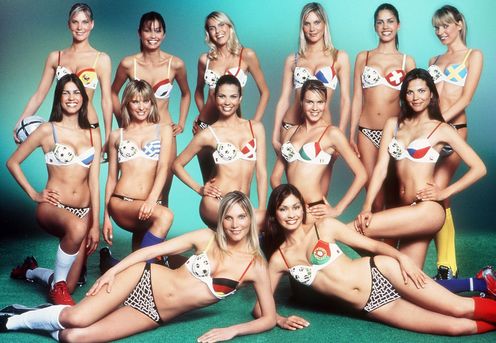
Bras have come a long way in 100 years. Credit: EPA/HO

By Deirdre McGhee, University of Wollongong

This year marks the 100-year anniversary of the first bra patent.

Amazingly for the time – 1914 – it was made by a woman in her twenties, Mary (Polly) Phelps Jacob (nee Crosby).

Polly made her bra initially from two handkerchiefs and some ribbon with the intent to show off her substantial cleavage in a sheer evening gown that had a plunging neckline. The handkerchiefs formed the bra cups and the ribbons formed the straps.

The location of oral cancers differ in smokers and nonsmokers and nonsmokers have a higher proportion of cancers occur on the edge of the tongue, according to a new paper in JAMA Otolaryngology-Head&Neck Surgery.

Induced pluripotent stem cells (iPSCs) and somatic cell nuclear transfer (SCNT)-derived cells are world's apart. iPSCs became a major research force because they are adult stem cells and lack the controversy of human embryonic stem cells (hESCs) while SCNT is banned by the Obama administration even though most biologists are in favor of it.

Yet that is politics. Scientifically, they have far more in common, which makes the scientization of politics issue more odd. A team led by the New York Stem Cell Foundation (NYSCF) Research Institute did a study comparing iPS cells and embryonic stem cells created using SCNT and they found that the cells derived from these two methods resulted in cells with highly similar gene expression and DNA methylation patterns.


Our brains make judgments about images before we're even aware of making a decision. A Health Blog/Flickr, CC BY-NC

By Daniel Bennett, University of Melbourne

What makes us decide? At one level, this seems like an easy question: we think our options through, pick the one we like best and act on it.

If we dig a little deeper, though, the question becomes more difficult to answer. How do we settle on what our options are? What makes us prefer one option to another?

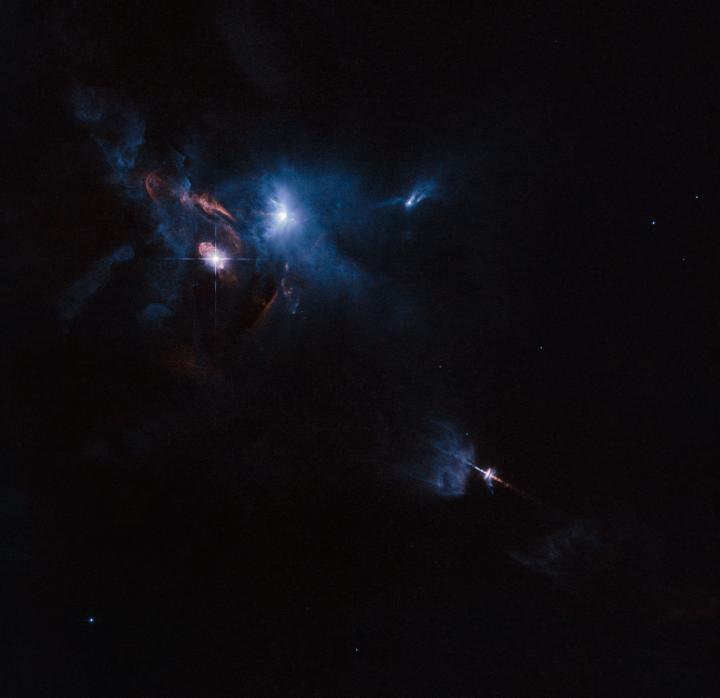
The XZ Tauri star system has been imaged blowing a hot bubble of gas into the surrounding space, which is filled with bright and beautiful clumps that are emitting strong winds and jets. These objects illuminate the region, creating a truly dramatic scene.

This dark and ominous landscape is located some 450 light-years away in the constellation of Taurus The Bull. It lies in the north-eastern part of a large, dark cloud known as LDN 1551, as seen in the Hubble telescope image below..

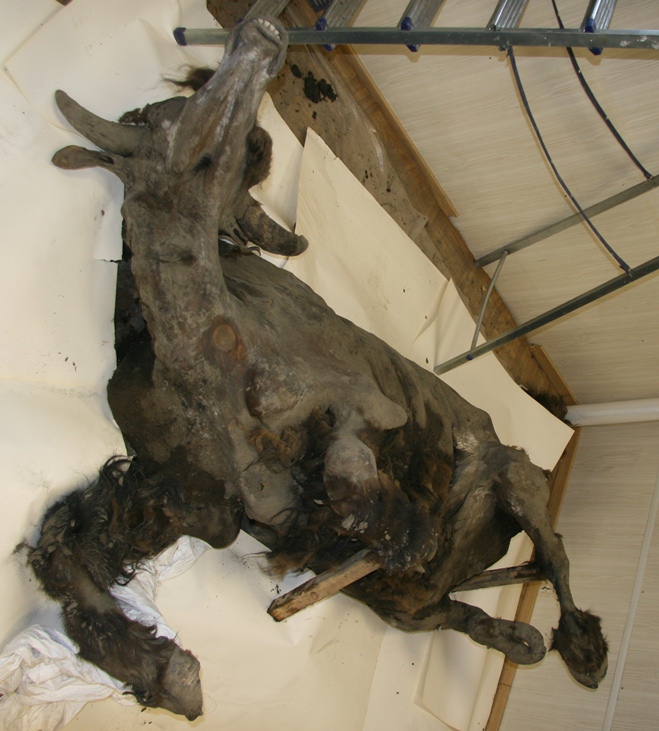
Many large mammals went extinct at the end of the most recent Ice Age (about 11,000 years ago), including the Steppe bison, Bison priscus.

Recently an intact one was found, literally frozen in time. This most complete frozen mummy of the Steppe bison yet discovered dates to 9,300 years ago and was uncovered in the Yana-Indigirka Lowland. 

The Yukagir bison mummy, as it is named, has a complete brain, heart, blood vessels and digestive system, although some organs have shrunk significantly over time. The necropsy of this unique mummy showed a relatively normal anatomy with no obvious cause of death. However, the lack of fat around abdomen of the animal makes researchers think that the animal may have died from starvation.


