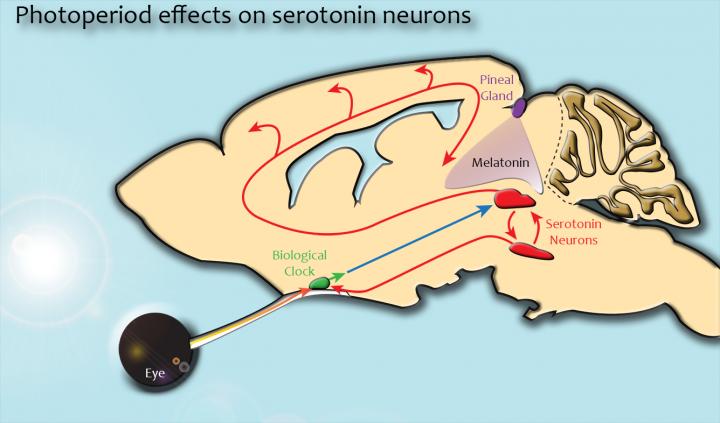



During the short, dreary days of winter, some people feel tired and oversleep, they are depressed and irritable and have trouble concentrating.  But once spring arrives, they say they feel fine.

4 percent of the American public say they suffer from this seasonal affective disorder (SAD), a type of depression that occurs during the same season each year.

Biologists know that variations in the amount of sunlight a person receives and her or his circadian clock play a role in the disorder and some have proposed that the neurotransmitters serotonin and melatonin may be involved. However, they have not yet identified the underlying neurobiological mechanisms responsible.

Kids from
multilingual environments
become better communicators, according to a new paper in 
Psychological Science
which says that such children are better at interpreting a speaker's meaning than children who are exposed only to their native tongue - even if the kids are not bilingual themselves.

Exposure to more than one language is the key for building effective social communication skills, says University of Chicago Katherine Kinzler, who believes this paper is the first to demonstrate the social benefits of just being exposed to multiple languages. 

"It takes a village to raise a child" is folk wisdom which means that quality communities turn out quality individuals.

It may have seemed like a new idea when First Lady Hillary Clinton said it in the 1990s but ancient societies formed cooperative groups to help raise their children. Why did that happen?

University of Utah anthropologist Karen Kramer and colleagues created an economic model where mothers had one dependent offspring at a time, ended support of their young at weaning and received no help from others and then mapped it to where mothers often have multiple kids who help rear other children.

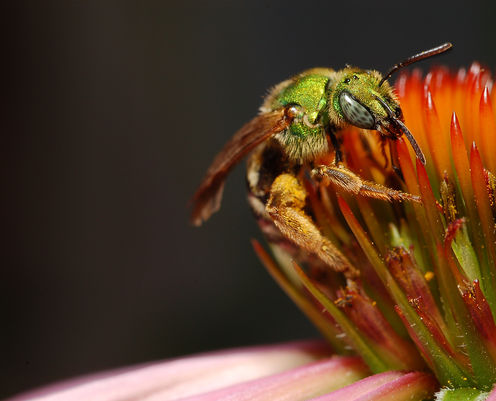
It’s bee season and now’s the time to go outside and observe these popular insects.

Bees hold a relatively special place in people’s affections – we have them to thank for honey, of course, and they’re also essential pollinators of many food crops and wild plants.

But most bees aren’t the snazzy hive-dwelling orange and black characters we know so well. In fact, there are around 20,000 species of bee globally and just seven of these are honeybees, and the vast majority of honeybee colonies belong to only one species: Apis mellifera.

Before 2009, nearly 4 in 10 cattle ranchers and slaughterhouse in Brazil reported recent deforestation but by 2013, this number dropped to 4 in 100, a 10-fold decrease.

What changed? Policies that were not simply advocated by first world elites that told people in Brazil they couldn't have an economy. Brazil is home to the world’s largest commercial herd of cattle, and its cattle ranchers were once linked to the destruction of huge swaths of rainforest. “Zero-deforestation agreements” put into place in 2009 use market-based strategies to reduce the impact of the beef industry on the environment, a much different methodology than in the past where some would follow guidelines and be penalized economically.

If you got a recent promotion, or a new car on Facebook, that's good news, and in the idealized vision of social media it should be shared.

That is just social media marketing talking. In reality, you have probably become convinced that your hard work and success elicits positive emotions and you are probably wrong. 

Irene Scopelliti, George Loewenstein and Joachim Vosgerau wanted to find out why so many try to increase the favorability of the opinion others have of them by engaging in more positive self-promotion, which has the opposite of the intended effect. 

For the last decade, engineers have deployed increasingly capable underwater robots to map and monitor pockets of the ocean to track the health of fisheries, and survey marine habitats and species. When deploying such autonomous underwater vehicles (AUVs), much of an engineer's time is spent writing scripts, or low-level commands, in order to direct a robot to carry out a mission plan but new programming approach developed by MIT engineers gives robots more "cognitive" capabilities, enabling humans to specify high-level goals, while the robot performs high-level decision-making to figure out how to achieve these goals. 

Photosynthesis, the process by which plants utilize the sun's energy to create their own, leaves behind a unique calling card in the form of a chemical signature that is spelled out with stable oxygen isotopes.

Photosynthesis by microscopic plants forms the base of the oceanic food chain, but it is difficult to measure how productive these plants are in natural settings. This research will make it easier to do so.

Most oxygen atoms contain eight protons and eight neutrons and are represented by the symbol O-16. More than 99.9 percent of Earth's oxygen is O-16, but two heavier oxygen isotopes exist in trace amounts: O-17, with one extra neutron, and O-18, with two.

Rydberg atoms, atoms whose outermost electrons are highly excited but not ionized, might be just the thing for processing quantum information. These outsized atoms can be sustained for a long time in a quantum superposition condition (a good thing for creating qubits) and they can interact strongly with other such atoms, making them useful for devising the kind of logic gates needed to process information. 

As scientists, my colleagues and I are often told we need to engage the general public and decision makers, to use our expertise to inform public discourse and debates and to reach a far wider audience than just our professional colleagues.

I very much believe in the importance of doing this. This is, for instance, my 25th article for The Conversation. I’ve also written scores of articles for other popular venues such as New Scientist, Natural History, Yale Environment 360, Australian Geographic, the Chronicle of Higher Education and the New York Times, among others.