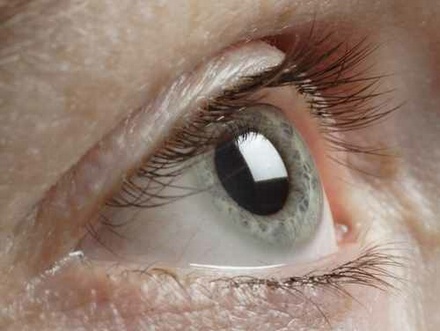
When we look at a known word, our brain sees it more like a picture than a series of letters needing to be processed, according to a new paper in the Journal of Neuroscience.
Neurons respond differently to real words, such as turf, than to nonsense words, such as turt, showing that a small area of the brain is "holistically tuned" to recognize complete words, says the study's senior author, Maximilian Riesenhuber, PhD, who leads the Georgetown University Medical Center Laboratory for Computational Cognitive Neuroscience.
The brain learns words quickly by tuning neurons to respond to a complete word, not parts of it.
Young children who received the 4CMenB vaccine as infants to protect against serogroup B meningococcal disease had waning immunity by age 5, even after receiving a booster at age 3 ½, according to new research in CMAJ (Canadian Medical Association Journal)
Serogroup B meningococcal disease is the leading cause of meningitis and blood infections in developed countries. Infants and young children under the age of 5 years are especially at risk, and there is a second peak of cases in the late teenage years.
Is Myopia the new Rickets? A new study compares the history of school myopia with the bone disease rickets. During the 17th century, rickets was common among children in England and then reached epidemic levels through northern Europe and North America. In some cities, 80 percent of children were affected.
The remedy proved elusive until the 1920s, when scientists discovered that a lack of sunlight, resulting in vitamin D deficiency, was the cause of rickets.
Ulnar collateral ligament (UCLR) reconstruction surgery, called "Tommy John Surgery" after the New York Yankees pitcher who made it famous in 1974, is now a common procedure for Major League Baseball pitchers after they get a damaged or torn ulnar collateral ligament.
It has been a boon for athletes. It had once been a career-ending injury but John pitched for 14 more years and racked up 164 more victories. But it has limits, according to a new study, namely in athletes who have it twice.

When most people think of quantum mechanics they think of Schroedinger's cat, a thought experiment describing a cat inside a closed box, that may be either dead or alive. Only when the classical physics world enters the box do we know. But what is the tipping-point between that cat's life and death, when does quantum behavior give way to classical physics?
Where, on the small scale, is Schroedinger's cat small enough size to be perceived as being both alive and dead at the same time?
A new study in Physical Review Letters has an answer, thanks to a fiber-based nonlinear process that allowed physicists to observe how, and under what conditions, classical physical behavior emerges from the quantum world.
Our bodies do not absorb all of the medicines we might take, some are excreted and though the impact individually is minor, over time and in a large population, there are concerns that such medical waste will lead to issues like antibiotic resistance.
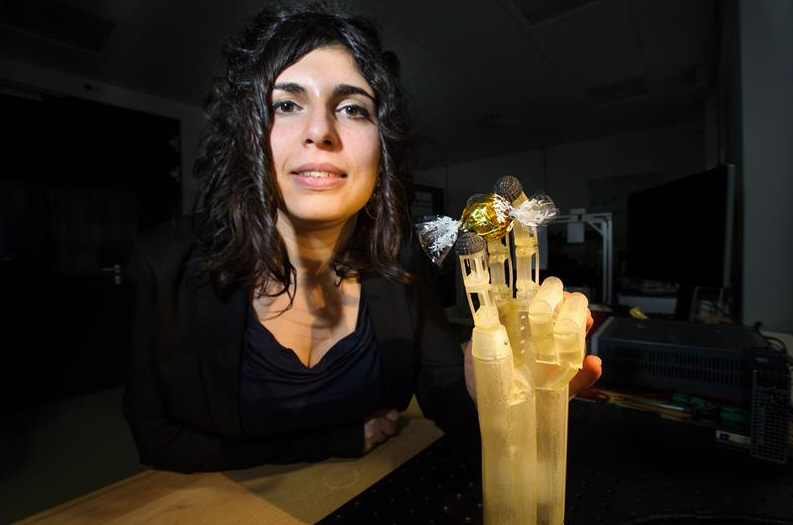
In cultural perception, an artificial hand looks something like a Steampunk reworking of a hand, with gears and pistons and rods. In the future, an artificial hand would look just like a hand, except with muscles made from smart metal wires.
Engineers at Saarland University have equipped an artificial hand with muscles made from
nickel-titanium
shape-memory wire, enabling the fabrication of flexible and lightweight robot hands for industrial applications and novel prosthetic devices. The muscle fibers are composed of bundles of the ultra-fine nickel-titanium alloy wires, each about the width of a human hair, and they are able to tense and flex and the material has sensory properties allowing the artificial hand to perform extremely precise movements.
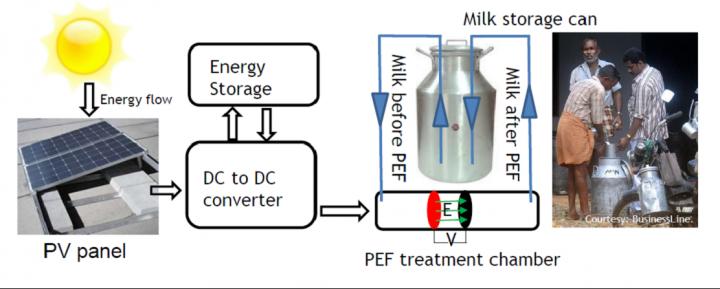
Milk has a long been a nutritional and economic staple in western countries but it is quickly susceptible to pathogens quite easily, which is why pasteurization, which kills harmful microbes, is the norm for all but the food fad fringes. Due to harmful microbes, raw milk is 150X as likely as pasteurized milk to result in illness.
Refrigeration and chemicals can manage pathogen growth but Listeria monocytogenes are less sensitive to low temperature; therefore, they can proliferate at refrigeration during transportation and storage. And not everyone has access to the infrastructure needed for a permanent electricity supply needed to drive refrigeration.
Perhaps if electricity were just needed in bursts.
The 2015 Alzheimer's Disease Facts and Figures report found that only 45 percent of people with Alzheimer's disease or their caregivers were told the diagnosis by their doctor.
That is significantly lower than the 90 percent of people told the diagnosis for the four most common cancers.
Why? The reason most commonly cited by health care providers for not disclosing an Alzheimer's diagnosis is fear of causing the patient emotional distress but, according to the report, "studies that have explored this issue have found that few patients become depressed or have other long-term emotional problems because of the [Alzheimer's] diagnosis."

Filmmakers know personality disorders make for compelling viewing.
Think of attention-seeking Scarlett O'Hara in "Gone with the Wind" (1939). Or the manipulation and callous disregard for others in "Silence of the Lambs" (1991), "The Talented Mr. Ripley" (1999) and "Chopper" (2000). Then there are the fears of abandonment and emotional instability in "Fatal Attraction" (1987) and "Girl, Interrupted" (1999).
Cinema is less adept, however, at showing the ordinary joys, heartache and sometimes suicidal despair of the friends, workers or relatives we might know with personality disorders.