Women take longer to give birth today than did women 50 years ago, according to an analysis of nearly 140,000 deliveries conducted by researchers at the National Institutes of Health which finds that women take longer to give birth today than did women 50 years ago, despite many technological advances in medicine.
The researchers compared data on deliveries in the early 1960s to data gathered in the early 2000s. They found that the first stage of labor had increased by 2.6 hours for first-time mothers. For women who had previously given birth, this early stage of labor took two hours longer in recent years than for women in the 1960s. The first stage of labor is the stage during which the cervix dilates, before active pushing begins.
“Here’s the story of the only truly awesome play I’ve ever made,” Jason Katz-Brown told me when I interviewed him for my book,
Brain Trust.
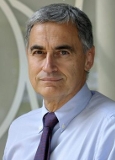
Antonio Ereditato (left), spokesperson of the Opera collaboration, announced today he stepped down. He is no longer leading the Opera experiment.
The Opera experiment last September made headlines around the world with their announcement that neutrinos sent from the CERN laboratories to the Gran Sasso cavern
appeared to be moving at superluminal speed.
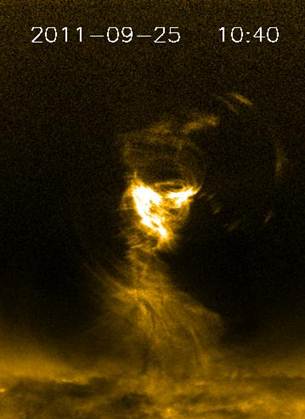
Solar tornadoes several times as wide as the Earth can be generated in the solar atmosphere and one such solar tornado was discovered using the Atmospheric Imaging Assembly telescope on board the Solar Dynamic Observatory (SDO) satellite.
The Atmospheric Imaging Assembly saw superheated gases as hot as 50,000–2,000,000 Kelvin sucked from the root of a dense structure called the prominence, and spiral up into the high atmosphere and travel about 200,000 kilometers along helical paths for a period of at least three hours. The tornadoes were observed on September 25th, 2011. The hot gases in the tornadoes have speeds as high as 300,000 km per hour. Gas speeds of terrestrial tornadoes only reach a comparatively mild 150 km per hour.
How do you know a scientist was right a lot? When an entire cottage industry exists to try and prove him wrong.
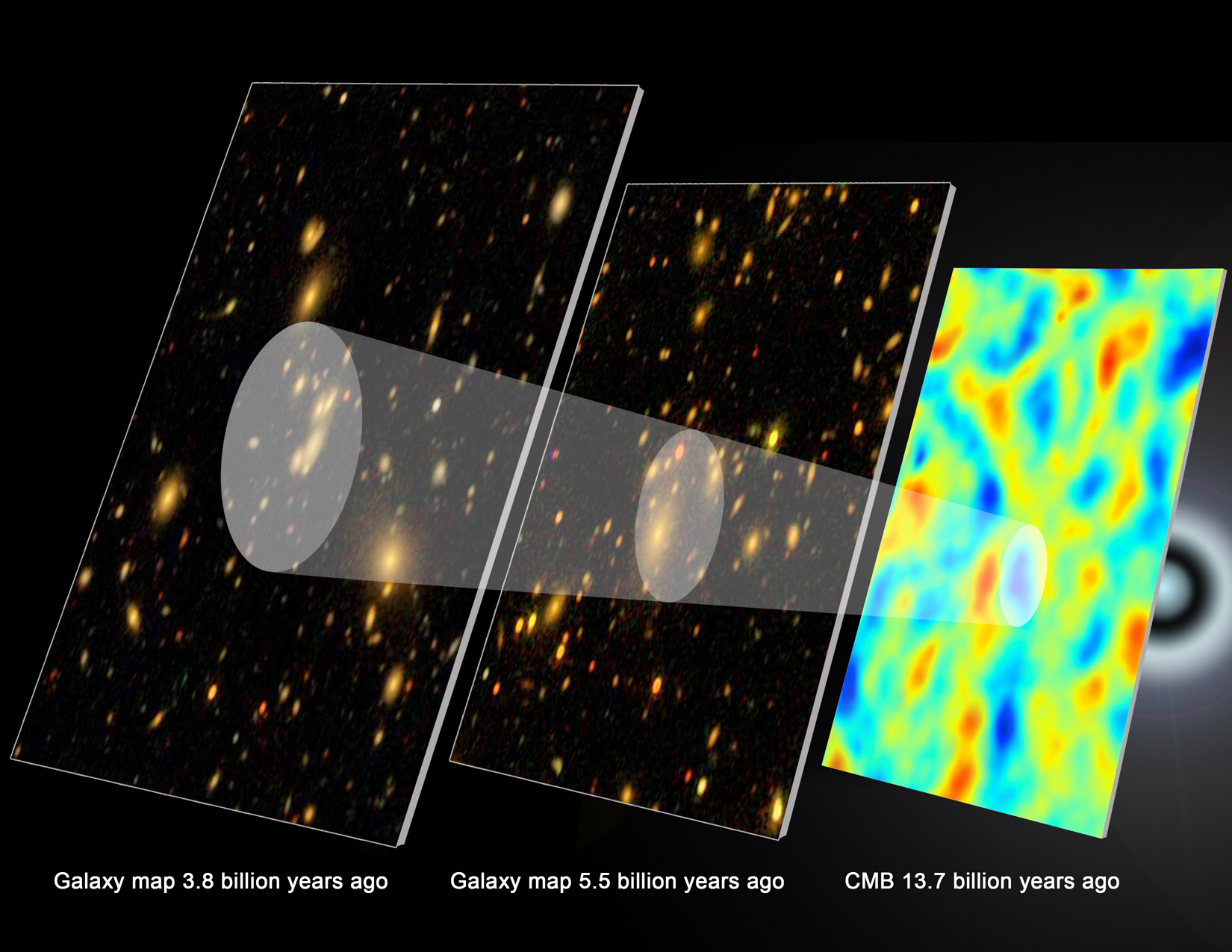
Einstein's view of the Universe has gotten some new respect; the most accurate measurement ever made of the distance to the time when the expansion of Universe began to accelerate. It means that the phenomenon can be explained using just Einstein’s general theory of relativity and the cosmological constant - the simplest theoretical explanation for the acceleration of the Universe. The results will be used to understand what is causing the acceleration and why, and could shed new light on 'dark energy' – the adopted name of the little-known fundamental agent driving the acceleration.
The atmosphere contained little carbon dioxide (CO
2) during the last Ice Age 20,000 years ago. Why did it rise when the Earth’s climate became warmer? Processes in the ocean are responsible for this, says a new study based on newly developed isotope measurements.
Around 20,000 years ago, the atmospheric CO2 concentration was distinctly lower than in the following warm period, showed measurements from Antarctic ice cores. An international team of glaciologists looked even further back and found that the close connection between carbon dioxide and temperature has existed over the past 800,000 years: with low CO2 concentrations during the Ice Ages and higher CO2 values during warm periods.
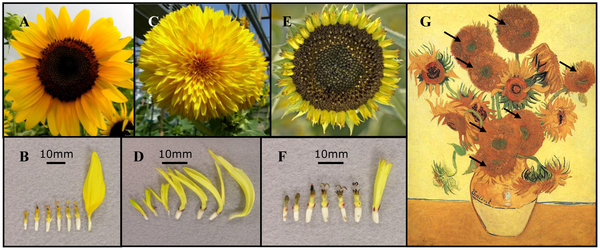
Vincent van Gogh's series of sunflower paintings, while spectacular to fans of his work, have also intrigued scientists because they depict a mutation whose genetic basis was a mystery. In a new study, a team of University of Georgia scientists reveal the mutation behind the distinctive, thick bands of yellow "double flowers" that the post-Impressionist artist painted more than 100 years ago.
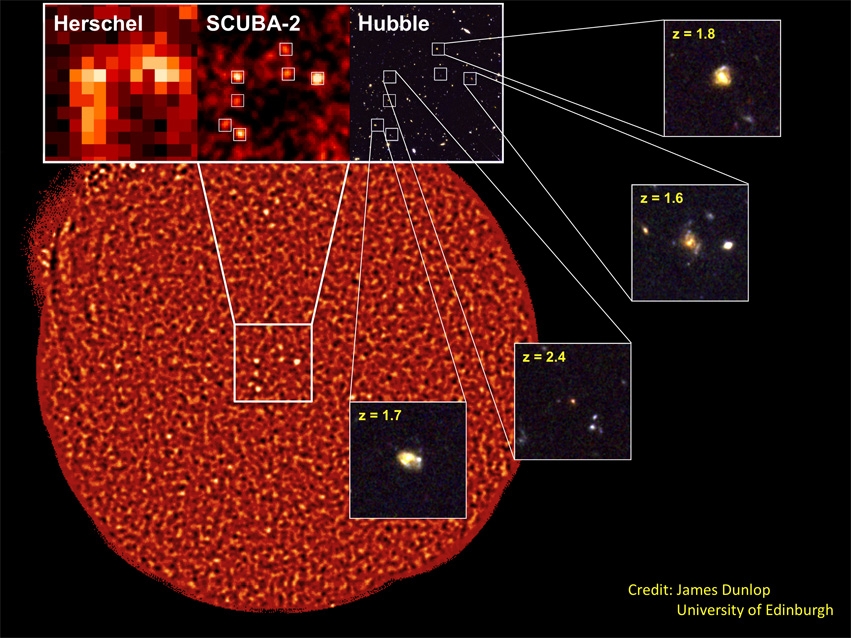
SCUBA-2, the most powerful camera ever developed for observing light at ‘sub-mm’ wavelengths (light that has a wavelength 1000 times longer than we can see with our eyes), has begun a revolutionary new study of cosmic star-formation history.
There was a time when people on the right trusted science far more than moderates and liberals. Distrust of scientists, including levels that verged on raging paranoia, was limited to the left side of the political spectrum.
“Body odor sampling is an essential tool in human chemical ecology research.”