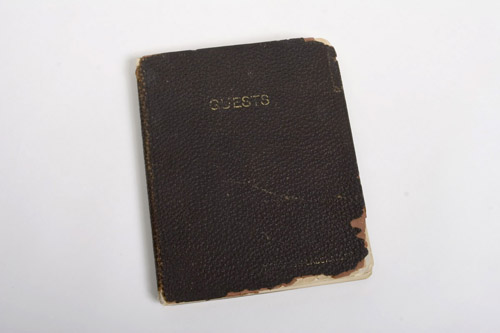

What do Ivan Pavlov, Guglielmo Marconi and Thomas Edison all have in common?  Not much, you might think - but after the creation of General Electric’s first Global Research Laboratory in the barn behind Chief Engineer Charles Steinmetz’s house in Schenectady, NY, numerous top scientists began to visit to see what GE was working on next.

MIT Chemistry professor Wilis Whitney was hired as the Global Research Laboratory's first director and each famous mind that visited would stop to sign the VIP guest book, which he kept at that desk from 1914 to 1935.  The signatures are a veritable Who’s Who of inventors, physicists, chemists, physiologists, and businessmen of the period.
I see people around very, very interested in what the CDF experiment has recently unearthed. I am talking, of course, of the jet-jet resonance candidate that they observe in their W+jets sample. A recent update of the previous result shows that the significance of the bump is just short of the coveted five-sigma: that is to say, for non-insiders, there is now a chance in two or three millions that the effect is due to a statistical fluke.

Last seen in 1898, the red-crested tree rat (or Santamartamys rufodorsalis) has turned up in an ecolodge at a nature reserve in Colombia. Showing up at the front door and calmly posing for pictures, the red-crested tree rat can get 18 inches long and possesses a mane-like band of reddish fur around its neck and a black and white tail.


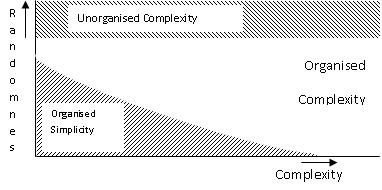
Complexity and Randomness

This pattern is from System's thinker Gerald Weinberg, and has been extremely helpful to illustrate the difference between complexity and randomness. It is also a nice example of the self-referential methodology of PAC, as the pattern is used to discuss scientific approaches: science discovers patterns, which are then used to elucidate scientific processes!

Methodological Stuff:

The creation, trapping and storage of antihydrogen atoms for up to 1,000 seconds not only represents the longest time period so far that antihydrogen has been captured, but it also brings us closer to answering the question, do matter and antimatter obey the same laws of physics?

Antimatter particles are routinely produced in particle accelerators as well as in space, but holding onto them, particularly the neutral ones, is difficult because antimatter and matter will annihilate on contact and conventional containers are made of matter.

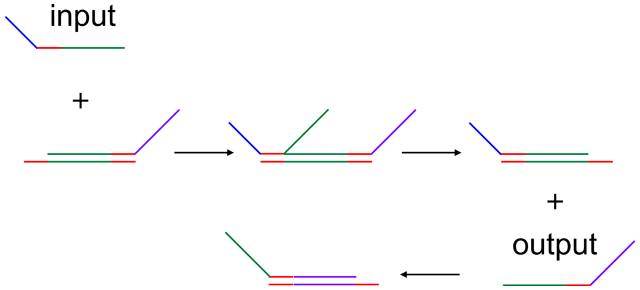
Figuring out the structure of DNA, and the ongoing research into its workings, have provided scientists with a lot of new knowledge. One of the, perhaps unexpected, new areas of research that have sprouted forth from this knowledge, is the area of DNA computing, where DNA molecules are used to perform computational operations.

Simon Baron-Cohen "sat down with me" this week via email and graciously took the time to answer my questions stemming from my review of  his new book, The Science of Evil, that appeared on my blogs last week. What follows is a response that is every bit as thorough as my original review; between the two (and I recommend you read both as a complete piece), there's 15 single spaced pages of material. I thoroughly enjoyed this opportunity and I think readers will, too. There's even dueling databases, which I absolutely loved, below!


My questions are in italics; SBC's in regular font.
Back in April, a well-known fisheries biologist named Ray Hillborn published an op-ed in the New York Times that was titled (by the editors, not Hillborn) "Let Us Eat Fish." The gist of it was: our fisheries are doing great, so chow down on seafood with a clear conscience!
Government work is usually a thankless job - yes, thanks to guaranteed pay raises and a union that can shut down the government, government employees make more money than the private sector and have better benefits and retirement, so it is not exactly thankless, but there are few instances where we can say 'government gets it right'.