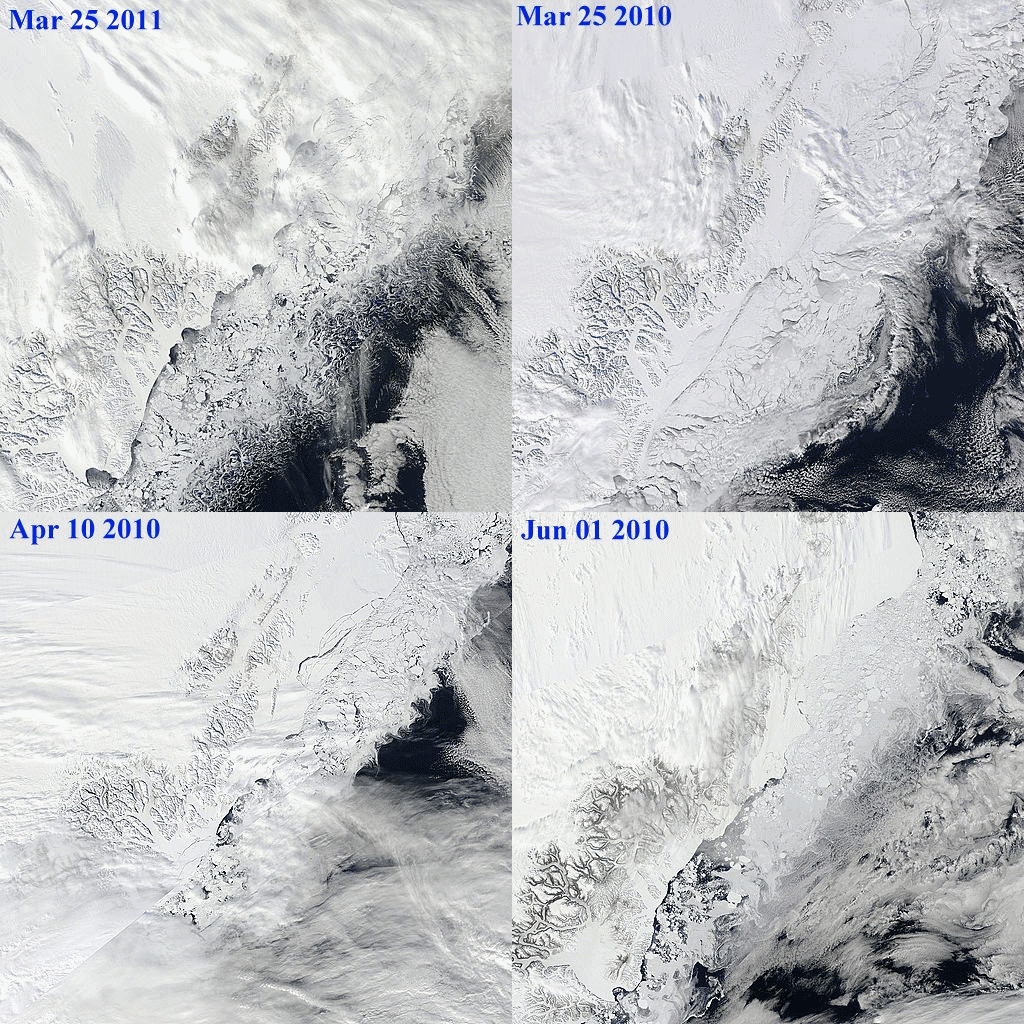
Arctic Ice March 2011 Update #2The melt season of 2010 ended with a low extent and with little ice older than two years. There are strong indications that the winter of 2010 - 2011 did not compact and thicken the sea ice as much as would normally be expected.
Arctic sea ice extent averaged over December 2010 was 12.00 million square kilometers (4.63 million square miles). This is the lowest December ice extent recorded in satellite observations from 1979 to 2010, 270,000 square kilometers (104,000 square miles) below the previous record low of 12.27 million square kilometers (4.74 million square miles) set in 2006 and 1.35 million square kilometers (521,000 square miles) below the 1979 to 2000 average.
...
Researchers have discovered a 525-million-year-old fossil which belongs to a group of tentacle-bearing creatures which lived inside hard tubes.
The creature belongs to a group called pterobranch hemichordates which are related to starfish and sea urchins but also show some characteristics that offer clues to the evolution of the earliest vertebrates. About 30 species of pterobranch are known to exist today although 380-490 million years ago a group of these animals called graptolites were common across the prehistoric oceans.
Scientists are launching a three-pronged attack on one of the most obstinate puzzles in materials sciences: what is the pseudogap?
They used three complementary experimental approaches to investigate a single material, the high-temperature superconductor Pb-Bi2201 (lead bismuth strontium lanthanum copper-oxide). Their results are the strongest evidence yet that the pseudogap phase, a mysterious electronic state peculiar to high-temperature superconductors, is not a gradual transition to superconductivity in these materials, as some have long believed.
Instead, it is a distinct phase of matter.
The pseudogap mystery
The Clovis people, Paleo-Indians whose tools were known for their distinctive 'fluted' points, were once thought to be the original settlers of North America about 13,000 years ago. The name originates not from the 5th century Frankish king but rather the town in New Mexico where the stone projectile points created by their distinctive percussion and pressure flaking techniques were first discovered.