


This week a computer science researcher named Vinay Deolalikar claimed to have a proof that P is not equal to NP.

Let’s set aside what this means for another day, lest I get distracted.  The important thing now is that this is big. Huge, even!

If, that is, he’s correct.

But correct or not, that’s the kind of thing one expects to see in academia. Tenure gives professors job security and research freedom, exactly the conditions needed to enable them to make the non-incremental breakthroughs that fundamentally alter the intellectual landscape. (And in the case of P not equal to NP, to acquire fame and fortune.)
Ever been stuck in an airport? A foreign country? Try being stuck in orbit! Poor Air Force Major Abacha Tunde plus a colleague were trapped on a Soyuz in orbit for over 14 years. Fortunately, thanks to email, they were (presumably) able to get help getting down. Here is their tale.

As related by Steve Johnson and verified using teh Internets, "the writer claimed to be an astronaut on the International Space Station who couldn't return from space due to a revolution in his country putting a halt to its space program. Fortunately, his rich uncle had just died, and if you'd let him use your bank account to route the money to China (for which you'd of course be rewarded), the Chinese would sell him a spot on their space shuttle."
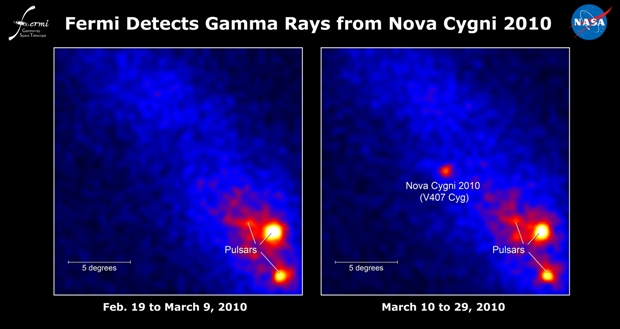
Citizen scientists are doing big things in astronomy in 2010.   A few days ago, three amateurs discovered PSR J2007+2722, a neutron star that rotates 41 times per second and a recent Science article highlights V407 Cyg in the constellation Cygnus, which is 9,000 light-years away and is a symbiotic binary containing a compact white dwarf and a red giant star about 500 times the size of the sun.

On March 11, amateur astronomers Koichi Nishiyama and Fujio Kabashima in Miyaki-cho of Saga Prefecture in Japan imaged a dramatic change in the brightness of V407 Cyg - 10 times brighter than an image they had taken three days earlier.

A few months ago, Google opened the Android Market to allow anyone to load software but now studies show that an average of one in every five applications had access to personal information , which could lead to all sorts of viruses, spyware, and malware being created to attack users.  

Weird World Weather

There is a lot of happy talk out there that is premised on the belief that you can't tell the public the bad news because it’ll scare them and they'll not do anything, or they will fall into despair.
David W Orr

