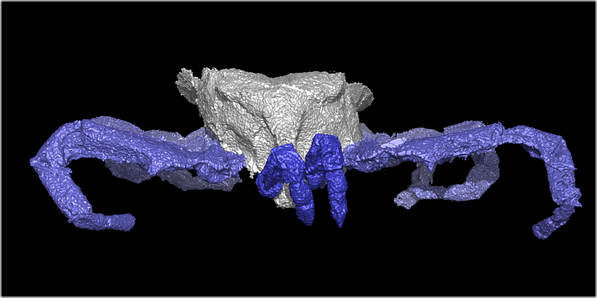




Scientists at Imperial College London have created detailed 3D computer models of two fossilized specimens of ancient creatures called Cryptomartus hindi and Eophrynus prestvicii that lived around 300 million years ago and are closely related to modern-day spiders. The study reveals some of the physical traits that helped them to hunt for prey and evade predators.

The researchers created their images by using a CT scanning device, which enabled them to take 3,000 x-rays of each fossil. These x-rays were then compiled into precise 3D models, using custom-designed software.

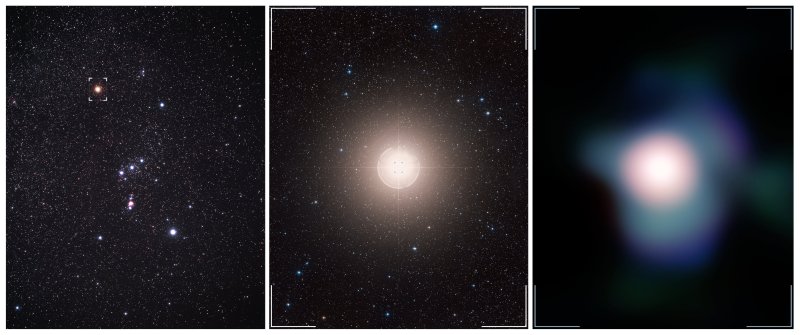
Betelgeuse, the second brightest star in the constellation of Orion (the Hunter), is a red supergiant, one of the biggest stars known, and almost 1,000 times larger than our Sun.

To put that in perspective, if Betelgeuse were at the center of our Solar System it would extend out almost to the orbit of Jupiter, engulfing Mercury, Venus, Earth, Mars and the main asteroid belt.
The world's environment ministers, government officials, diplomats and campaigners are preparing for the biggest poker game of their lives - the COP15 conference in Copenhagen in December 2009.

It's one of the most complicated political deals the world has ever seen but third world countries are holding the cards.

In Environmental Research Letters, the paper 'Tripping Points: Barriers and Bargaining Chips on the Road to Copenhagen' lays bare the main tripping points – those political barriers and bargaining chips – which need to be overcome for countries to reach a consensus on how to address global climate change. 
CO2 reduction targets can be met with affordability. An EPRI report released this week concludes affordability requires a "full portfolio" of electricity sector technologies. Diverse generation "could simultaneously address the challenge of growing load demand while meeting carbon constraints and limiting increases in the cost of electricity." 
Tangential Science: it's not necessarily science, but it's still funny.

Last month New York’s Attorney-General Andrew Cuomo criticized banks – including Citi, Merrill Lynch, Goldman Sachs, Morgan Stanley and JPMorgan Chase – for paying large (okay, huge) executive bonuses when the companies were losing money.

He called this an illicit transfer of shareholder wealth to the pockets of individual managers. 

Cuomo’s report spurs me to tell you about a certain illicit transfer of taxpayer money to private pockets, one that’s been bothering me a lot... 

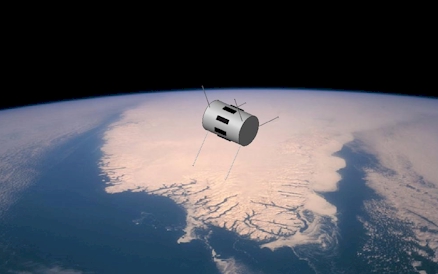
What would you do with 3/4 of a kilogram of gear in space? For the price of a Harley-Davidson Sportster 883, you can now go to space.

InterOrbital Systems (IOS) has announced their TubeSat Personal Satellite Kit. This is 'complete', giving you the basic interface bus for your payload and including the launch costs.

If I were a salesman, I'd point out that launches alone typically cost five times that price!

The previous low-access route to space was the CubeSat, which is still an active and viable program. TubeSat just adds competition, which can only be good. IOS even mentions "the new IOS TubeSat PS Kit is the low-cost alternative to the CubeSat."
Organic solar cells that can be produced easily and inexpensively are the perfect solution to future 'personalized' power generation.  

Major obstacles remain, such as coaxing these carbon-based materials to reliably form the proper structure at the nanoscale level - tinier than 2-millionths of an inch - and be efficient in converting light to electricity,  transforming at least 10 percent of the sunlight that they absorb into usable electricity.
There's an irrational belief held by some about economics that if a technology is subsidized, the magic of capitalism will make it cheaper even though there being no benefit to consumers or industry to do so, since it is already cheap for one and profitable as is for another.

So it goes with hybrid vehicles, though you can insert ethanol or wind power or solar panels and the math is the same.  Despite major costs to taxpayers in the U.S. and Canada, government programs that offer rebates to hybrid vehicle buyers are failing to produce environmental benefits, according to a new University of British Columbia study.

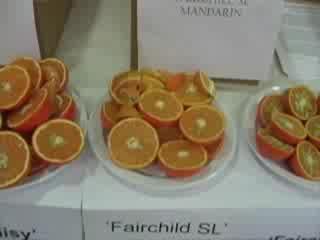
Researchers at the University of California Riverside (UCR) have developed a new mid-season maturing variety of tangerine. They call it DaisySL, for for Daisy seedless. It is made from an irradiated bud of the seedy diploid mandarin cultivar 'Daisy,' that is a hybrid of the mandarins Fortune and Fremont

Supervised by staff scientist Timothy Williams, the planting of the trees and performed evaluations and selections of promising varieties were meticulously monitored. It was 'DaisySL' that had the right characteristics he and Mikeal Roose, a professor of genetics in the Department of Botany and Plant Sciences at UCR, were looking for in a new variety: beautiful appearance, exceptional flavor, and hardly any seeds.

