A new technique has allowed researchers to make film bacteria infecting their living host.
Most studies of bacterial infection are done after the death of the infected organism a new technique developed by scientists at the University of Bath and University of Exeter has allowed researchers to make film bacteria and follow the progress of infection in real-time with living organisms.
The researchers used developing fruit fly embryos as a model organism, injecting fluorescently tagged bacteria into the embryos and observing their interaction with the insect's immune system using time-lapse confocal microscopy.
Scientists at Penn State University, in collaboration with institutes in the US, Finland, Germany and the UK, have figured out the long-sought structure of a layer of C60 – carbon buckyballs – on a silver surface. The results in Physical Review Letters and Physics could help in the design of carbon nanostructure-based electronics.
Ever since the 1985 discovery of C60, this molecule, with its perfect geodesic dome shape has fascinated scientists, physicists, and chemists alike. Like a soccer ball, the molecule consists of 20 carbon hexagons and 12 carbon pentagons. The electronic properties of C60 are very unusual, and there is a massive research effort toward integrating it into molecular scale electronic devices like transistors and logic gates.
Citizen scientists working through an online project called Galaxy Zoo have discovered a group of rare galaxies called the "Green Peas" which could lend unique insights into how galaxies form stars in the early universe.
Galaxy Zoo users volunteer their spare time to help classify galaxies in an online image bank. When they came across a number of objects that stuck out because of their small size and bright green color, they dubbed them the Green Peas. Employing the help of the volunteers to further analyze these strange new objects, the astronomers discovered that the Green Peas are small, compact galaxies forming stars at an incredibly high rate.
Millions of children, as many as 2% of all births in the U.S. and Europe, have been born to couples with fertility problems through assisted reproductive techniques such as in vitro fertilization (IVF). Because it is a newer field, relatively little research has been conducted to evaluate the long term effects of assisted reproductive techniques.
Research presented at the Annual Meeting of the Society for the Study of Ingestive Behavior (SSIB) says that assisted reproductive techniques alter the expression of genes that are important for metabolism and the transport of nutrients in the placenta of mice.
Abandoned mine shafts could be used to provide geothermal energy to local towns, say two engineers from the University of Oviedo in the journal Renewable Energy. They say the method they have developed makes it possible to estimate the amount of heat that a tunnel could potentially provide.
Rafael Rodríguez, from the Oviedo Higher Technical School of Mining Engineering and colleague María Belarmina Díaz have developed a "semi-empirical" method (part mathematical and part experimental) to calculate the amount of heat that could be produced by a mine tunnel that is due to be abandoned, based on studies carried out while it is still in use.
Switching off a key DNA repair system, Xrcc1 , in the developing nervous system was linked to smaller brain size as well as problems in brain structures vital to movement, memory and emotion in new research.
The study in Nature Neuroscience also provided the first evidence that cells known as cerebellar interneurons are targeted for DNA damage and are a likely source of neurological problems in humans. The cerebellum coordinates movement and balance. The cerebellar interneurons fine tune motor control.
We know how oil and natural gas deposits were created; living organisms died, were compressed, and heated under heavy layers of sediments in the Earth's crust.
Scientists have debated for years whether some of these
hydrocarbons could also have been created deeper in the Earth and formed without organic matter. Now scientists say they have found that ethane and heavier hydrocarbons can be synthesized under the pressure-temperature conditions of the upper mantle; the layer of Earth under the crust and on top of the core.
I’m reviewing a book by philosopher of science Peter Godfrey-Smith entitled “Darwinian Populations and Natural Selection.” (This is not the book review, forthcoming.) Godfrey-Smith makes an excellent argument at some point in the book (chapter 7, on the gene’s eye view) that genes are not at all the sort of things Richard Dawkins and some other biologists think they are.
One year ago, a
paper by a distinguished group of theorists
announced first evidence of new physics from measurements of the properties of B_s mesons performed at the Tevatron by the
CDF and
DZERO experiments. They had combined all the available information, obtaining a result which disagreed with the Standard Model (SM) prediction by more than three standard deviations.
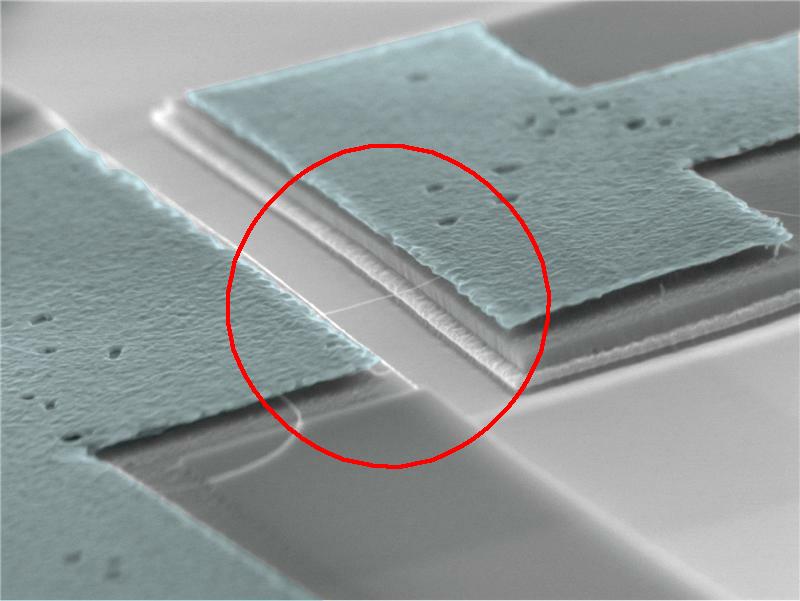
Researchers at TU Delft have succeeded in measuring the influence of a single electron on a vibrating carbon nanotube. That can be a real milestone on the road to ultra-small measuring instruments.
Researchers in the Kavli Institute for Nanoscience at TU Delft basically suspended a carbon nanotube, comparable in size to an ultra-small violin string, and then applied an alternating electric field to the nanotube using an antenna.