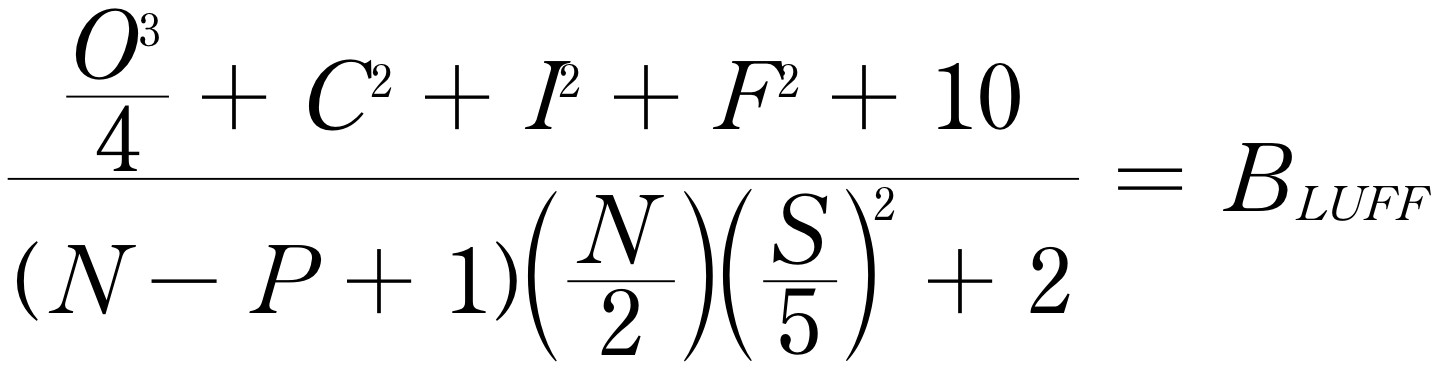


So, you've seen the WSOP on ESPN—big money, big personalities, big bluffs. But what these highlight reels forget to mention is the fact that, at the highest level, there's method behind the blood-pumping madness. Behind every good bluff is a strong foundation of numbers. And here it is: the equation that defines when to pull the trigger, even if you're holding three-six offsuit.

Plug your numbers into this equation (or into the attached spreadsheet calculator) to calculate the percentage that you should bluff. Note—this works well for a specific situation: No Limit Texas Hold' Em, just after seeing the flop.

Rather than waxing poetic, it seems best to look at the variables in order:

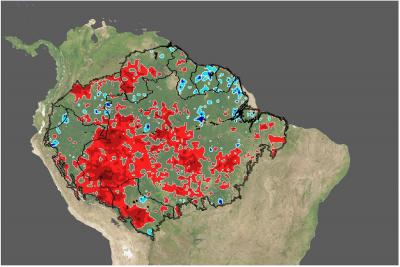
Accepted global climate models had predicted the Amazon forest would begin to "brown down" after just a month of drought and eventually collapse as the drought progressed. Instead, drought-stricken regions of the Amazon forest grew particularly vigorously during the 2005 drought, according to new research.

“Instead of ‘hunkering down’ during a drought as you might expect, the forest responded positively to drought, at least in the short term," said study author Scott R. Saleska of The University of Arizona. "It's a very interesting and surprising response."

UA co-author Kamel Didan added, "The forest showed signs of being more productive.

In case you happen to be in town:

Professor Jim Al-Khalili of the University of Surrey will host the third public Surrey Debate ‘The God Particle: Is science the new religion?’ on Wednesday, October 17 from 7.00 p.m. – 8.30 p.m.

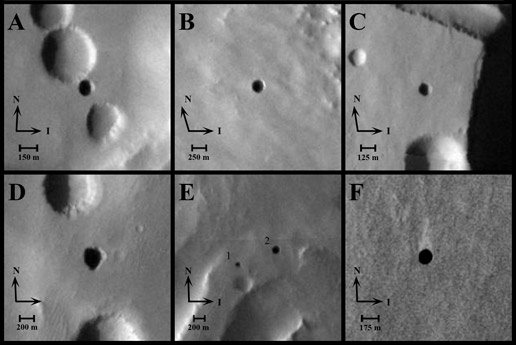
A heat-sensitive camera flying on NASA's Mars Odyssey orbiter has led a team of Mars geologists to find seven small, deep holes on the flanks of Arsia Mons, a giant volcano on Mars. The holes may be openings, called skylights, in the ceilings of underground caves.

Very dark, nearly circular features ranging in diameter from about 100 to 250 meters (328 to 820 feet) puzzled researchers who found them in images taken by NASA's Mars Odyssey and Mars Global Surveyor orbiters. Using Mars Odyssey's infrared camera to check the daytime and nighttime temperatures of the circles, scientists concluded that they could be windows into underground spaces.

For as many people as seem to like the metric system, few realize that both the motive for its creation ( competing with England, much like the calendar the French created, though that did not last ) and its inherent accuracy were flawed. The French took a provisional measurement ( conveniently in Paris ) between the North Pole and the Equator for the meter, for example, and got it wrong.

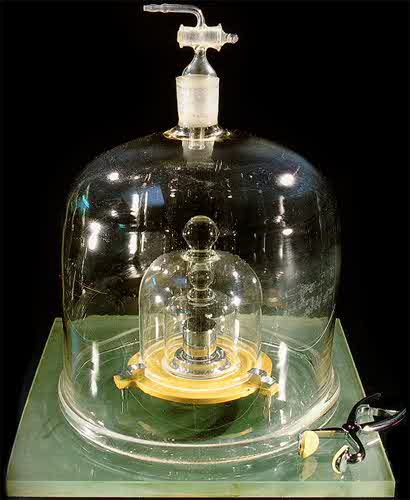
Likewise, the 'official' kilogram has been losing weight for a while and some people think it's time to fix the metric measure of mass so that it will still be accurate 10 or 10,000 years from now, using the number of carbon-12 atoms rather than an object.

“Our standard would eliminate the need for a physical artifact to define what a kilogram is,” said Ronald F.

Basic principles of biology rather than women’s newfound economic independence can explain why fewer of them are getting married and having children, and why the trend may only be temporary, says a Queen’s researcher.

“Only in recent times have women acquired significant control over their own fertility, and many are preferring not to be saddled with the burden of raising children,” says Lonnie Aarssen, a Biology professor who specializes in reproductive ecology. The question is whether this is just a result of economic factors and socio-cultural conditioning, as most analysts claim, or whether the choices that women are making about parenthood are influenced by genetic inheritance from maternal ancestors that were dominated by paternal ancestors.”

In Sunday’s NY Times Magazine, Gary Taubes argued that epidemiology does not provide a good basis for health decisions — it is often wrong, he claimed. By “wrong” he meant experiments were more pessimistic. Things that seemed to help based on surveys turned out not to help, or help much less, when experiments were done. A 2001 BMJ editorial disagrees:

Astronomers have found evidence that stars have been forming in a long tail of gas that extends well outside its parent galaxy. This discovery suggests that such "orphan" stars may be much more prevalent than previously thought.

The comet-like tail was observed in X-ray light with NASA's Chandra X-ray Observatory and in optical light with the Southern Astrophysical Research (SOAR) telescope in Chile. The feature extends for more than 200,000 light years and was created as gas was stripped from a galaxy called ESO 137-001 that is plunging toward the center of Abell 3627, a giant cluster of galaxies.

"This is one of the longest tails like this we have ever seen," said Ming Sun of Michigan State University, who led the study.

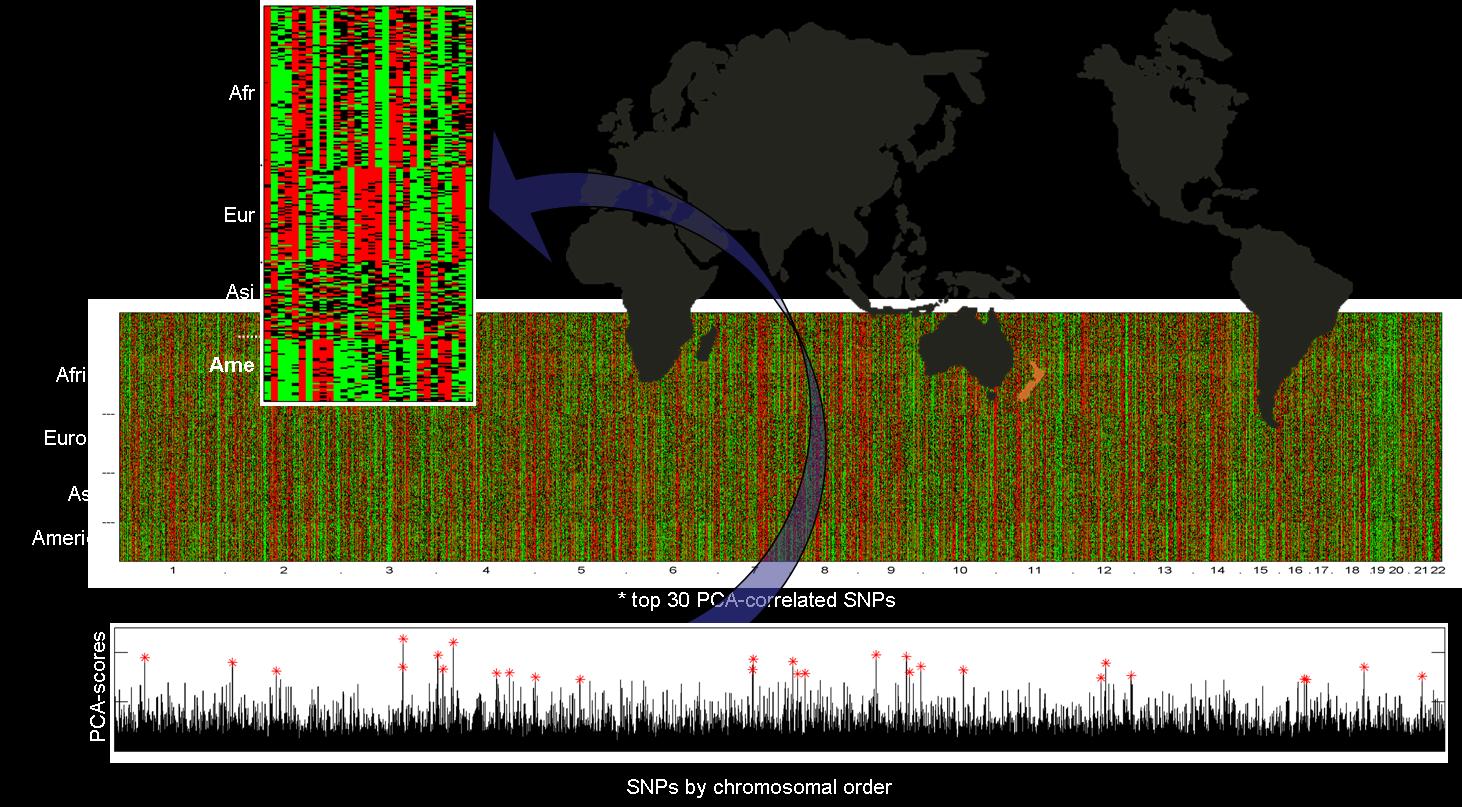
A group of computer scientists, mathematicians, and biologists from around the world have developed a computer algorithm that can help trace the genetic ancestry of thousands of individuals in minutes, without any prior knowledge of their background.

Unlike previous computer programs of its kind that require prior knowledge of an individual’s ancestry and background, this new algorithm looks for specific DNA markers known as single nucleotide polymorphisms, or SNPs (pronounced snips), and needs nothing more than a DNA sample in the form of a simple cheek swab. The researchers used genetic data from previous studies to perform and confirm their research, including the new HapMap database, which is working to uncover and map variations in the human genome.

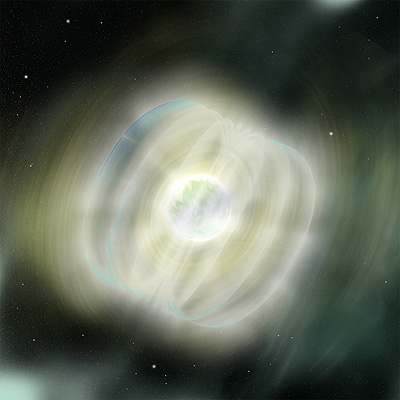
Magnetars are small neutron stars that occasionally suffer extraordinarily powerful outbursts which shine X-rays across the galaxy.

In 2003, astronomers saw a neutron star brighten to around 100 times its usual faint luminosity. This outburst allowed them to discover XTE J1810-197. Detecting pulsations from the source helped classify it as the first transient anomalous X-ray pulsar (AXP). The massive outburst moved it to the rank of magnetar.

Magnetars are perplexing objects. Each one is the highly magnetic core of a star that was once at least eight times more massive than the Sun. When it exploded as a supernova, the core was compressed into a highly compact object, a neutron star, roughly fifteen kilometres in diameter, but containing about as much mass as the Sun.

