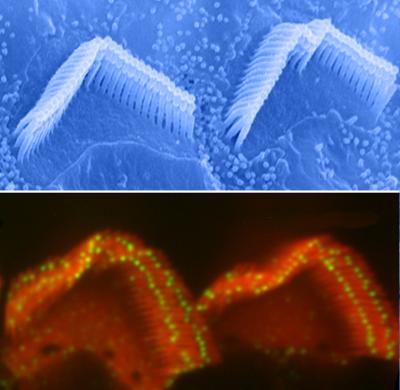






According to new research, two key proteins join together at the precise location where energy of motion is turned into electrical impulses. These proteins, cadherin 23 and protocadherin 15, are part of a complex of proteins called “tip links” that are on hair cells in the inner ear. The tip link is believed to have a central function in the conversion of physical cues into electrochemical signals.

“Mutations in [the genes] cadherin 23 and protocadherin 15 can cause deafness as well as Usher syndrome, the leading cause of deaf-blindness in humans,” says Professor Ulrich Mueller, of the Scripps Research Department of Cell Biology and Institute for Childhood and Neglected Diseases.

A new research study at Northwestern University is investigating innovative ways to rehabilitate people with lousy health habits.

Bonnie Spring, a professor of preventive medicine at Northwestern's Feinberg School of Medicine, says the way to improve eating habits is to make change as easy as possible. Her method is based on the Behavioral Economics Theory used by Nobel Prize winner Daniel Kahneman.

The study uses high-tech tools, including a specially programmed Palm Pilot to monitor eating and exercise, virtual visits with a personal coach and an accelerometer which straps around the waist to record the intensity of their movements. Participants are assigned to eat more veggies and fruits or cut down on saturated fat and are encouraged to exercise.

Cholera is an infectious disease caused by a bacterium, the bacillus Vibrio cholerae. In 2004 there were 101,383 cases - 95,000 in Africa - resulting in 2,345 deaths, according to the World Health Organization. Increases in the frequency of torrential rain, floods and periods of drought, said by some to result from global climate change, has contributed to the spread of cholera.

In studies aiming to understand better the emergence and persistence of cholera in Africa, IRD and CNRS researchers showed the strong correlation that exists between outbreaks and the different parameters linked to climate changes in West Africa.

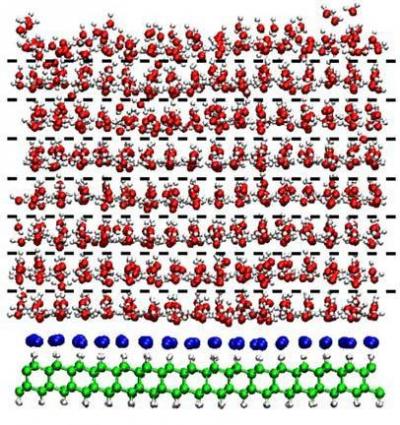
A recent simulation has shown that thin layers of ice could persist on specially treated diamond coatings at temperatures well above body temperature, which could make ice-coated-diamond films an ideal coating for artificial heart valves, joint replacements, and wear-resistant prosthetics.

Physicists Alexander D. Wissner-Gross and Efthimios Kaxiras of Harvard modeled water ice on top of a diamond surface coated with sodium ions. They found that ice layers should persist on the treated diamond up to temperatures of 108 degrees Fahrenheit (42 Celsius), and in some circumstances could remain frozen beyond the boiling point of water.

I welcome the blog from Michael Bailey this morning, and thank him for contributing it. This is the first time I am aware of where an exchange can take place in an open forum. Bailey's passages help make clear where the disagreements exist, which might suggest that an armistice is someday possible. On the other hand, his passages illustrate why this acrimonious dispute has persisted for over four years, and will not find an easy reconciliation.

Bailey has still not been able to grasp that people may think he is wrong because they.... really, actually think he is wrong.

It's hardly surprising that clinically depressed people act differently than healthy people. Quantifying the difference, however, can be difficult. Now a collaboration of physicists and psychiatrists in Japan has found a way to clearly and objectively measure depression.

The researchers outfitted both healthy control subjects and depressed patients with accelerometers to continuously measure their motions over 5-day periods. Although activity levels in all of the subjects followed power-law patterns (a type of distribution that often turns up in physics studies of natural systems) the activity levels of depressed patients were clearly distinguished from healthy subjects by a number known as the scaling parameter.

While we are a long way off from the lightweight, high-performance, magical cloak of Harry Potter, physicists have been busy designing ways to make invisibility possible.

A recent theoretical analysis of a column-shaped invisibility cloak, by a collaboration of researchers from Sweden and China, showed that a cloak made to ideal specifications could render an object (or wizard) hidden inside perfectly invisible. However, even slight deviations from these specifications will cause the invisibility to break down.

The researchers analyzed the properties of a simulated tube of special metamaterials (manmade materials with intricate, microscopic structures) that can force light to follow a specified path.

Several genes with strong associations to schizophrenia have evolved rapidly due to selection during human evolution, according to researchers who found a higher prevalence of the influence of so-called positive selection on genes or gene regions known to be associated with the disorder than a comparable control set of non-associated genes, functioning in similar neuronal processes.

This is consistent with the theory that positive selection may play a role in the persistence of schizophrenia at a frequency of one per cent in human populations around the world, despite its strong effects on reproductive fitness and its high heritability from generation-to-generation.

It also provides genetic evidence consistent with the long-standing theory that schizophrenia represents, in part, a ma

According to new research at the University of Virginia Health System, N-acetylcysteine (NAC), an anti-oxidant commonly used in nutritional and body-building supplements, can form a red blood cell-derived molecule that makes blood vessels think they are not getting enough oxygen. This leads to pulmonary arterial hypertension (PAH), a serious condition characterized by high blood pressure in the arteries that carry blood to the lungs.

“NAC fools the body into thinking that it has an oxygen shortage,” said Dr. Ben Gaston, UVa Children’s Hospital pediatrician and researcher who led the study. “We found that an NAC product formed by red blood cells, know as a nitrosothiol, bypasses the normal regulation of oxygen sensing.

Both in her recent appearance on KQED’s Forum talk show and in her blog, Stanford University’s Joan Roughgarden continues her campaign to discredit me and my book, The Man Who Would Be Queen.

Roughgarden’s rate of false accusations per utterance is so high that it is tempting to take the time to refute them one by one to the exclusion of getting around to discussing the science. Indeed, I believe that is the intent of Roughgarden and my other chief critics.

