





The research group of Prof. Dr. Magdalena Götz at the Institute of Stem Cell Research of the GSF – National Research Centre for Environment and Health, and the Ludwig Maximilians University, Munich, has achieved an additional step for the potential replacement of damaged brain cells after injury or disease: functional nerve cells can be generated from astroglia, a type of supportive cells in the brain by means of special regulator proteins.

The majority of cells in the human brain are not nerve cells but star-shaped glia cells, the “astroglia”. "Glia means 'glue'," explains Götz. "As befits their name, until now these cells have been regarded merely as a kind of 'putty' keeping the nerve cells together."

The “world’s fattest mice” can overeat without developing insulin resistance or diabetes thanks to a glut of adiponectin, a hormone that controls sensitivity to insulin, and a lack of leptin, a hormone that curbs appetite - a dichotomy that helps explain why not all obese people are diabetic, a UT Southwestern Medical Center researcher has found.

Consuming excess calories usually spurs insulin resistance and diabetes, but the new findings demonstrate how mice can store excess calories in fat tissue instead of in liver, heart or muscle tissue – places where excess fat can lead to inflammation, diabetes and heart disease. The mice get morbidly obese, but are insulin-sensitive with normal blood-glucose levels.

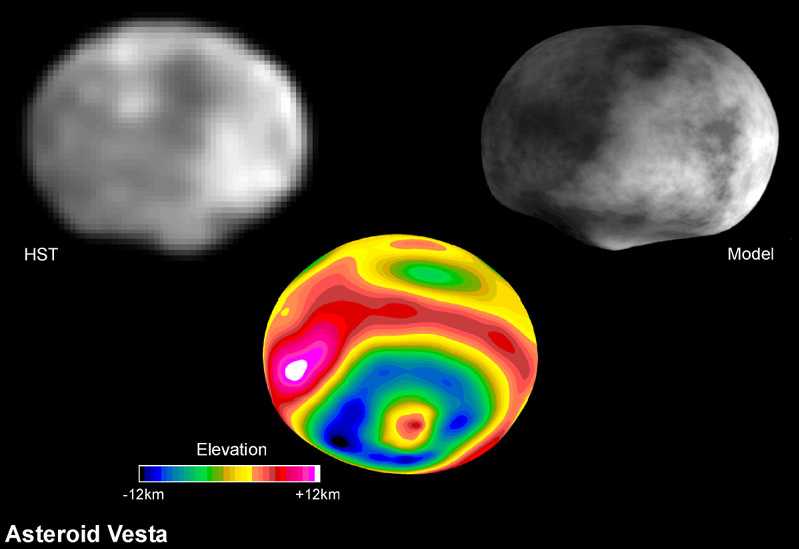
Analysis of the chemical make up of two asteroids in the outer asteroid belt has thrown the classification system for these small bodies, which orbit between Mars and Jupiter, into disorder.

Dr Rene Duffard, said, “We appear to have detected basalt on the surface of these asteroids, which is very unusual for this part of the asteroid belt. We do not know whether we have discovered two basaltic asteroids with a very particular and previously unseen mineralogical composition or two objects of non basaltic nature that have to be included in a totally new taxonomic class.”

The presence of basalt means that the asteroid must have melted partially at some time in the past, which implies that it was once part of a larger body which had internal heating processes.

A nanoparticle drug delivery system designed for brain tumor therapy has shown promising tumor cell selectivity in a novel cell culture model devised by University of Nottingham scientists.

Therapy for brain cancers is particularly difficult for a number of reasons, including getting sufficient drug to the tumor and selectivity of drug action. “We are working on a number of new therapeutic approaches using nanoparticle drug delivery systems explained Dr Martin Garnett, Associate Professor of drug delivery at the School of Pharmacy, however, understanding and developing these systems requires suitable models for their evaluation.”

The nanoparticles used in this study were prepared from a novel biodegradable polymer poly(glycerol adipate).

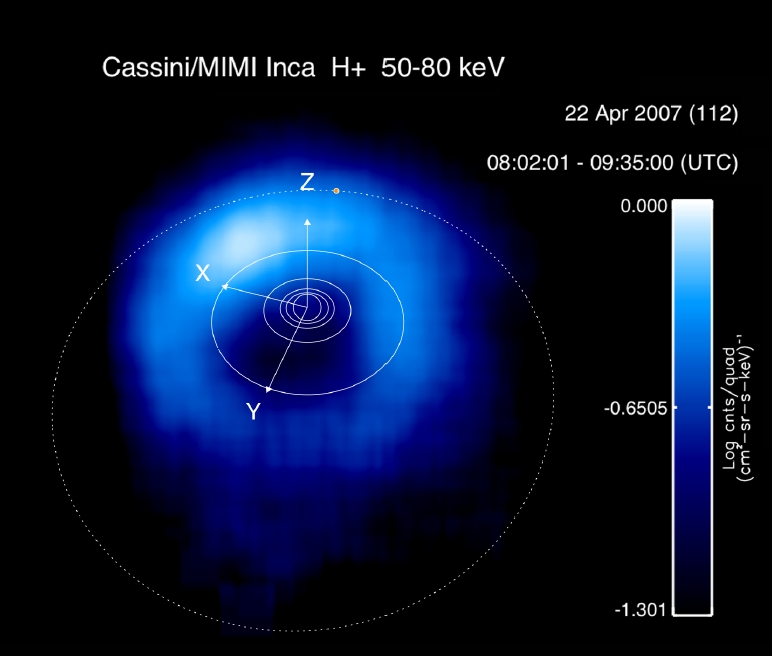
Images taken by Cassini’s Magnetospheric Imaging Instrument (MIMI) show that Saturn’s ring current is a warped disc that balloons out of the equatorial plane on the planet’s dayside and remains a thin disk that rises above the plane at larger distances on the nightside.

Dr Stamatios “Tom” Krimigis, the Principal Investigator for the instrument said, “Ring currents surround planets sort of like the brim of a hat. Uniquely in Saturn’s case, that brim has been crushed at the front and tipped up at the back, so it’s pretty bent out of shape!”

The presence of a ring current around Saturn was first suggested in the early 1980s following magnetic anomalies observed by the Pioneer 11 and Voyager 1 and 2 spacecraft. Ring currents are also found around Earth and Jupiter.

Cutting calories helps rodents live longer by boosting cells’ ability to recycle damaged parts so they can maintain efficient energy production, says a University of Florida scientist.

“Caloric restriction is a way to extend life in animals. If you give them less food, the stress of this healthy habit actually makes them live longer,” said Christiaan Leeuwenburgh, Ph.D., chief of the division of biology of aging in UF’s Institute on Aging.

Understanding how the process works at the cellular level in rodents could help scientists develop drugs that mimic the process in humans, Leeuwenburgh added.

University of Cincinnati Assistant Professor Michael Fry and student Andrew Lundberg have an interesting approach to the fantasy football draft: all you really need to know is what set of players is not going to be available when your turn comes up.

Fry and Lundberg published their results in the Journal of Quantitative Analysis in Sports with co-author Jeffrey Ohlmann from the University of Iowa.

Fantasy sports drafts have a sequential order in which owners choose players from the available remaining pool of players.

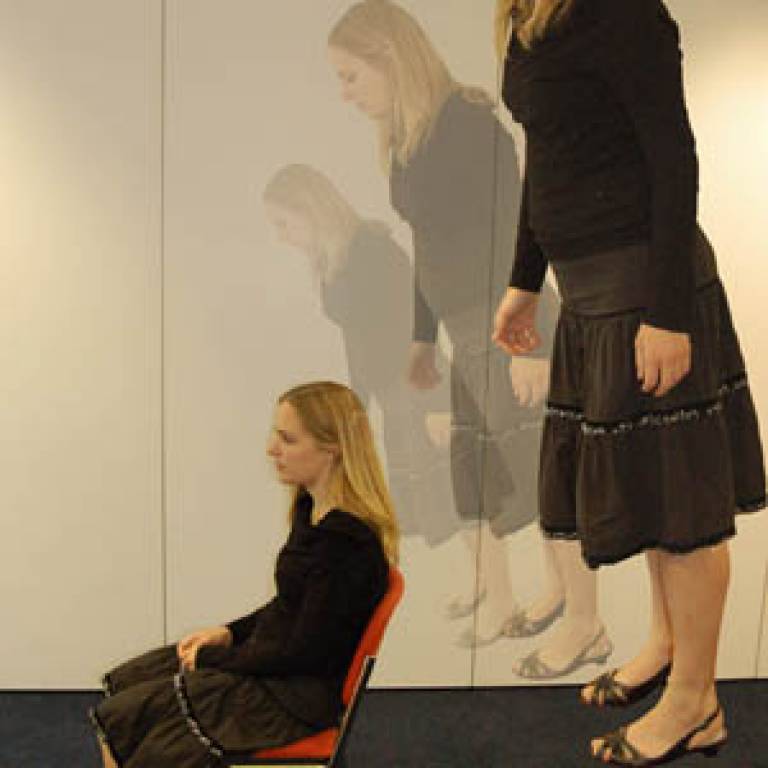
An out-of-body experience (OBE) occurs when a person who is awake sees themselves from a location outside their physical body.

OBEs have been reported in conditions where brain function is compromised, such as stroke, epilepsy and drug abuse. They have also been reported in association with traumatic experiences such as car accidents.

Around one in ten people claim to have had an OBE at some time in their lives.

Now Dr. Henrik Ehrsson, a University College London neuroscientist, has devised the first experimental method to induce an out-of-body experience in healthy participants.

Certain types of bacteria have sunlight-sensing molecules similar to those found in plants, according to a new study. Surprisingly, at least one species—responsible for causing the flu-like disorder Brucellosis—needs light to maximize its virulence. The work suggests an entirely new model for bacterial virulence based on light sensitivity.

“The central message is that many bacteria have signaling proteins that contain the same light-absorbing domain as those found in the higher plants,” Briggs explains. “One of these is a vicious pathogen called Brucella. A species of Brucella is a serious pathogen of cattle that causes abortion of calves, and another species is a nasty pathogen of humans.”

Sony today announced the development of a bio battery that generates electricity from carbohydrates (sugar) utilizing enzymes as its catalyst, through the application of power generation principles found in living organisms.

Test cells of this bio battery have achieved power output of 50 mW, currently the world's highest level2 for passive-type3 bio batteries. The output of these test cells is sufficient to power music play back on a memory-type Walkman.


4 prototype bio battery units (left) connected to Walkman for playback


